

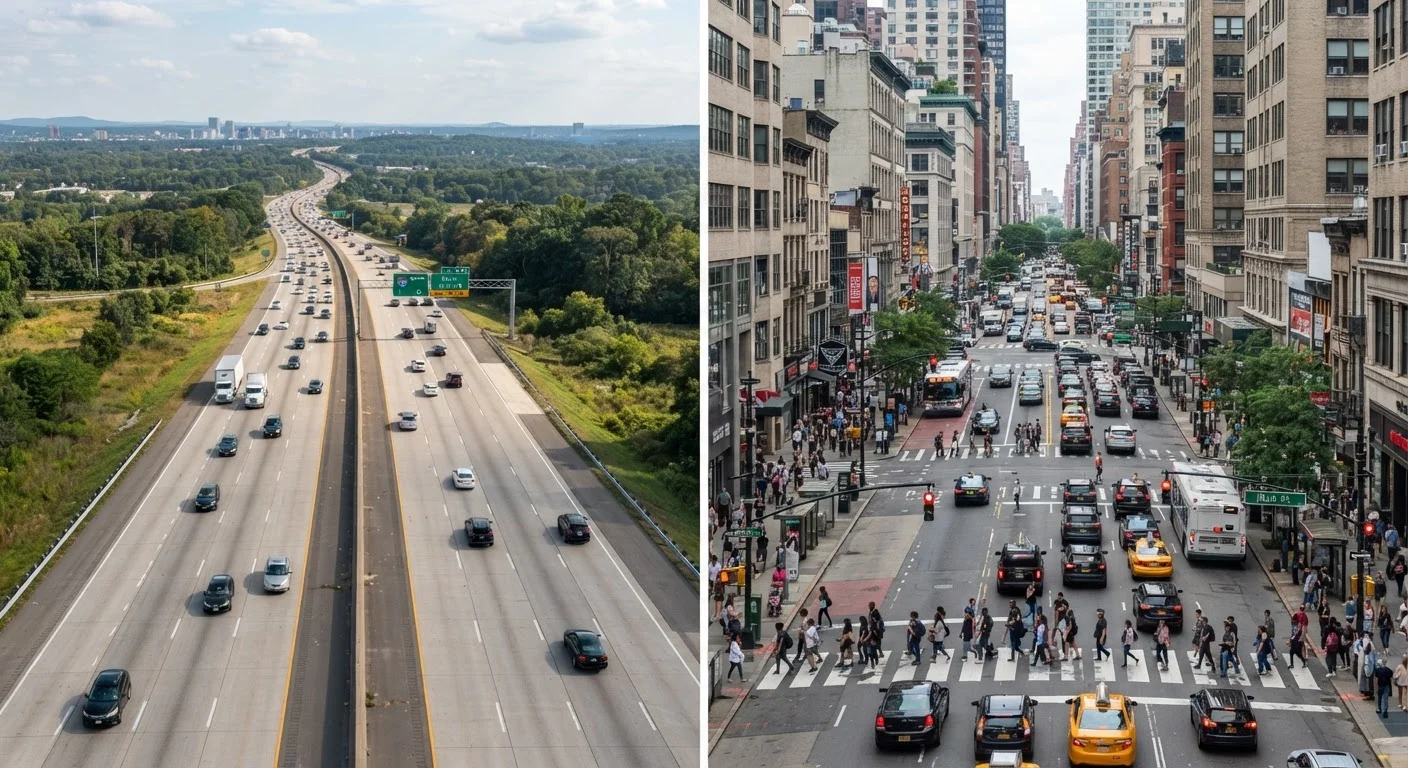
Option A
Highway Driving
High-speed, long-distance travel with controlled access and fewer intersections.
Best for: Drivers covering long distances between cities or commuting on controlled-access interstates.
Option B
City Driving
Low-speed, stop-and-go navigation through dense, unpredictable urban environments.
Best for: Drivers navigating urban neighborhoods, commercial corridors, and mixed-use streets daily.
The Core Risk Difference: Frequency vs. Severity
Highway and city roads don't just feel different - they produce statistically distinct crash patterns. Data from the National Highway Traffic Safety Administration (NHTSA) consistently shows that rural and highway roads account for a disproportionate share of traffic fatalities relative to the miles driven, while urban roads generate far more total crashes but at lower severity rates.
The core trade-off comes down to speed. Highway speeds - typically 55 to 80 mph - mean that when a crash does occur, the kinetic energy involved is dramatically higher. City crashes happen more often, but lower speeds give vehicle safety systems and road design more opportunity to limit fatal outcomes. Neither environment is inherently "safe"; they simply demand different kinds of attention.
| Criterion | Highway Driving | City Driving |
|---|---|---|
| Typical crash frequency | Lower crashes per mile | Higher crashes per mile |
| Fatal crash risk | Higher fatality rate per crash | Lower fatality rate per crash |
| Primary speed range | 55-80 mph | 15-45 mph |
| Top hazard type | Fatigue, speed, lane departure | Intersections, pedestrians, distraction |
| Vulnerable road user risk | Low | Very high |
| Driver cognitive load | Monotony, alertness maintenance | High complexity, constant scanning |
| Road access points | Controlled (ramps only) | Uncontrolled (driveways, alleys, crosswalks) |
What Makes Highways Dangerous
The controlled design of interstates - limited access points, grade-separated interchanges, and divided lanes - removes many of the collision types common in cities. What replaces them is a different set of high-severity hazards.
- High-speed rear-end crashes: At highway speeds, even a brief lapse in following distance can make a rear-end collision unsurvivable. The NHTSA identifies distraction and following too closely as leading contributors.
- Driver fatigue and drowsiness: Monotonous highway environments reduce alertness. The AAA Foundation for Traffic Safety has documented that drowsy driving significantly elevates crash risk, and long stretches of uniform roadway accelerate fatigue onset.
- Lane departure and run-off-road events: Without the constant stimulation of intersections and pedestrians, drivers are more vulnerable to drifting. These crashes frequently involve rollover or barrier impact at lethal speeds.
- Wrong-way driving: Though relatively rare, wrong-way entries onto divided highways are almost always catastrophic due to head-on impact speeds.
See our guide to night driving hazards for more on how darkness compounds highway fatigue and visibility risks.
~50%
Share of U.S. traffic fatalities on rural roads
Despite carrying far less total traffic, rural and highway roads consistently account for roughly half of all U.S. traffic deaths, per NHTSA annual reports.
~40%
Crashes occurring at intersections
The Federal Highway Administration attributes approximately 40% of all reported U.S. crashes to intersection conflicts, most concentrated in urban environments.
3-4x
Increased crash risk from severe drowsiness
The AAA Foundation for Traffic Safety has found that severely drowsy drivers face crash rates comparable to legally intoxicated drivers - a dominant highway hazard.
What Makes City Driving Dangerous
Urban roads compress risk into short distances. More road users, more conflict points, and more unpredictability mean the mental workload is far higher per mile driven than on a highway.
- Intersection crashes: The Federal Highway Administration has identified intersections as the location of roughly 40% of all reported crashes in the U.S. Left turns across oncoming traffic are especially hazardous.
- Pedestrian and cyclist exposure: Vulnerable road users - those without the protection of a vehicle - are overwhelmingly killed on urban roads. NHTSA data shows pedestrian fatalities are heavily concentrated in urban areas, particularly at non-intersection locations and after dark.
- Distracted and erratic behavior: City environments involve frequent starts, stops, double-parked vehicles, delivery trucks, and cyclists emerging from blind spots. Any distraction in this environment closes reaction windows rapidly.
- Speed limit complexity: School zones, crosswalks, and business districts create constantly shifting speed requirements that drivers - especially unfamiliar ones - may not process in time.
Understanding right-of-way rules at intersections is particularly valuable in urban settings, where confusion about yielding causes thousands of preventable crashes each year.
Common habits that feel safe but raise risk - like riding through yellow lights or failing to check blind spots before lane changes - are especially consequential on dense city streets.
Adapting Your Driving Approach to Each Environment
Recognizing which environment you're in should actively shift how you allocate attention.
On the Highway
- Maintain at least a 3-second following distance - extend to 4-6 seconds in heavy traffic or adverse weather. See our guide to driving in rain, snow, ice, and fog for how weather changes this calculus.
- Take breaks on trips longer than two hours to counteract fatigue accumulation.
- Use mirrors actively every 5-8 seconds to maintain awareness of traffic building behind you.
- Never rely solely on cruise control as a substitute for attention.
In the City
- Scan intersections early - look left, center, right before entering, even on green.
- Anticipate pedestrian movement at crosswalks, driveways, and between parked vehicles.
- Reduce speed proactively near schools, bus stops, and areas with heavy foot traffic.
- Increase following distance to give yourself more reaction time during stop-and-go patterns.
Both environments reward the principles covered in defensive driving: anticipating hazards before they materialize rather than reacting after they do.
Teen Drivers Face Elevated Risk in Both Settings
Inexperience amplifies the distinct hazards of both environments. On highways, teens are more susceptible to speed misjudgment and fatigue; in cities, the cognitive demands of complex intersections exceed their developing hazard-recognition skills. Graduated licensing programs are specifically designed to introduce teens to increasingly complex driving environments in a structured sequence, reducing crash exposure during the highest-risk learning period.
The content on this site is for informational purposes only and is not a substitute for professional advice. Always consult a qualified professional for guidance specific to your situation.