

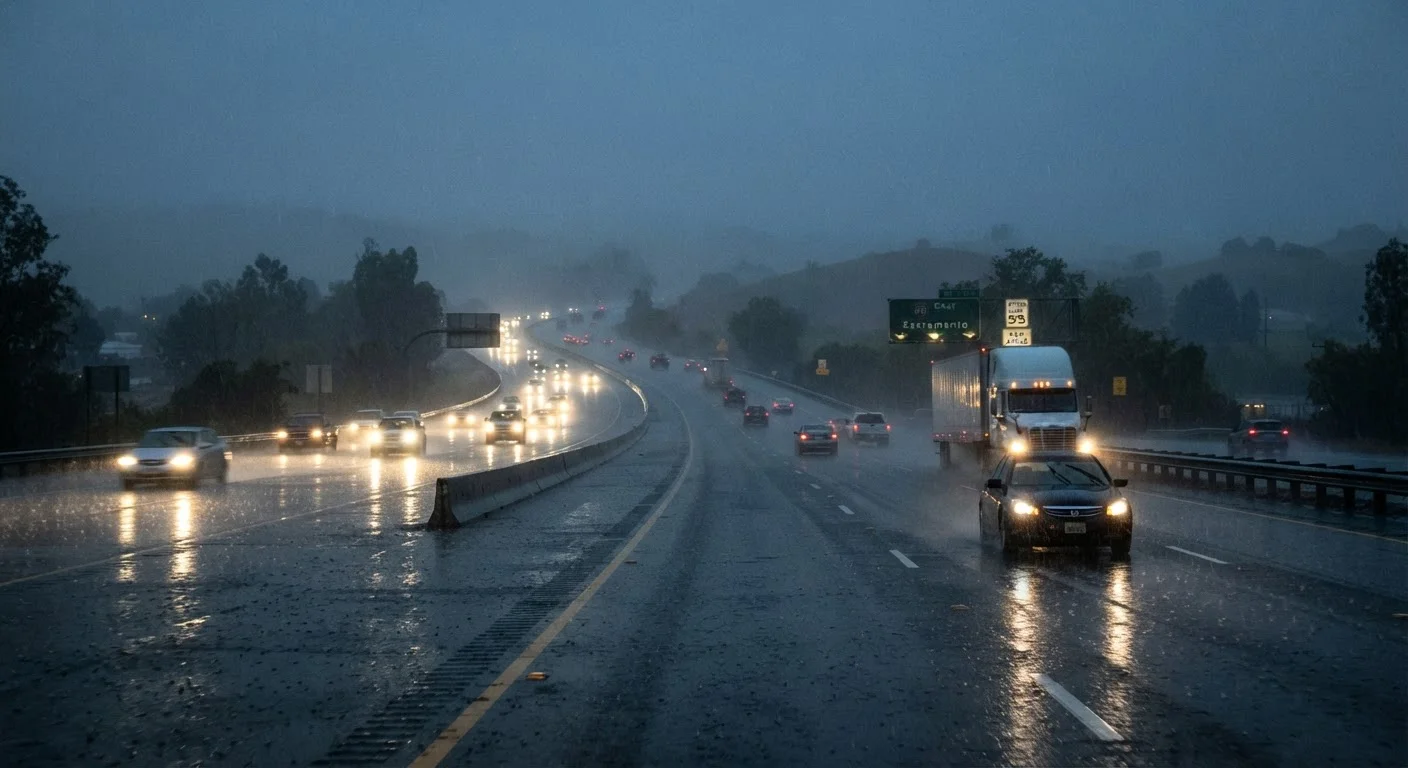
Why Weather Demands More Than Just Slowing Down
Most drivers know they should slow down when conditions deteriorate. But reducing speed is only one part of the equation. Rain, snow, ice, and fog each alter the physics of driving in distinct ways - changing how your tires grip the road, how quickly you can stop, and how much of the environment you can see. A response calibrated for rain can be insufficient or even counterproductive on ice.
Understanding what actually changes under each condition - and why - allows drivers to make more precise, effective adjustments. The goal isn't just caution; it's correct technique matched to the specific hazard present.
See also how environmental variables interact with vehicle maintenance in our guide to seasonal car care by climate.
Driving in Rain: Traction and Hydroplaning
Rain is the most common adverse weather condition American drivers face, but familiarity can breed complacency. Wet pavement reduces tire-road friction substantially, and at higher speeds, tires can begin to ride on a thin layer of water rather than gripping the road surface - a phenomenon called hydroplaning. When hydroplaning occurs, steering and braking lose effectiveness almost entirely.
The risk of hydroplaning increases with speed, worn tread depth, and standing water depth. Tire condition is a major variable: tires with adequate tread channels water away from the contact patch; worn tires cannot do this effectively. Drivers should ease off the accelerator gradually if they feel the steering go light - sudden braking or sharp steering inputs during hydroplaning can cause a spin.
Rain also compromises visibility through windshields and headlight range, and other drivers' behavior becomes less predictable. Increasing your following distance to at least four to five seconds - compared to the standard two to three - gives more reaction time.
Driving on Snow: Gentle Inputs and Reading the Road
Snow-covered roads demand a different style of vehicle control than rain-wet asphalt. The key principle is smoothness: abrupt acceleration, braking, or steering can break traction on a snowy surface far more easily than on dry pavement. Traction control and all-wheel drive help maintain forward momentum but do not significantly improve braking distance - a common and dangerous misconception.
Before driving in snow, clear all snow from the vehicle's roof, hood, and lights, not just the windshield. Snow blown from a roof onto following traffic is both a visibility hazard and, in some states, a legal liability. Leave earlier and plan for longer travel times rather than maintaining normal speed with the assumption that your vehicle can compensate.
Understanding how common driving habits quietly raise risk is especially valuable in winter conditions, where normalized behavior can prove dangerous.
Driving on Ice: The Most Unforgiving Surface
Ice - particularly black ice (a thin, nearly transparent layer on pavement) - offers dramatically less friction than even packed snow. Stopping distances on ice can be 10 times longer than on dry pavement at the same speed. Black ice forms most readily on bridges, overpasses, and shaded road sections because these surfaces cool faster than sun-exposed pavement.
The correct response on ice is to slow to the lowest safe speed before entering a potentially icy stretch, not during it. If a skid begins, the standard guidance for rear-wheel skids is to steer gently in the direction of the skid without overcorrecting. For front-wheel skids (understeer), easing off the accelerator and avoiding sharp steering allows the front tires to regain grip. Consult your vehicle's owner manual and consider a defensive driving course for hands-on practice - reading about technique is no substitute for practiced muscle memory.
Should you lose control entirely, knowing what to do in those first critical seconds is essential - our article on responding to a sudden loss of vehicle control covers the fundamentals.
Driving in Fog: Speed, Light, and Space
Fog is deceptive. Drivers often underestimate how much it has reduced their visibility until they're already traveling too fast to stop within the visible distance ahead. This is sometimes called overdriving your headlights - moving faster than you could safely stop within the range you can see.
Use low-beam headlights in fog, not high beams. High beams direct light into the water droplets suspended in fog, creating glare that reflects back at the driver and reduces effective visibility. Many modern vehicles include dedicated rear fog lights for this reason - consult your owner's manual if you're unsure how to activate them. Hazard lights, by contrast, are not appropriate while a vehicle is moving; they interfere with other drivers' ability to judge your speed and direction.
In dense fog, pull completely off the road if safe to do so - ideally into a parking area or well beyond the fog line - turn off your lights so following drivers don't mistake your taillights for the travel lane, and wait for conditions to improve. Driving in heavy fog shares some hazard characteristics with night driving; see how darkness changes road hazards for related visibility principles.
The content on this site is for informational purposes only and is not a substitute for professional advice. Always consult a qualified professional for guidance specific to your situation.