

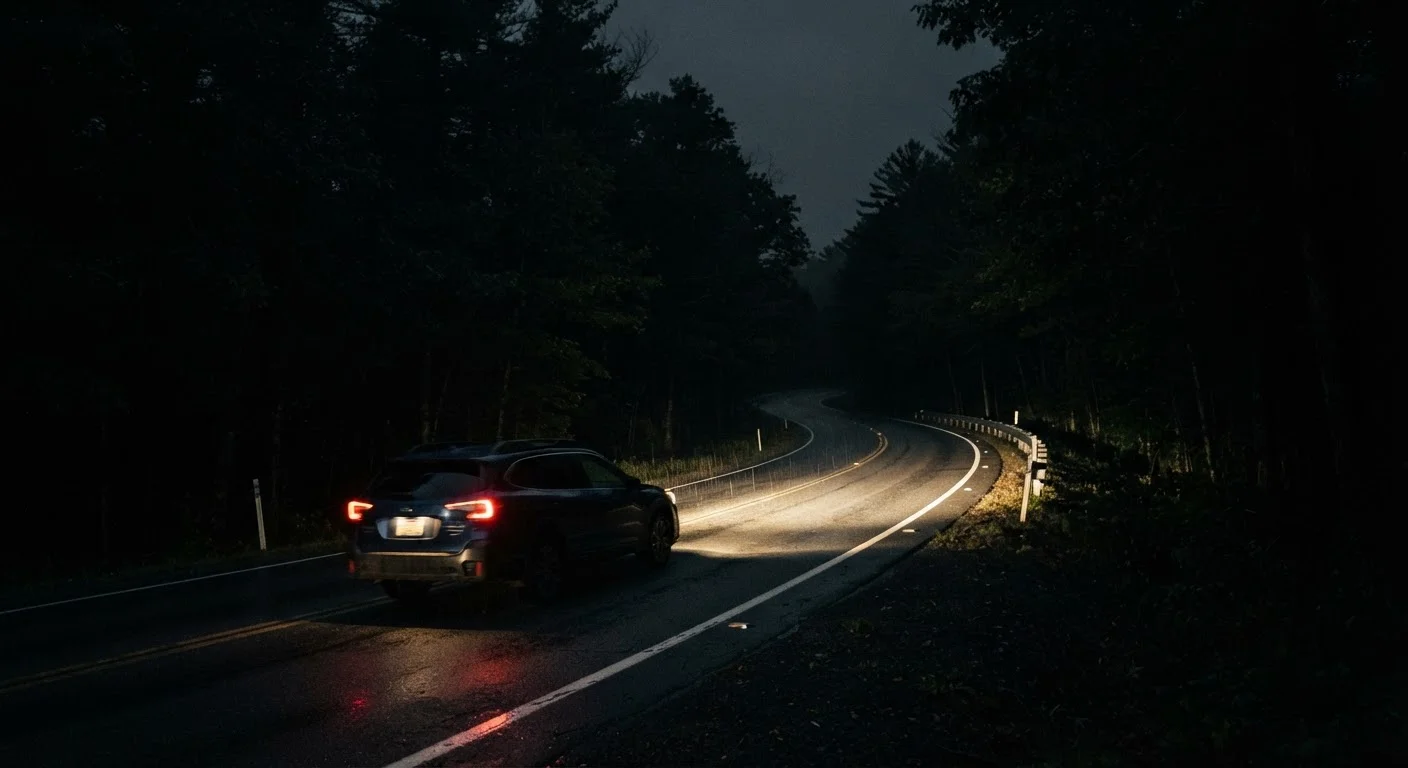
The Numbers Behind Night Driving Risk
Darkness does not just make driving uncomfortable - it fundamentally changes the risk profile. According to the National Safety Council, traffic death rates are roughly three times higher at night than during daylight hours, even though nighttime carries significantly less traffic volume. The NHTSA consistently reports that a large share of fatal crashes occur between dusk and dawn.
The reasons are well-documented: human vision is designed for daylight. When light levels drop, the eye shifts from cone-based (color and detail) vision to rod-based (low-contrast, peripheral) vision. That transition reduces your ability to judge distance accurately, perceive the edges of the road, and detect hazards at the speed your vehicle demands.
3×
Higher fatal crash rate at night vs. daytime
According to the National Safety Council, traffic fatality rates are approximately three times higher per mile driven at night compared to daytime.
Up to 80%
Headlight output lost to oxidized lenses
Automotive researchers have found that heavily oxidized or yellowed headlight housings can reduce usable light output by up to 80% compared to new, clear lenses.
Understanding why darkness raises risk is the foundation of driving smarter after dark. It also helps explain why certain habits - speeding, following too closely, relying on familiarity - become far more dangerous once the sun goes down. See how speed compounds crash severity for context on why nighttime and excess speed are a particularly dangerous pairing.
Best Practices for Safer Night Driving
Most night driving hazards are manageable with deliberate, consistent habits. The practices below address the specific sensory and mechanical limitations that darkness creates.
Reduce your speed to match your actual sight distance at night.
Headlights on low beam typically illuminate about 160-200 feet ahead, but stopping distances at highway speeds can exceed that. Driving faster than your headlights allow is sometimes called 'overdriving your headlights' - a condition where you cannot stop in time for an object at the edge of your visibility. Reducing speed creates the margin your eyes need.
Use high beams whenever oncoming traffic allows, and switch promptly to low beams when approaching another vehicle.
High beams can extend visibility to 350-500 feet, roughly doubling your reaction time window compared to low beams. Most drivers underuse them. Equally, failing to switch to low beams for oncoming traffic causes glare that can temporarily blind other drivers.
Increase your following distance to at least four seconds behind the vehicle ahead.
Reaction times don't improve at night - they often worsen due to fatigue and reduced visual input. Greater following distance gives you more time to respond to brake lights, sudden stops, or debris that the vehicle ahead disturbs. The standard three-second rule is calibrated for daytime conditions.
Keep your windshield, mirrors, and headlight lenses clean and free of haze.
A dirty or hazy windshield scatters oncoming light into glare far more than a clean one, dramatically reducing your effective vision in night conditions. Oxidized headlight lenses reduce output by up to 80% compared to new lenses, according to automotive research. Regular cleaning and lens maintenance are simple but high-impact steps.
Look slightly to the right edge of the road when facing oncoming headlights.
Staring directly at oncoming headlights causes temporary glare blindness that can last several seconds after the car passes. Shifting your gaze to the right edge line helps you maintain lane position without exposing your central vision to the full glare intensity.
Be especially alert for pedestrians, cyclists, and animals near roadway edges.
Pedestrians in dark clothing are nearly invisible at night until they're dangerously close. Animals frequently move onto roads at night, and deer activity peaks at dawn and dusk. Neither category is easily detected by automated vehicle systems. Active scanning - not passive monitoring - is required.
Special Considerations: Fatigue, Age, and Impairment
Three factors interact with darkness in ways that deserve explicit attention.
Fatigue: Drowsiness is not just an inconvenience - it mimics the cognitive impairment of alcohol, and it tends to peak in the late-night hours due to the body's circadian rhythm. Combining nighttime darkness with fatigue creates compounding impairment. Our guide to drowsy driving covers the warning signs and science in detail.
Age-related vision changes: The aging eye transmits less light to the retina, recovers more slowly from glare, and has a reduced ability to distinguish low-contrast objects. Drivers over 60 may find night driving noticeably more demanding, and that's a physiological reality - not a reflection of skill. If night driving feels significantly harder than it used to, discussing it with an eye care professional is worthwhile.
Impairment: Alcohol, cannabis, and certain prescription medications all reduce the visual processing and reaction speed you need most after dark. The combination of chemical impairment and low-visibility conditions is among the most dangerous situations on public roads. See how different substances affect driving ability based on current research.
What Your Vehicle Can and Can't Do
Modern vehicles increasingly include driver-assistance features - automatic high-beam control, lane-departure warnings, and forward-collision alerts - that can reduce night driving risk. However, these systems have important limitations. They can fail to detect pedestrians in dark clothing, animals at the edge of headlight range, or road debris that doesn't register clearly on sensors.
Keeping your headlights properly aimed, replacing aging bulbs before they dim noticeably, and ensuring your windshield is clean on both sides are low-cost steps that meaningfully extend your usable visibility. Seemingly minor habits - like forgetting to clean a hazy windshield - can quietly degrade your night driving safety in ways that are easy to overlook.
Technology assists - it doesn't substitute for attentive, adjusted driving. Treat every automated feature as a supplement to good judgment, not a replacement for it.
The content on this site is for informational purposes only and is not a substitute for professional advice. Always consult a qualified professional for guidance specific to your situation.