

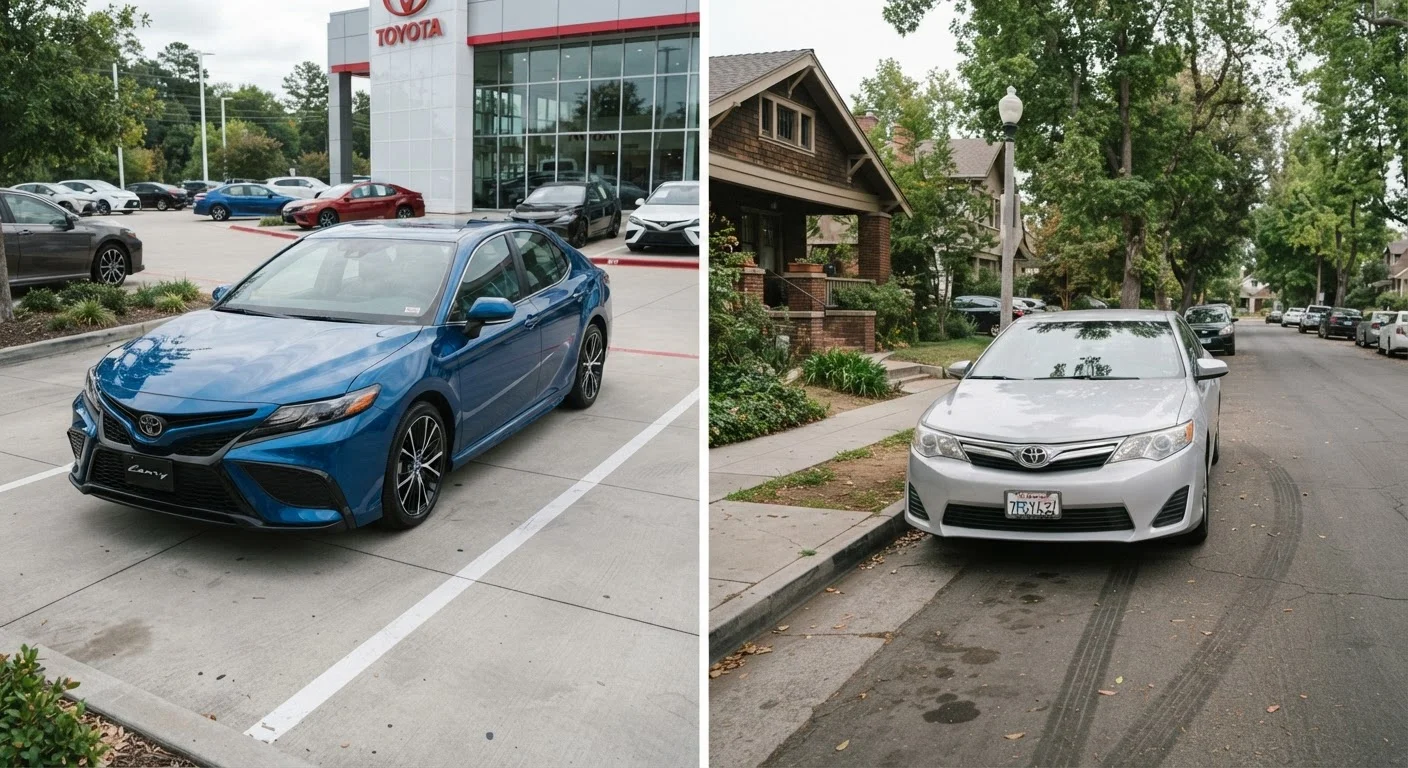
Option A
New Car
The full-warranty, latest-tech, straight-from-the-factory choice.
Best for: Buyers who prioritize peace of mind, the latest safety technology, and predictable ownership costs over a lower purchase price.
Option B
Used Car
The depreciation-adjusted, value-focused alternative.
Best for: Buyers who want to maximize purchasing power, avoid steep first-year depreciation, and are comfortable doing more upfront research.
Depreciation: The Biggest Financial Lever
Depreciation is the single largest factor separating the financial profiles of new and used cars. A new vehicle typically loses a significant portion of its value in the first year alone - industry data consistently places this figure between 15% and 25%, depending on the model and market conditions. By year three, many vehicles have shed roughly 40-50% of their original purchase price.
For used-car buyers, that drop has already happened. Purchasing a vehicle that is two to three years old effectively means someone else absorbed the steepest part of the depreciation curve. For new-car buyers, that loss is real but spread across ownership - and if you hold the vehicle long enough, the per-year impact narrows considerably.
How depreciation works over a vehicle's life matters enormously when calculating true cost of ownership. A lower sticker price on a used car does not automatically translate to lower total cost if reliability issues or higher interest rates close the gap.
| Criterion | New Car | Used Car |
|---|---|---|
| Purchase price | Higher sticker price | Lower sticker price |
| Depreciation exposure | Buyer absorbs first-year drop | Steepest drop already occurred |
| Manufacturer warranty | Full coverage included | None (CPO offers partial coverage) |
| Typical financing APR | Generally lower rates | Generally higher rates |
| Insurance cost | Higher premiums typical | Lower premiums typical |
| Vehicle history | No prior use or incidents | Requires research and verification |
| Technology & safety features | Latest available systems | Depends on model year |
| Selection | Limited to current model year | Wide range of years and trims |
Warranties, Financing, and Insurance
New cars come with manufacturer warranties - typically a 3-year/36,000-mile bumper-to-bumper and a 5-year/60,000-mile powertrain warranty, though terms vary by automaker. These cover most mechanical failures during your most vulnerable ownership years and can meaningfully reduce out-of-pocket repair costs.
Used cars generally arrive without that coverage, though exceptions exist. Certified pre-owned (CPO) programs, offered through franchised dealerships, include manufacturer-backed inspections and limited warranty extensions. However, CPO vehicles carry a price premium over non-certified used cars, so the value calculation requires scrutiny. If you're considering an older used vehicle, it's worth understanding what extended warranties on used cars actually cover - exclusions and deductibles vary widely.
Financing rates also differ. Lenders and automakers' finance arms typically offer lower annual percentage rates (APRs) on new vehicles than on used ones, and promotional 0% financing offers - when available - apply exclusively to new cars. Counterintuitively, the lower sticker price of a used vehicle may still result in a higher effective financing cost per dollar borrowed.
Insurance is another cost layer. Comprehensive and collision coverage on a new, higher-value vehicle typically costs more than coverage on an older, lower-value counterpart. See the real cost of owning a car beyond the monthly payment for a fuller accounting of these ongoing expenses.
15-25%
Typical first-year depreciation on a new vehicle
Industry analysts and automotive valuation services consistently report this range, though it varies significantly by make, model, and market demand.
~40-50%
Value lost by year three for many new vehicles
Automotive data firms tracking resale values find most mainstream vehicles reach this depreciation level within 36 months of purchase.
Higher APR
Typical used-car loan rate vs. new-car loan
Federal Reserve consumer credit data shows auto loan rates for used vehicles are generally several percentage points above new-vehicle rates.
Reliability, History, and Due Diligence
New cars carry no prior history - no accidents, no deferred maintenance, no unknown previous owners. That clean slate has real value. Used cars, by contrast, carry an unknown past unless you actively uncover it.
A vehicle history report is a critical starting point: it can reveal title issues, odometer discrepancies, reported accidents, and prior ownership patterns. But reports have limits - they only capture incidents that were formally reported. Knowing how to read a used car vehicle history report - and understanding what it cannot tell you - is essential before committing to any used purchase.
A pre-purchase inspection by an independent, licensed mechanic adds another layer of protection and is generally worth the cost. For used-car buyers deciding between purchase channels, buying from a private seller vs. a dealership involves different legal protections, pricing dynamics, and risk profiles. Neither option is inherently superior, but understanding the differences helps you prepare appropriately.
This article provides general information about vehicle purchasing considerations and is not a substitute for personalized financial or mechanical advice. Consult qualified professionals before making significant financial decisions.
The content on this site is for informational purposes only and is not a substitute for professional advice. Always consult a qualified professional for guidance specific to your situation.