

Our Verdict
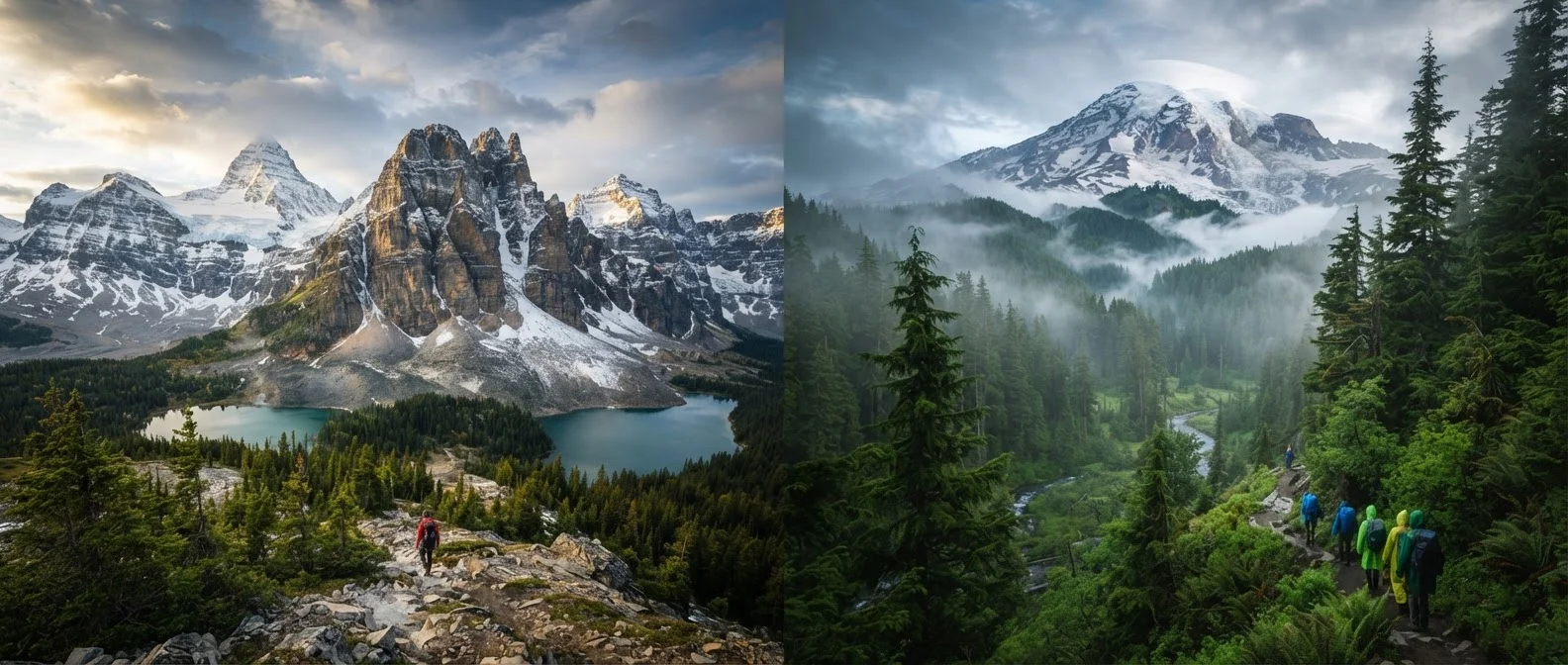
The Mountain West and Pacific Northwest are both extraordinary outdoor destinations, but they suit different travelers. The Mountain West rewards those who want big skies, reliable sunshine, and varied terrain from red rock canyons to alpine tundra. The Pacific Northwest captivates visitors drawn to dramatic coastlines, ancient forests, and iconic volcanic scenery - provided they're flexible about weather.
| Best for | Recommended |
|---|---|
| Sun-seekers and high-altitude adventurers | Mountain West |
| Rainforest and coastal landscape enthusiasts | Pacific Northwest |
| Road-trippers covering maximum terrain variety | Mountain West |
| Travelers prioritizing lush greenery and moody scenery | Pacific Northwest |
What We Mean by Each Region
When travel writers talk about the Mountain West, they're generally referring to states like Colorado, Utah, Wyoming, Montana, and Idaho - a sweeping inland zone defined by the Rocky Mountains, high desert plateaus, and basin-and-range geography. Think Yellowstone, the Grand Tetons, Zion, Arches, and Rocky Mountain National Park.
The Pacific Northwest centers on Washington and Oregon, with a personality shaped by the Cascade Range, the Pacific Coast, and temperate rainforests. Its headliners include Olympic National Park, Mount Rainier, Crater Lake, and the Oregon Coast. These two regions share almost nothing climatically or geographically - which is exactly why comparing them matters for trip planning. For a broader look at how US state-level destinations stack up, state parks across America often fill in the gaps between the big-name national parks in both regions.
Climate and Weather: The Biggest Deciding Factor
Weather may be the single most important variable when choosing between these regions. The Mountain West is famously sunny - Denver, for instance, averages more sunny days annually than Miami. Afternoons in summer bring predictable thunderstorms at elevation, but mornings are usually clear and dry. Humidity is low, and the air at altitude can be intense.
The Pacific Northwest operates differently. Western Washington and Oregon are among the rainiest areas in the continental US, particularly from October through April. Summers - roughly July through September - are genuinely spectacular, with mild temperatures and clear skies. But outside that window, expect persistent cloud cover and rainfall. If your travel window is flexible, late summer is the Pacific Northwest's sweet spot.
Acclimatize Before You Hit the Trails
Altitude affects everyone differently, and the Mountain West's most popular destinations sit well above sea-level comfort zones. Plan a lighter first day - short walks, lots of water, and no alcohol - before tackling strenuous hikes. Symptoms like headache or fatigue are common and usually resolve within 24-48 hours.
Altitude is also a real consideration in the Mountain West. Many popular destinations sit above 7,000-10,000 feet. Travelers coming from sea-level cities may need a day or two to acclimate before strenuous hikes.
Landscape and Terrain: Opposite Ends of the Spectrum
The Mountain West is a study in contrasts across short distances. You can drive from Utah's red-rock canyon country into Wyoming's sagebrush flats and up into alpine meadows blanketed in wildflowers - sometimes in a single day. The scale is enormous, the palette is warm and earthy, and the sky dominates every view.
The Pacific Northwest leans green and dramatic in a completely different register. Ancient Douglas firs, coastal fog, basalt sea stacks, and the brooding presence of active volcanoes like Mount Rainier and Mount Hood define the visual experience. The Hoh Rainforest in Olympic National Park receives over 12 feet of rain annually, making it one of the few temperate rainforests in North America. For travelers who've already explored the Southwest's desert landscape, the contrast is striking - see our Southwest road-trip orientation for context on that drier terrain.
| Mountain West | Pacific Northwest | |
|---|---|---|
| Typical Summer Weather | Sunny, dry, afternoon thunderstorms possible | Clear and mild, best July-September |
| Fall/Winter Conditions | Cold, snowy at elevation, sunny in lower deserts | Rainy, overcast, some snow at elevation |
| Primary Terrain | Canyons, high desert, alpine peaks | Rainforests, volcanoes, rugged coastline |
| Altitude Considerations | High - many sites above 7,000 ft | Lower - most trailheads under 5,000 ft |
| Crowd Management | Timed entries common at top parks | Permit systems at select trails |
| Best For | Sun-lovers, desert explorers, alpine hikers | Rainforest trekkers, coastal scenery fans |
Planning Logistics: Crowds, Permits, and Getting Around
Both regions require advance planning, especially in summer. Zion and Arches in Utah have implemented timed entry and shuttle-only access to manage high visitor volumes. Grand Teton and Yellowstone are enormous but still see significant congestion at peak overlooks and geyser basins. In the Pacific Northwest, popular trails at Mount Rainier - particularly the Skyline Trail loop - also benefit from early starts.
Driving is essential in both regions; public transportation options are extremely limited outside of a handful of urban trailheads. Distances between attractions are significant, so plan for more time behind the wheel than you might expect. If you're road-tripping through mountain or high-desert terrain, it's worth reviewing how your vehicle handles regional climate demands - seasonal vehicle care by region is a useful pre-trip reference. National parks in both regions fill campgrounds weeks or months in advance; reservations through official channels (recreation.gov) are strongly recommended.
For matching your travel style to the right park in either region, our national park guide by traveler type can help narrow down your priorities before you commit to an itinerary.
The content on this site is for informational purposes only and is not a substitute for professional advice. Always consult a qualified professional for guidance specific to your situation.