

Why These Labels Exist - and Who Sets the Rules
Country of origin labels serve two distinct purposes: they help enforce trade laws and customs duties, and they give consumers information about where a product comes from. But the agencies involved, and the rules they apply, differ significantly depending on what you're buying.
For general consumer goods, the Federal Trade Commission (FTC) governs "Made in USA" claims. For food, the U.S. Department of Agriculture (USDA) oversees Country of Origin Labeling (COOL) requirements. For customs purposes, U.S. Customs and Border Protection (CBP) applies its own origin determination standards. Automobiles have their own framework under the American Automobile Labeling Act. This fragmentation means there's no single, universal definition of "country of origin" that applies to everything on a store shelf.
Understanding which agency's rules apply to a given product is the first step toward reading these labels accurately. For a broader look at how product labels and designations are verified - or aren't - see our article on which certifications actually mean something.
The Gap Between "Made In" and "Everything Came From"
Modern manufacturing is globally distributed. A product labeled "Made in Germany" may contain components sourced from a dozen countries - the label reflects where the final, substantial transformation occurred, not where every input originated. This is especially true in electronics, automobiles, and industrial goods.
The legal concept of substantial transformation - which asks whether manufacturing created a new article with a distinct name, character, and use - determines origin for customs and many labeling purposes. A circuit board assembled from globally sourced chips in one country, then integrated into a finished device in another, may carry the origin of either country depending on which step is deemed more substantial.
40%+
Average imported content in U.S.-assembled vehicles
The American Automobile Labeling Act requires new cars to disclose parts content percentages, and many vehicles assembled in the U.S. contain substantial imported components.
3+
Federal agencies governing origin labeling
The FTC, USDA, and U.S. Customs and Border Protection each administer distinct country of origin rules across different product categories.
This complexity is why identical-looking products from the same brand can carry different origin labels depending on where they were manufactured for a given market or production run. The label tells you the legal answer to a regulatory question - it doesn't provide a complete supply chain map.
This same principle applies when evaluating vehicles. The Monroney sticker on a new car actually breaks down domestic and foreign parts content percentages - one of the more transparent origin disclosures in consumer retail.
What Labels Don't Tell You
A country of origin label says nothing about quality, labor conditions, environmental standards, or safety testing. A product made in a country with strict regulatory oversight may be no better or worse than one made somewhere with different standards - the label alone is not a quality signal.
"Designed In" Is a Marketing Phrase, Not a Disclosure
Phrases like "Designed in the USA" or "Engineered in Germany" have no standardized legal definition under U.S. consumer labeling regulations. They are not regulated origin claims and do not indicate where a product was manufactured, assembled, or tested. Treat them as branding, not factual disclosure.
Similarly, "Designed in " claims - a phrase commonly used in tech marketing - have no standard legal definition in the United States. They are marketing statements, not regulated disclosures. A product can be fully designed domestically and manufactured entirely abroad, or vice versa.
Consumers who want to assess actual build quality should look beyond origin labels to materials, construction methods, and independent testing data. Our article on build quality versus brand perception explores how to make that evaluation more rigorously. And when a product's marketing language feels vague, reading between the lines of product marketing can help you ask sharper questions.
How to Use Origin Information Constructively
Rather than treating a country of origin label as a proxy for quality or ethics, it's more useful as one data point among several. Here's how to approach it:
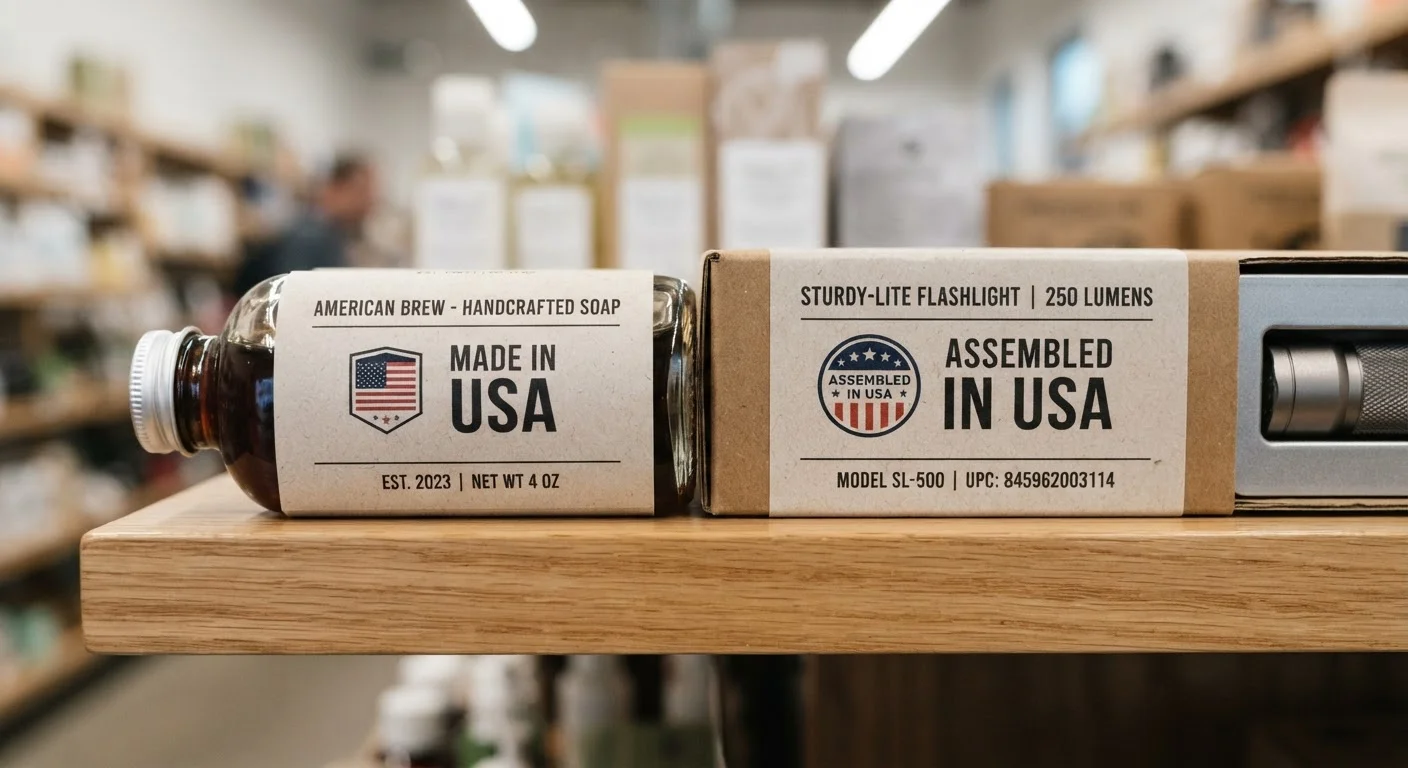
- Distinguish the label type. "Made in USA," "Assembled in USA," and "Made in USA of imported parts" all mean different things. Note the exact wording.
- Check the regulatory category. Food, textiles, and vehicles have richer mandatory disclosures than most other goods. Look for that additional detail when it exists.
- Supplement with other information. Certifications, materials disclosures, and independent testing data tell you things origin labels cannot. Specification sheets, when available, are worth reading critically - our guide on what a product specification sheet actually tells you explains how.
- Be skeptical of design-only claims. "Designed in " is an unregulated marketing phrase, not a disclosure with legal weight.
Country of origin labels are a legitimate and often useful piece of consumer information - but only when understood within the regulatory framework that defines them. Knowing what the label is actually saying, and what it isn't required to say, puts you in a stronger position to evaluate what you're buying.
Frequently Asked Questions
The Federal Trade Commission (FTC) requires that "Made in USA" claims mean a product is "all or virtually all" made in the United States - meaning all significant parts, processing, and labor originate domestically. Products that only partially meet this standard must qualify the claim, such as "Made in USA of imported parts."
No. "Assembled in USA" means the final assembly occurred domestically, but components may be imported from anywhere. It is a legally permissible claim but carries a significantly lower bar than a full "Made in USA" designation.
Not directly. A country of origin label reflects where manufacturing occurred, not the quality standards applied or the safety testing the product underwent. Safety is governed separately by regulatory agencies and independent certifications.
Not universally. Labeling requirements depend on product category. Textiles, food, and automobiles have specific mandatory disclosure rules; many other consumer goods have more limited requirements. Rules are set by different agencies including the FTC, USDA, and CBP.
Yes. Design origin and manufacturing origin are separate. A product can be conceptualized and engineered domestically while being manufactured entirely abroad. Design claims are generally unregulated and carry no standard legal definition.
The USDA administers Country of Origin Labeling (COOL) rules for certain foods including fresh fruits, vegetables, fish, shellfish, and muscle cuts of meat. These rules specify how origin must be disclosed at the retail level, though coverage categories have changed over time.
The content on this site is for informational purposes only and is not a substitute for professional advice. Always consult a qualified professional for guidance specific to your situation.