

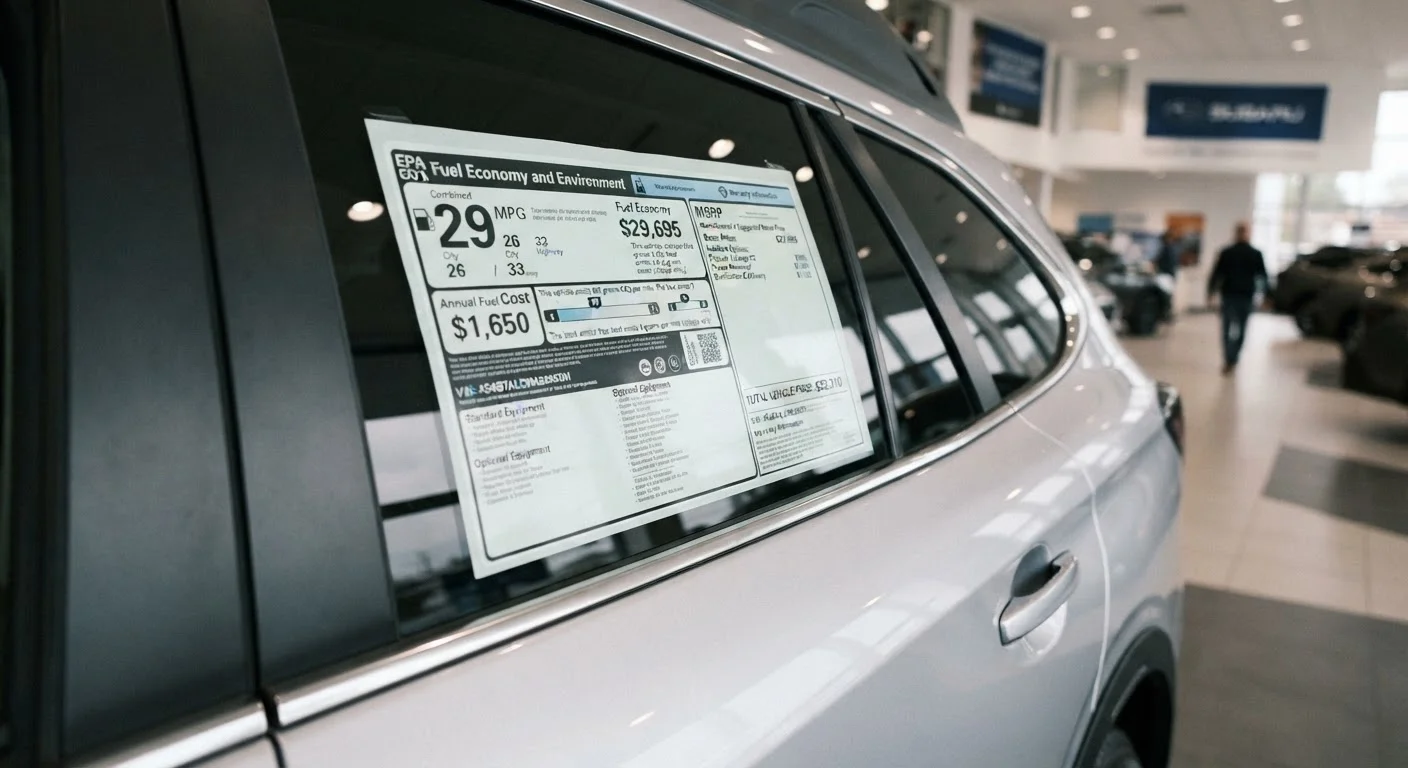
Why the Window Sticker Exists
Before 1958, new car pricing was largely opaque. Dealers could charge whatever the market would bear without any disclosure of what the manufacturer actually recommended. The Automobile Information Disclosure Act changed that, requiring automakers to attach a standardized label to every new vehicle before it reaches the showroom floor.
The result is the Monroney sticker - a document that, if you know how to read it, gives you a significant information advantage before a single word of negotiation begins. Think of it as the nutrition label of the car world: packed with data that rewards careful readers. For a broader look at how pricing terminology works across retail contexts, see how MSRP and list prices relate.
Breaking Down the Sticker Section by Section
A standard Monroney sticker is divided into several distinct sections, each serving a different informational purpose.
Vehicle Identification and Base Price
At the top, you'll find the make, model, trim level, and the base MSRP - the price of the vehicle with its standard equipment and no added options. This figure is the manufacturer's suggested retail price, not a binding offer. Common negotiation myths often cause buyers to treat this number as fixed when it generally is not.
Standard Equipment
This section lists what comes included at the base price: engine specifications, drivetrain, safety systems, infotainment features, and more. Reading this carefully helps you avoid paying extra for things the vehicle already includes.
Optional Equipment and Packages
Each add-on option or package is listed with its individual price. These can range from a few hundred dollars for floor mats to several thousand for technology or appearance packages. This is also where dealer-installed accessories sometimes appear - these may carry higher margins and are worth scrutinizing.
1958
Year window sticker disclosure became law
The Automobile Information Disclosure Act was signed into law in 1958, establishing the Monroney sticker as a federal requirement for all new vehicle sales.
$1,000+
Typical destination charge range for many vehicles
Destination and delivery charges vary by vehicle type and manufacturer but commonly run from several hundred to over a thousand dollars, added uniformly to the base MSRP.
MPGe
Efficiency metric used for electric vehicles
The EPA uses miles-per-gallon equivalent (MPGe) to allow consumers to compare the energy efficiency of electric and plug-in hybrid vehicles against conventional gasoline models.
Destination and Delivery Charge
This line item covers the manufacturer's cost to ship the car from the plant to the dealership. It is uniform for a given model nationwide and is added to the base price. Unlike optional equipment, this charge is not negotiable.
Total MSRP
The sticker's final price line adds the base MSRP, all selected options, and the destination charge. This total is the figure most dealers use as the starting point for negotiation - understanding what drives it up gives buyers a clearer picture of where flexibility may exist.
Fuel Economy and Environmental Ratings
A dedicated section of the sticker displays EPA fuel economy estimates for city driving, highway driving, and a combined figure. These numbers come from standardized laboratory tests designed to be consistent and comparable across vehicles - not to replicate any specific driver's experience.
The sticker also shows an estimated annual fuel cost based on a set number of miles and an assumed fuel price. This figure is useful for comparison shopping between models, but treat it as a benchmark rather than a prediction. Driving style, traffic patterns, and local fuel costs all affect what you'll actually spend.
Compare Stickers Before You Visit
Most automakers publish window sticker information on their websites, allowing you to configure a vehicle and view an estimated sticker before setting foot in a dealership. Reviewing this in advance helps you identify which options matter to you and what a realistic price range looks like - reducing the chance of being caught off-guard by add-ons.
Many stickers now include an energy impact score and a CO₂ emissions rating, which reflect the vehicle's environmental footprint. For electric and plug-in hybrid vehicles, equivalent MPG (MPGe) figures and electric range estimates appear in place of - or alongside - traditional fuel economy numbers.
Safety Information and What Comes Next
Some window stickers reference crash-test ratings from NHTSA's 5-Star Safety Ratings program or the IIHS. Where included, these offer a quick snapshot of how the vehicle performed in controlled crash scenarios. If ratings aren't listed, check NHTSA's and IIHS's public databases directly - not all vehicles are tested before going on sale.
The sticker also typically includes the vehicle identification number (VIN), which is your gateway to additional information. If you're comparing a new vehicle against a pre-owned alternative, understanding how to interpret a used car vehicle history report offers a useful parallel skill set.
Finally, the country of final assembly is listed on the sticker. This reflects where the vehicle was built, though components may originate from multiple countries. For a fuller picture of what assembly origin labels do and don't convey, see the guide on country of origin labels.
Arriving at the dealership with a clear understanding of what the window sticker contains - and what each line means - is one of the most practical steps any buyer can take. It turns a document that can feel overwhelming into a straightforward reference tool.
Frequently Asked Questions
No. The MSRP on a window sticker is the manufacturer's suggested retail price - a starting point, not a final number. Dealers may sell above or below it depending on demand, inventory, and negotiation. Understanding this distinction is one of the most important parts of the car-buying process.
Under the Automobile Information Disclosure Act, it is illegal for a dealer to remove the Monroney sticker before the vehicle is sold to its first buyer. The sticker must remain on the car throughout the sales process so consumers can review it.
EPA estimates are produced under standardized laboratory conditions, so real-world mileage often differs based on driving habits, terrain, temperature, and load. The EPA itself acknowledges this variation and provides a range on the sticker, not just a single figure.
The destination charge covers the cost of shipping the vehicle from the assembly plant to the dealership. It is set by the manufacturer - not the dealer - and is the same for all buyers purchasing that model, regardless of location. It is typically not negotiable.
Some stickers reference available safety ratings from the National Highway Traffic Safety Administration (NHTSA) or the Insurance Institute for Highway Safety (IIHS), though full rating details are found on those agencies' websites. Not all new vehicles have been rated at the time of sale.
The content on this site is for informational purposes only and is not a substitute for professional advice. Always consult a qualified professional for guidance specific to your situation.