

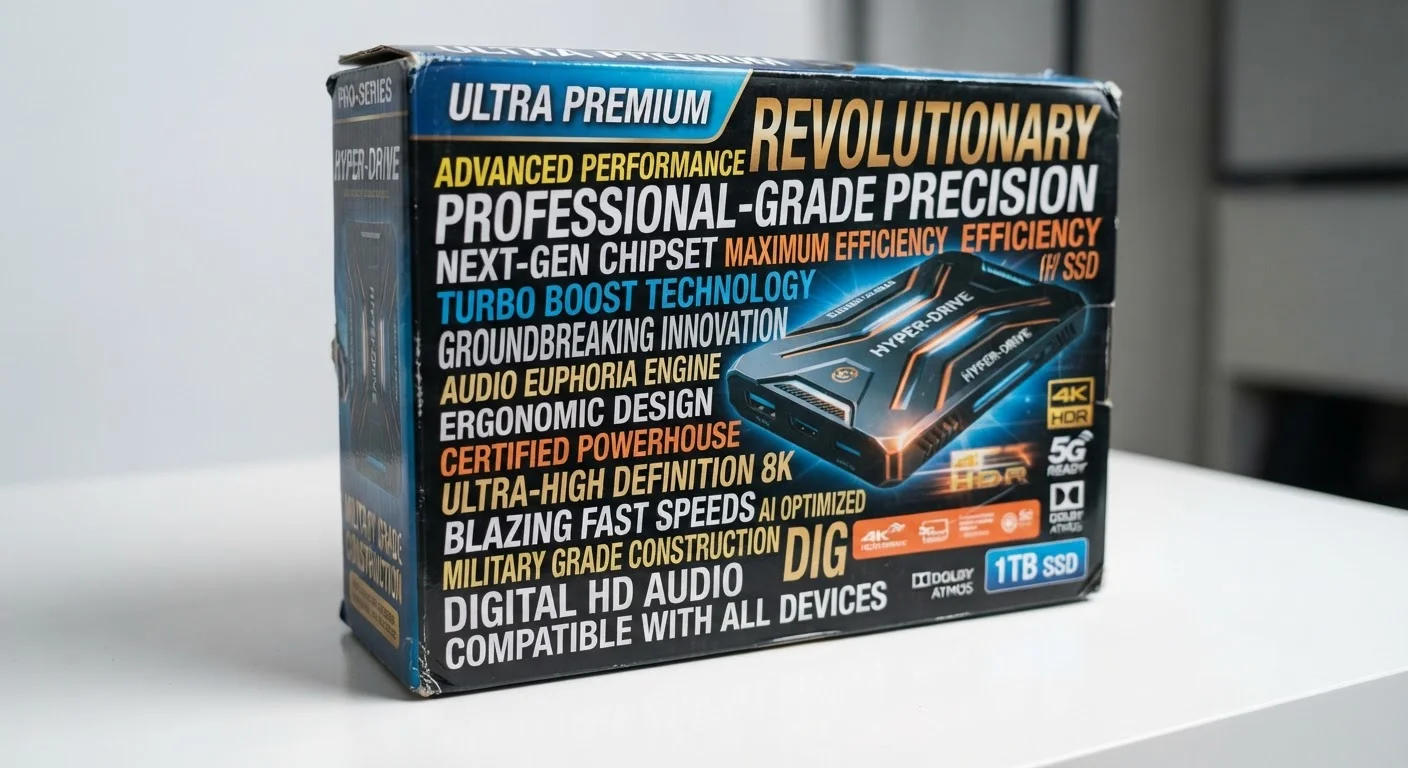
Why Marketing Language Exists - and What It's Designed to Do
Product marketing language has a single primary function: to create a favorable impression quickly. Packaging, advertisements, and product listings are optimized for split-second decisions, not careful analysis. The words chosen - "premium," "innovative," "professional-grade," "advanced formula" - are selected because they trigger positive associations, not because they carry precise, enforceable meaning.
This isn't inherently deceptive. Persuasion is a legitimate part of commerce. But consumers who understand the mechanics of marketing language are less likely to pay a premium for an adjective and more likely to evaluate what's actually inside the box. The gap between a product's marketed image and its real-world performance is exactly where uninformed purchases happen.
Understanding this gap is especially valuable in categories with high price variance - electronics, cleaning products, personal care, automotive accessories, and home goods - where marketing budgets can far exceed investment in engineering or materials. See how build quality and brand perception diverge to understand how logos and reputation can substitute, in a consumer's mind, for actual craftsmanship.
No standard
Definition for 'premium' in most U.S. consumer categories
The FTC and most U.S. consumer product regulators do not define 'premium' or 'professional-grade' as regulated terms for general merchandise.
42%
Of online green claims found potentially misleading
A European Commission screening of online environmental claims found that nearly 42% could not be substantiated or were outright false, illustrating how common unverified marketing language is.
"Up to"
Qualifier that can make any performance number defensible
Regulatory guidance from the FTC notes that 'up to' claims must reflect results consumers typically achieve - a standard that is frequently tested but difficult to enforce at the point of sale.
The Most Common Vague Terms and What They Actually Mean
Several words appear so frequently on product packaging that they have effectively lost communicative value. Here's how to interpret the most common ones:
- Premium: No regulated definition in most consumer product categories. Often signals a higher price point more than superior materials or construction.
- Professional-grade: Unless accompanied by specific performance benchmarks or genuine trade-channel sourcing, this phrase is largely aspirational. Ask: professional by whose standard, tested how?
- Advanced: Implies improvement over a prior version or competitor, but rarely specifies what changed or by how much.
- Natural: In food and personal care, "natural" has limited regulatory definition in many contexts. It does not automatically mean organic, minimally processed, or free of synthetic ingredients.
- Clinically proven: This phrase can be technically accurate while describing a study funded by the manufacturer, conducted on a small sample, or measuring a proxy metric unrelated to consumer benefit.
- Eco-friendly / Sustainable: Without third-party certification or specific data, these terms are considered "greenwashing" by consumer protection regulators in many jurisdictions.
The guide to certifications and standards labels explains which third-party marks carry genuine verification weight versus those that are self-awarded or poorly audited.
Claims That Sound Technical But Aren't
A subtler category of marketing language borrows the vocabulary of science or engineering to convey rigor without providing any. These pseudo-technical claims are worth recognizing:
- "Micro-engineered" / "nano-technology": Legitimate engineering disciplines, but these terms are sometimes applied to products where the claimed mechanism is either unverifiable or irrelevant to performance.
- "Up to X% more effective": The phrase "up to" makes almost any number defensible. If the best-case result is 30% improvement for one user in ideal conditions, the claim is technically not false - but it is not representative.
- "Laboratory tested": Testing occurred, but the claim says nothing about what was tested, by whom, using what protocol, or whether results were favorable.
- "Patented formula / technology": Patents protect inventions from copying - they do not verify that an invention works as marketed or outperforms alternatives.
For products where performance claims are central to the purchase decision, understanding the gap between manufacturer specs and independent testing is an essential read. Manufacturers have structural incentives to present data in the most favorable light; independent testers typically do not.
When a product claim uses the word 'up to,' mentally replace it with 'in the best-case scenario.' Then ask whether that scenario applies to your actual use conditions.
The FTC has guidance on qualifying claims, but at the point of sale consumers must do their own parsing. 'Up to 10 hours of battery life' and '10 hours of battery life' are very different statements.
Search for the product name alongside the word 'study' or 'test' in a separate browser tab before purchasing. If the only results are from the manufacturer's own site, treat performance claims with additional skepticism.
Independent corroboration - from trade publications, consumer testing organizations, or academic sources - is a reliable proxy for whether a claim can withstand scrutiny outside a controlled marketing environment.
How to Ask Sharper Questions Before You Buy
The most practical response to vague marketing language is to replace adjectives with questions. When a label says "superior durability," the useful question is: superior to what, measured how, over what time period? Specific, testable answers - or the absence of them - tell you a great deal.
A few productive questions to apply to any significant purchase:
- What does this claim measure? Performance claims should connect to a unit - hours, cycles, decibels, grams, temperature range. If no unit exists, the claim is aesthetic, not technical.
- Who verified this? Self-reported data and third-party data are not equivalent. Look for named testing bodies, published methodologies, or certification marks from organizations you can independently research.
- What's excluded from this claim? Warranty exclusions, use-condition qualifiers, and "typical results" disclaimers can significantly narrow what a product actually guarantees. See how to decode warranty terms before committing to any major purchase.
- Does the spec sheet support this? Marketing language and technical specifications should align. When they diverge, reading the spec sheet critically helps identify which claims have numerical backing.
Before finalizing any significant purchase decision, working through a structured product evaluation checklist can help ensure you haven't missed a key question.
Where to Find Meaning Beyond the Label
Once you've identified which claims on a product lack substance, the next step is finding information that does. Several sources are consistently more reliable than marketing copy:
- Independent testing organizations: Established consumer testing publications apply standardized protocols and publish methodology alongside results. Their findings are not influenced by advertising relationships.
- Verified purchaser reviews with specifics: Reviews that describe conditions of use, duration of ownership, and specific failure points are more informative than aggregate star ratings. Understanding which review signals are trustworthy can help you filter for genuine experience.
- Regulatory and safety databases: For product categories subject to federal oversight - appliances, vehicles, medical devices, children's products - government recall and compliance databases are publicly searchable.
- Certified standards marks: Marks from recognized, independent certification bodies indicate that a product met a defined standard at the time of testing - a meaningful, if limited, assurance.
Marketing language will always be part of the retail environment. The goal isn't to distrust every claim, but to calibrate how much weight each type of claim deserves. Specific, independently verified, measurable claims earn trust. Adjectives alone do not.
This article is for general informational and educational purposes only and does not constitute personalized purchasing or financial advice.
The content on this site is for informational purposes only and is not a substitute for professional advice. Always consult a qualified professional for guidance specific to your situation.