

Why Most Kids' Rooms Become Unmanageable
The average children's bedroom holds far more objects than any child - or adult - can realistically keep organized. Toys accumulate through birthdays, holidays, and impulse purchases, and storage solutions often get chosen for how they look in a catalog rather than how a six-year-old actually interacts with them. The result: a room that parents tidy and children immediately undo.
The core problem isn't a lack of discipline. It's a mismatch between the storage system and the child's physical and cognitive abilities. Deep toy chests require sorting through a pile to find anything; high shelves are inaccessible without help; lidded bins add friction that discourages putting things away at all. When cleanup feels hard, kids avoid it - and that's a design failure, not a character flaw.
Before buying a single bin or label, it helps to understand what makes organization sustainable for children. The common organizing myths about needing more storage - rather than less stuff - apply just as much in kids' rooms as anywhere else in the home.
Less Really Is More in Kids' Rooms
Research on child development consistently suggests that children play more creatively and with greater focus when they have fewer toys available at once. A curated, rotating selection of toys is not deprivation - it's an environment that supports deeper engagement. Consider keeping roughly a third of toys in accessible storage rotation at any one time.
Setting Up the System: Tools and Approach
Before organizing, start with a meaningful reduction. Pull everything out of the room and involve your child in deciding what stays. For younger children, a useful guideline is keeping only what they've engaged with in the past few months. Toys they've outgrown, duplicates, and broken items can be donated, passed on, or discarded. This process pairs naturally with a broader room-by-room decluttering approach if you're tackling the whole house.
Once the volume is reduced to what genuinely belongs, organize by category and by where the child plays. Art supplies near the desk, building toys near the floor space, books at a reachable shelf. Group things intuitively based on how your child actually uses the room - not based on matching sets or color coordination.
What you will need
For storage hardware, prioritize accessibility over appearance:
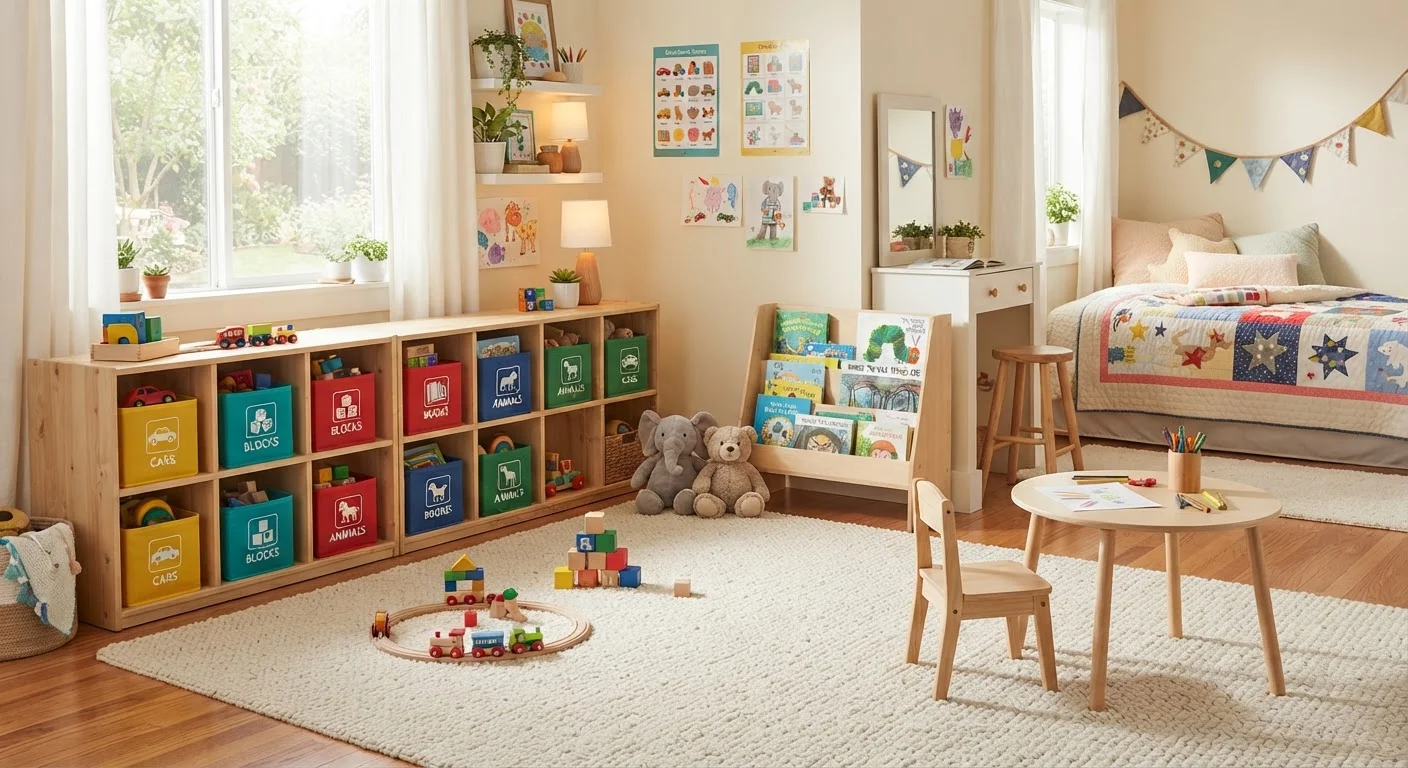
- Open bins and baskets at low heights - no lids, no digging
- Low shelves the child can reach independently
- Picture labels on every container, especially for pre-readers
- Divided trays or small boxes inside drawers for small pieces like Legos or crayons
The open shelving vs. closed cabinets tradeoff is worth considering here: for children's rooms, open shelving almost always wins on usability.
Open-top bins or baskets
Store categorized toys without the friction of lids, making it easy for children to put items away.
Low bookshelf or cube shelving unit
Provides accessible, visible storage that children can reach and use independently.
Picture labels
Identify each bin or section visually so pre-readers can find and return items correctly.
Small divided trays or containers
Contain small pieces like building blocks, crayons, or game pieces within a larger drawer or bin.
Wall anchors and furniture straps
Secure freestanding shelves to the wall to prevent tip-overs in children's rooms.
Donation bags or boxes
Collect items being removed from the room during the initial sort-and-reduce phase.
Step-by-Step: Building the System
Follow these steps to set up a storage system your child can realistically maintain on their own - or with minimal prompting.
Reduce before you organize
Sort all toys and belongings into three groups: keep, donate, and discard. Aim to keep only what your child actively uses and enjoys. A smaller collection is the single most effective change you can make - it immediately reduces the cognitive load of tidying for both you and your child.
Define clear categories for what remains
Group items logically: art supplies, books, building sets, stuffed animals, dress-up items, puzzles. Keep categories broad and intuitive rather than overly specific. Every item in the room should belong to one clear category - if something doesn't fit, it may not belong in the room at all.
Choose accessible, low-friction storage
Select open bins, baskets, or low shelves that your child can reach without help. Avoid lidded containers for everyday items - the extra step of removing a lid is enough friction to prevent a child from putting things away. Reserve closed storage for items that are infrequently used or need to be kept away from younger siblings.
Label everything with pictures
Create labels for each bin or shelf section that include a simple image of what belongs there, not just a word. For pre-readers, a picture of crayons means far more than the word "art." You can draw simple sketches, print images, or take a photo of the actual items and tape it to the bin.
Walk your child through the system
Before expecting your child to use the system independently, walk through it together. Practice putting items away. Ask them where each category belongs and let them answer. This reinforces the mental map of the room and builds confidence in their ability to maintain it.
Establish a consistent daily reset habit
Pick one consistent time each day for a brief tidy - before dinner or at bedtime work well for most families. Keep the reset short (five to ten minutes) and predictable. Consistency matters more than thoroughness. A quick daily reset prevents the buildup that makes cleanup feel overwhelming.
Reassess and adjust every six months
Children's interests change quickly. Schedule a brief review of the system twice a year to remove items that are no longer relevant, update labels as needed, and adjust storage categories to match your child's current stage. Keeping the system current prevents it from quietly falling apart.
Keeping It Working Over Time
Even a well-designed system needs occasional upkeep. As children grow, their interests shift rapidly - a system that worked at age five may not suit a seven-year-old. Plan to reassess the setup every six months or so, removing items that no longer get used and adjusting categories as needed.
Build a short daily reset into the routine rather than waiting for a full cleanup to become necessary. Five minutes before bed or before dinner prevents the slow accumulation that leads to overwhelming messes. Make it low-stakes and consistent rather than infrequent and intense.
Rotating toys - keeping some in storage and swapping them out every few weeks - can dramatically reduce visible clutter and reignite a child's interest in items they've forgotten about. This strategy also keeps the total number of available toys at a level a child can reasonably manage.
If you find the entire home needs a reset alongside the bedroom, the end-to-end home organization guide offers a full-household framework that complements these room-specific strategies.
Don't Let the System Drift Silently
The most common reason children's organization systems fail is gradual drift - new items come in without anything leaving, labels fall off and aren't replaced, and categories blur over time. Set a calendar reminder every six months to do a quick audit. Catching drift early takes fifteen minutes; ignoring it for a year can mean starting over completely.
The content on this site is for informational purposes only and is not a substitute for professional advice. Always consult a qualified professional for guidance specific to your situation.