

The Core Principles Behind Lasting Organization
Most organization projects fail not because people lack storage - they fail because the underlying principles are skipped. Before touching a single shelf, it helps to understand what actually makes a home stay organized over time.
Reduce before you organize. Adding bins and baskets to a cluttered space only relocates the problem. The first step is always deciding what stays. A useful benchmark: if an item hasn't been used in 12 months and holds no strong practical or sentimental value, it's a strong candidate for removal.
Design for your real life, not your ideal life. Systems built around aspirational habits collapse quickly. If you never fold laundry the same day it's washed, your system needs to account for that reality - perhaps a designated chair or basket - rather than assuming you will change.
Everything needs a designated home. Clutter is largely composed of things that have no fixed place. When an item has a clear, logical home, it gets returned there automatically. This principle is sometimes called the "one home" rule in organizing literature.
For a deeper dive into the vocabulary and frameworks professional organizers use, the Complete Household Organization Reference is a useful companion to this guide.
25%
Of Americans cite clutter as a major stressor
According to survey research published by the National Association of Productivity & Organizing Professionals (NAPO), roughly one in four Americans report that household clutter significantly affects their stress levels.
1 hour
Average time lost daily searching for misplaced items
Research from the National Association of Professional Organizers has suggested Americans lose approximately 55 minutes per day, on average, looking for things they own but cannot locate.
80%
Of clutter is items rarely or never used
Professional organizers frequently cite estimates suggesting the vast majority of household clutter consists of items that have not been used in a year or more.
Room-by-Room Strategies That Actually Stick
No two rooms function the same way, and effective organization reflects those differences.
Kitchen
Kitchens are high-traffic zones where inefficiency creates daily frustration. Group items by task - baking supplies together, coffee station consolidated - rather than by cabinet proximity. Store frequently used items at eye level and heavier items below the counter. Drawer dividers for utensils and a consistent system for pantry items (first-in, first-out) prevent both clutter and food waste.
Bedrooms
The bedroom should support rest, which means minimizing visual noise. Limit surfaces to what you actively use each night. In closets, organizing by category and then by color within each category makes it faster to find what you need and easier to spot when something is out of place.
Living Areas
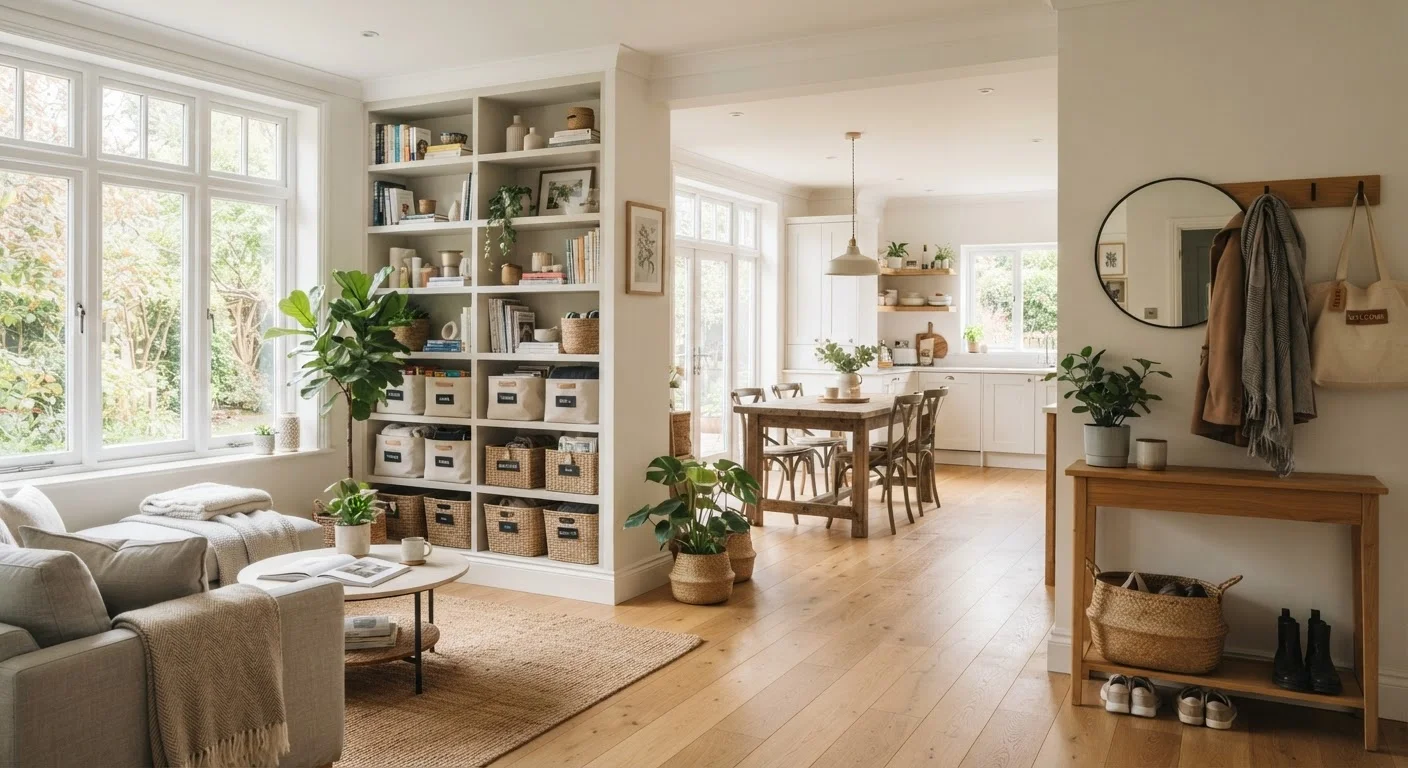
Shared spaces accumulate items from everyone in the household. Baskets or small bins assigned to each family member for personal items reduce ownership disputes over clutter. A designated drop zone near the main entrance - a hook, a tray, a small shelf - prevents bags, keys, and mail from spreading through the home.
Bathrooms
Small bathroom spaces require ruthless editing. Expired medications, duplicate products, and single-use travel items are common culprits. Under-sink areas benefit from small bins rather than open shelving, which tends to become a catch-all.
Home Office or Study Areas
Paper is the biggest challenge in work spaces. A simple three-tray inbox system - action required, pending, to file - processes paper before it piles up. Digital scanning of important documents reduces physical paper load significantly over time.
Label the inside of cabinet doors with what belongs in that cabinet - not just the outside. This subtle cue helps every household member (and guests) return items correctly without guessing.
Visible internal prompts reduce the decision fatigue associated with putting things away, which is one of the most common points where organizational systems break down.
When organizing a kitchen or pantry, decant staples like grains, pasta, and nuts into uniform clear containers. Uniform shapes stack efficiently and visibility prevents duplicate purchasing.
Pantry waste and over-purchasing are strongly linked to poor visibility - if you can't see what you have, you buy what you already own.
Organizing Through Life's Major Transitions
A home's organization needs evolve alongside the people living in it. What works at 25 rarely works at 45, and what suits a single-person apartment fails spectacularly in a family home.
First apartment or new home: Resist the urge to fill space immediately. Living in a space for a few weeks before committing to furniture or storage layouts reveals how you actually move through rooms. See our buying a home guide for tips on evaluating a new space's storage potential before you move in.
Growing families: Children introduce an enormous volume of small, easily scattered items. Dedicated toy zones with low, accessible bins teach children to participate in cleanup. As children grow, revisit systems seasonally - what worked at age three won't work at age eight.
Working from home: Remote work blurs the line between living space and workspace. Physical boundaries - even a curtain or a dedicated desk area - help maintain psychological separation and keep work materials from colonizing the rest of the home.
Aging in place: Organization for older adults or those with mobility considerations should prioritize frequently used items within comfortable reach, minimize trip hazards, and reduce the cognitive load of maintaining complex systems. Simpler is consistently better at every stage, but especially here.
Building Daily Habits That Maintain Order
The most common reason organized homes fall back into chaos is the absence of maintenance habits. A single deep-declutter session is not a permanent solution - it's a reset that requires follow-up.
The reset routine: A 10-15 minute nightly walk-through to return items to their designated homes prevents small disorder from compounding into overwhelming clutter. This works best when it becomes a non-negotiable routine, like brushing teeth.
One-in, one-out: For categories like clothing, books, and kitchenware, adopting a simple rule - one new item enters only when one leaves - naturally limits accumulation without requiring periodic purges.
Weekly maintenance windows: Set aside a brief window each week (Sunday evenings work for many households) to address paper accumulation, check pantry stock, and reset shared spaces. Fifteen minutes of weekly maintenance prevents hours of reactive decluttering later.
Make the Reset Easy, Not Heroic
The best maintenance routine is the one that requires the least willpower. Set a specific time each day - right after dinner works for many families - and keep it to 10 minutes maximum. Pair it with something pleasant, like a podcast, to reduce resistance. The goal is consistency over completeness.
If you want to understand why some common approaches to tidying actually backfire, the article on organizing myths that make homes messier is worth reading alongside your planning process.
Common Mistakes - and How to Sidestep Them
Even motivated, well-intentioned organizers repeat certain predictable errors. Recognizing them early saves significant time and money.
Buying storage before decluttering. This is the most widespread mistake. Storage products purchased before editing a space often end up holding items you didn't need to keep in the first place. Always declutter first.
Creating systems for other people's habits. An organization system only works for the people who use it. A filing system that requires your partner to remember seven categories will fail. Involve household members in designing shared spaces.
Perfectionism as a barrier. Waiting for the "right" organizational product or the perfect free weekend means many projects never start. An imperfect system that exists beats a perfect system that doesn't. Start with what you have.
Neglecting maintenance. Organization is not a one-time event. Homes are dynamic - families grow, hobbies change, seasons shift. Scheduling a seasonal review (twice a year is a workable cadence for most households) keeps systems relevant and prevents major backslides.
For broader home improvements that complement better organization - from storage built-ins to mudroom additions - the Home Improvement hub offers practical guidance on structural upgrades that support an organized home.
The content on this site is for informational purposes only and is not a substitute for professional advice. Always consult a qualified professional for guidance specific to your situation.