

Our Verdict
Open shelving suits homeowners who maintain tidy habits, have curated collections worth displaying, and want a more open, airy feel. Closed cabinets are the more practical all-purpose choice for households with heavy storage needs, young children, or a preference for low-maintenance living. Neither option is universally superior - the right fit depends on how you actually live in the space.
Open shelving is best for organized, design-minded households; closed cabinets are the stronger choice for busy families or anyone who values effortless tidiness.
What You're Really Choosing Between
The open shelving versus closed cabinets debate is really a conversation about how you use your space - and how much visual and physical maintenance you're willing to take on. Both storage systems are legitimate tools, and neither is inherently superior. What separates them is how they perform under real-world conditions in specific rooms.
Open shelving typically means wall-mounted or freestanding shelves without doors, leaving contents visible and accessible at all times. Closed cabinets use doors - whether solid, glass-paneled, or slatted - to conceal what's stored inside. Many homes use both, often without much deliberate thought about which type belongs where.
This breakdown will help you think through the trade-offs more intentionally, so your storage actually supports a calmer, more functional home. If you're working within a compact floor plan, see our small-space storage guide for strategies tailored to tighter rooms.
The Case for Open Shelving
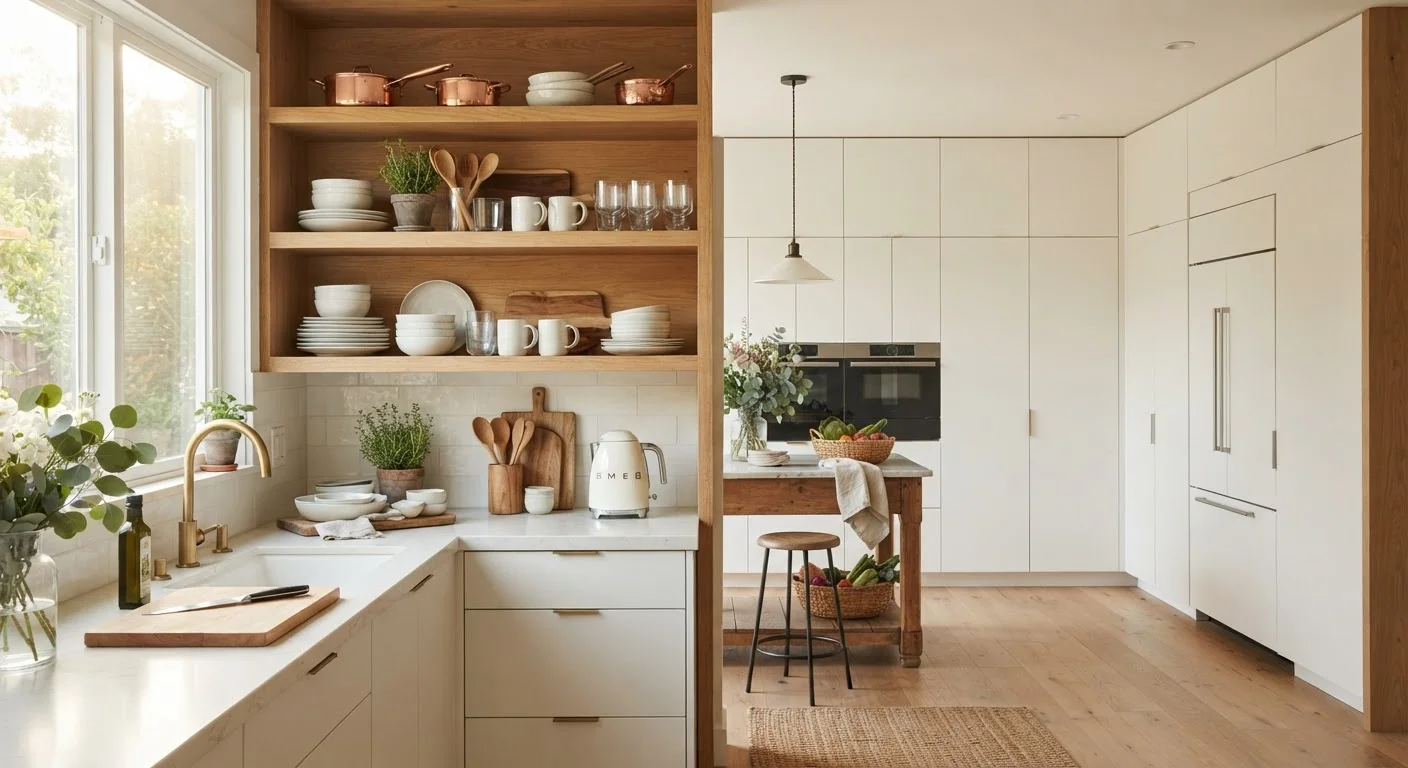
Open shelving has surged in popularity partly for aesthetic reasons - exposed dishes, plants, and books add warmth and personality to a room in a way closed cabinetry rarely can. But the practical benefits go beyond looks.
Contents are always visible and easy to access
Seeing what you own at a glance reduces time spent searching and helps prevent buying duplicates of items you already have.
Creates an open, airy feel in smaller rooms
Removing upper cabinet doors or switching to open shelving can make a compact kitchen or bathroom feel noticeably larger and less boxy.
Generally simpler and less costly to install
Wall-mounted shelves require fewer materials and less labor than full cabinet runs, making them more accessible for renters and budget-conscious homeowners.
Encourages intentional editing of possessions
Because everything on display is visible, open shelving naturally motivates homeowners to keep only what they genuinely use or find beautiful.
Flexible and easy to reconfigure over time
Adjustable bracket systems allow shelf heights to be changed quickly as storage needs evolve, without a major renovation.
Visibility is one of open shelving's biggest underrated strengths. When you can see everything stored on a shelf, you're less likely to forget what you own or buy duplicates. In a kitchen, this translates to faster meal prep. In a home office or craft room, it means fewer minutes hunting for supplies.
Open shelves are also typically easier and less expensive to install than full cabinet runs, making them an appealing option for renters or homeowners on a budget. They can be repositioned as needs change without the commitment of a full cabinetry project.
The Case for Closed Cabinets
Closed cabinets have earned their place as the default storage choice in most American kitchens, bathrooms, and living spaces - and for good reason. Their ability to conceal clutter instantly makes a room look tidier without any extra effort from the homeowner.
Dust and grease accumulate on exposed items
Without a door barrier, dishes, books, and décor collect airborne particles and kitchen grease far more quickly, requiring more frequent cleaning.
Demands consistent tidiness to look intentional
A single busy week can turn a curated open shelf into a visual jumble - open storage is unforgiving to households with variable tidying habits.
Less protection for fragile or sensitive items
Glassware, electronics, and items sensitive to light or moisture are better stored behind doors where they're shielded from environmental exposure.
Not suitable for households with young children
Cleaning products, medications, or breakable items stored on open shelves present safety risks that closed, lockable cabinets eliminate.
Can feel visually overwhelming in busy rooms
In rooms with heavy traffic and frequent use - like a family kitchen - too much open storage can make the space feel chaotic rather than inviting.
For households with children, closed cabinets offer an additional layer of safety by keeping cleaning products, sharp objects, or breakable items out of reach. Child locks add another tier of security that open shelving simply cannot provide.
Closed storage also protects contents from dust, grease, and airborne particles - particularly important in kitchens near stovetops or in garages. Items stored behind doors require far less frequent cleaning than those left exposed. This is a meaningful consideration for anyone who wants low-effort organization that holds up over time. For a related look at how storage myths can backfire, check out our piece on common organizing myths.
Making a Hybrid Approach Work
For most households, the most functional answer is a deliberate mix of both. The key is matching the storage type to the specific room and category of items being stored.
A Room-by-Room Matching Guide
Kitchens often benefit from closed lower cabinets (heavier pots, pantry items) paired with one or two open upper shelves for everyday dishes. Bathrooms work well with open shelving for towels and toiletries you reach for daily, and closed storage beneath the sink for cleaning supplies. Living rooms can use a mix of closed media cabinets for cords and equipment alongside open shelving for books and display objects.
A practical framework: use open shelving for items you access daily and are comfortable displaying - mugs, cookbooks, folded towels, decorative objects. Reserve closed cabinets for things you want protected, rarely use, or simply don't want on display - pantry staples, cleaning supplies, off-season items, and anything that accumulates dust quickly.
This division also makes organizing systems more sustainable. Organization myths often suggest that more storage containers solve clutter - but the bigger lever is assigning the right type of storage to the right category of stuff.
~60%
Homeowners preferring concealed kitchen storage
National Association of Home Builders surveys consistently show a majority of homebuyers prioritize ample closed cabinet storage in kitchen design preferences.
2-3×
More frequent cleaning needed for open shelves
Home organization experts commonly note that exposed shelving in kitchens requires dusting and wiping roughly two to three times more often than closed cabinetry.
In spaces shared with children, the balance often tips toward more closed storage for safety reasons. Our guide on children's bedroom storage explores how to set up systems that kids can actually maintain.
The content on this site is for informational purposes only and is not a substitute for professional advice. Always consult a qualified professional for guidance specific to your situation.