

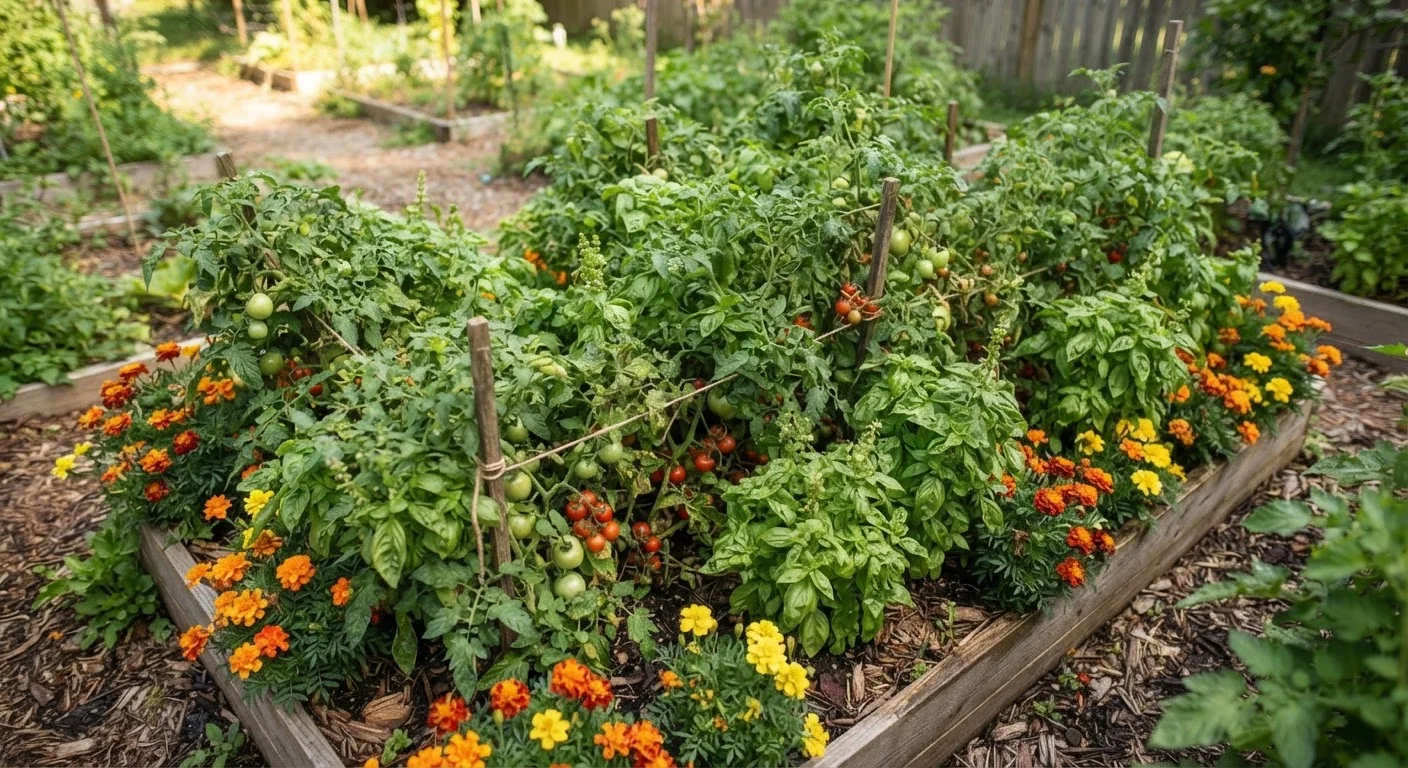
What Companion Planting Actually Does
At its core, companion planting is about designing plant communities rather than growing crops in isolation. When plants share space thoughtfully, they can do things for each other that inputs like fertilizers and pesticides are designed to replicate - but through biological relationships instead.
There are four main mechanisms worth understanding:
- Nitrogen fixation: Legumes like beans and peas form relationships with soil bacteria that convert atmospheric nitrogen into a form plants can use. Growing these alongside nitrogen-hungry crops - like corn or leafy greens - can improve soil fertility over time.
- Pest confusion and deterrence: Strong-smelling plants can mask the scent of nearby crops from insects that locate hosts by smell. Aromatic herbs like basil and plants like marigolds are frequently used this way.
- Beneficial insect attraction: Flowering companions attract predatory or parasitic insects - such as parasitic wasps or hoverflies - that feed on common garden pests like aphids and caterpillars.
- Physical structure: Tall plants can shade low-growing ones that prefer cooler conditions, while sprawling ground covers suppress weeds and retain soil moisture.
Understanding which mechanism a pairing relies on helps you evaluate whether it's likely to work in your specific garden conditions. See our guide to soil pH for context on how soil conditions interact with plant health more broadly.
A Note on Research Variability
The science behind companion planting is genuinely uneven. Some pairings - particularly those involving nitrogen-fixing legumes - are backed by extensive agricultural research. Others, like the carrot-onion pairing, have limited or conflicting experimental support. University cooperative extension programs in your region are among the most reliable sources for evidence-based guidance specific to your climate and common local pests.
The Three Sisters and Other Classic Pairings
The most famous companion planting system in North American gardening history is the Three Sisters, practiced for centuries by many Indigenous peoples of North America. Corn provides a vertical trellis for beans to climb; beans fix nitrogen that feeds the corn and squash; squash spreads along the ground, shading out weeds and retaining moisture with its large leaves. The three crops support each other structurally, nutritionally, and spatially.
Other well-regarded pairings include:
- Tomatoes and basil: Often cited as a classic pair, and while the evidence that basil repels tomato pests is mixed, basil attracts pollinators and the two crops share similar water and light needs - making them practical neighbors regardless.
- Carrots and onions: The theory is that carrot fly is deterred by the scent of onions, and onion fly by the scent of carrots. Some gardeners report success with this pairing, though research results are inconsistent.
- Brassicas and nasturtiums: Nasturtiums are sometimes used as trap crops, drawing aphids away from cabbages, kale, and broccoli. The idea is to sacrifice the nasturtium and remove it - along with the aphid population - before infestation spreads.
If you're planning your first vegetable plot, our beginner's vegetable garden guide walks through bed planning in a way that makes incorporating companions straightforward from the start.
A home gardener plants marigolds around the border of a tomato bed every season and notices far fewer whiteflies than in previous years.
A community garden plot uses a traditional Three Sisters layout - corn, climbing beans, and squash - in a single raised bed.
A gardener interplants dill among brassica crops like broccoli and cabbage.
Applying Companion Planting Without Overcomplicating It
One of the most common mistakes new gardeners make is treating companion planting as a complex puzzle with rigid rules. In practice, a few simple principles go a long way.
Start by identifying your biggest garden challenges. If aphids or squash beetles are a recurring problem, focus on pairings that address those pests specifically. If your soil is poor, prioritizing nitrogen-fixing legumes makes more sense than worrying about aromatic deterrents.
A practical starting point: add one or two flowering companions - like marigolds, sweet alyssum, or calendula - to any vegetable bed. These attract a range of beneficial insects and are low-effort to grow. From there, layer in aromatic herbs or trap crops based on what problems you observe.
Start Simple: One Flowering Companion Per Bed
Rather than planning an elaborate companion planting chart before your first season, add a single row of marigolds or sweet alyssum to each vegetable bed. This introduces beneficial insects without requiring you to overhaul your layout. You can build more intentional pairings in future seasons based on what you observe.
Companion planting also pairs naturally with other garden strategies. Mulching your beds correctly reduces weeds and retains moisture in ways that give companion plants better conditions to do their job. If you're working with limited space, the principles apply equally well to containers and raised beds - see our guide on small-space gardening for ideas adapted to tighter environments.
The goal is a garden that requires fewer external inputs over time - not perfection in year one. Keep notes on what you observe, adjust pairings that don't seem to help, and build on what works in your specific growing conditions.
Frequently Asked Questions
Some pairings, like nitrogen-fixing legumes near heavy feeders, have solid scientific support. Others are based more on tradition than controlled research. The most honest approach is to treat well-documented pairings as reliable and more anecdotal claims as worth testing in your own garden.
Certain plants inhibit each other's growth through allelopathy - releasing chemical compounds into the soil. Black walnut trees, for instance, produce juglone, which suppresses many vegetable crops. Fennel is famously poor company for most garden vegetables. Research specific incompatibilities before planning your layout.
Companion planting can meaningfully reduce pest pressure but is rarely a complete substitute for an integrated pest management strategy. Think of it as one useful layer in a broader approach that also includes healthy soil, proper spacing, and monitoring.
Proximity matters, but the ideal distance depends on the mechanism involved. Aromatic pest deterrents are most effective within a few feet. Nitrogen-fixing plants need root contact or proximity in the same bed. In most cases, interplanting within the same bed or row is sufficient.
Yes. Small-space gardeners can apply companion planting principles in raised beds and containers. Pairing compact basil with tomatoes in a single large pot, or marigolds at the edge of a patio planter, can deliver real benefits even without a full garden bed.
The content on this site is for informational purposes only and is not a substitute for professional advice. Always consult a qualified professional for guidance specific to your situation.