

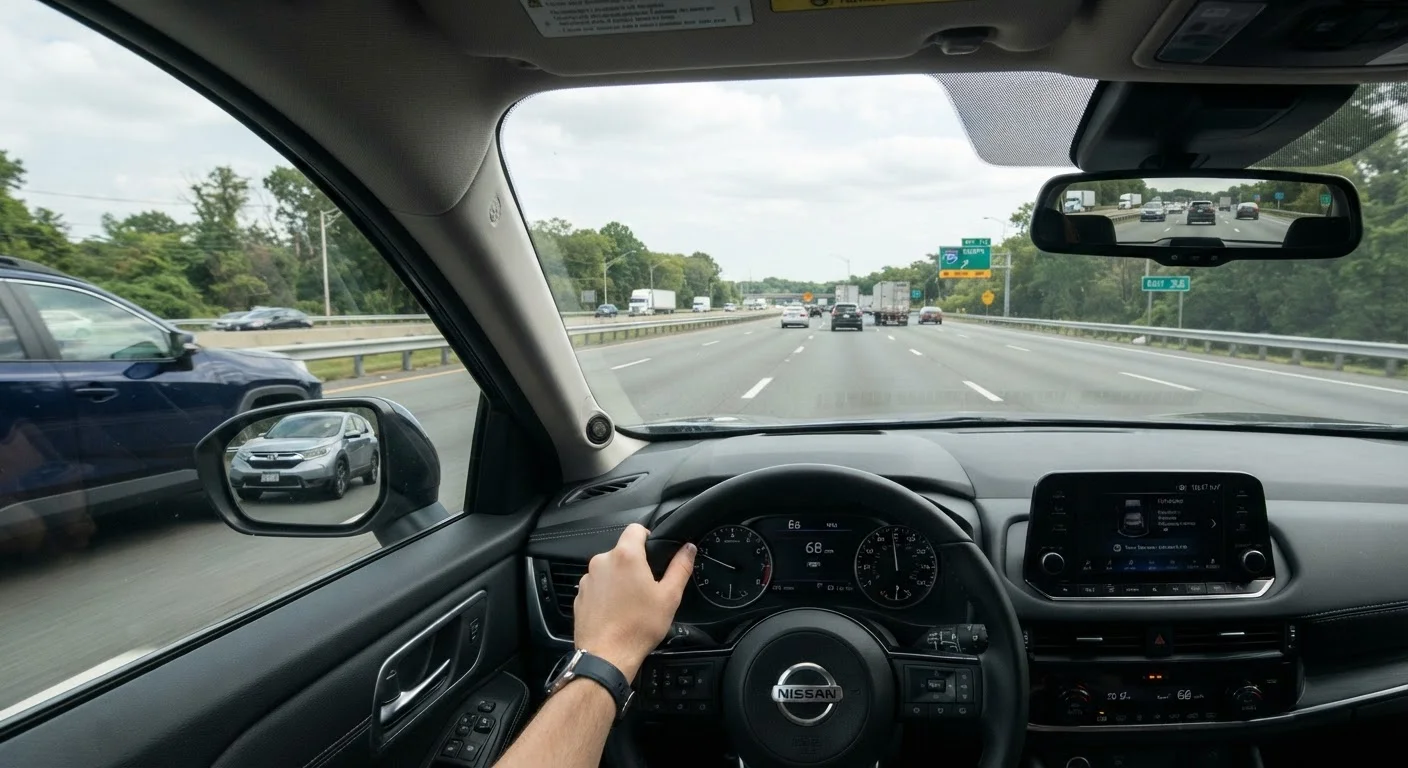
Why Mirrors Don't Tell the Whole Story
Most drivers assume that a quick scan of their mirrors before changing lanes is sufficient. It rarely is. Mirrors - even when correctly adjusted - have a fundamental limitation: they reflect only what is directly behind and to the side of the vehicle. The zone that falls just beyond that coverage, but before your peripheral vision picks up, is where blind spots live.
The geometry is straightforward. Your rearview mirror shows a narrow band centered on the lane directly behind you. Each side mirror picks up an angled slice extending backward from roughly your rear wheel well. The gap between the edge of a side mirror's field and the front of your peripheral view - typically spanning the area beside your rear doors and trunk - creates the classic blind spot. A full-sized sedan traveling at highway speed can fit entirely within that gap.
Adjusting mirrors outward (rather than angled to show the side of your own car) closes some of this gap. Many driver education programs now teach this technique. But even optimally positioned mirrors cannot eliminate the zone entirely, and the overlap between mirror coverage and peripheral vision still leaves a narrow corridor where vehicles can hide. That makes the physical head-check - turning your head briefly to look over your shoulder - a non-negotiable step before any lane change.
Mirror Adjustment Is a Starting Point, Not a Fix
Correctly adjusting your mirrors improves coverage and is worth doing, but it does not create a complete picture of surrounding traffic. Even with optimally positioned mirrors, a physical head-check over the appropriate shoulder is required before changing lanes. Relying solely on mirrors - however well adjusted - is a driving habit that quietly raises risk for many drivers.
What Makes Blind Spots More Dangerous in Certain Vehicles
Not all blind spots are equal. Vehicle design plays a large role in how large and how hazardous they are.
Pillar thickness: The A-, B-, and C-pillars - the vertical supports flanking the windshield, front doors, and rear window - block driver sightlines. As vehicles have been built with stronger safety cages over the decades, pillars have grown thicker. A robust B-pillar that protects occupants in a side impact also creates a wider visual obstruction at an angle frequently occupied by adjacent vehicles.
Vehicle height and hood length: Trucks and SUVs ride higher, which elevates the driver's eye level and creates a forward blind zone directly in front of the hood - an area that can obscure a small child or animal at close range. Sedans with long hoods share a version of this problem.
Rear cargo and window size: Heavily loaded pickup beds, rear window tint, and small rear windows all shrink rearview mirror effectiveness. The rearview mirror becomes nearly useless when a van or tall SUV with opaque rear-side windows backs up or switches lanes.
~840,000
Annual blind-spot crashes in the US
The National Highway Traffic Safety Administration has attributed approximately 840,000 crashes per year to blind-spot factors, based on crash data analysis.
300+ ft
Truck driver's blind zone directly behind the trailer
Federal Motor Carrier Safety Administration guidance notes that large trucks can have a rear blind spot extending more than 30 feet behind the trailer - far beyond what most drivers assume.
~27%
Lane-change crash reduction with blind-spot monitoring
Research published by the Insurance Institute for Highway Safety found blind-spot monitoring systems were associated with meaningful reductions in lane-change and merging crashes when drivers responded to warnings.
Understanding your own vehicle's specific weak points - and accounting for them - is a core element of what defensive driving looks like in practice.
The Moments When Blind Spots Cause Crashes
Blind-spot incidents cluster around a specific set of maneuvers. Lane changes on multi-lane roads and highways account for a large share of these crashes, particularly when a driver signals and moves without performing a shoulder check. The vehicle that was invisible in the mirror is suddenly present in the same space.
Merging from an on-ramp presents a compounded version of the same problem. The merging driver must manage speed matching, gap selection, and signaling simultaneously - all while a vehicle may be sitting in the blind spot created by the ramp's curvature. See our guide to merging and right-of-way rules for a closer look at how these situations unfold.
Backing out of parking spaces is another common scenario. Rearview cameras have reduced parking-lot blind-spot incidents, but the side zones when reversing from an angled space remain largely uncovered by cameras and standard mirrors.
Riding in another driver's blind spot is equally hazardous - a risk that often goes underappreciated. If you are traveling beside a large truck or SUV for an extended stretch, that driver may change lanes without detecting your presence. Moving through the adjacent lane promptly, or falling back to a position where you are clearly visible, reduces your exposure.
Building Habits That Compensate for Mirror Limitations
The head-check remains the most reliable tool available. Before initiating a lane change, signal first, check all mirrors, then turn your head to look over the appropriate shoulder for roughly one to two seconds. This sequence - signal, mirrors, head-check, move - is taught in commercial driver training precisely because it closes the coverage gap mirrors cannot address.
Mirror adjustment also matters. A common habit is to angle side mirrors inward so that a sliver of the car's rear quarter panel is visible. While this provides a reference point, it sacrifices outward coverage. Adjusting mirrors further outward - to the point where the car's body just disappears from the mirror's edge - expands lateral coverage and reduces the blind zone's width.
Adjust Side Mirrors for Maximum Coverage
Try positioning each side mirror far enough outward that you can just barely see the rear corner of your own vehicle at the mirror's inner edge. This expands lateral coverage compared to the common inward-angled default setting. Combine this adjustment with a consistent shoulder-check habit for the most complete view of surrounding traffic.
Technology can supplement these habits. Blind-spot monitoring systems use radar or cameras to detect vehicles in adjacent lanes and alert drivers with a light in the mirror housing or an audible warning. Research generally supports their effectiveness in reducing lane-change crashes when drivers respond to alerts. However, these systems have known failure modes - they can be blocked by snow, mud, or trailer hitches, and some configurations struggle with fast-closing motorcycles or cyclists. Treating technology as a backup, not a replacement, for the head-check is the appropriate posture.
Reduced visibility at night amplifies blind-spot risk. Dim lighting means vehicles in adjacent lanes are harder to pick up even when you do turn your head. Our overview of how darkness changes road hazards covers visibility challenges that compound what mirrors already can't show. Similarly, reviewing your vehicle's overall safety readiness - including mirrors and lighting - is part of the pre-trip safety check that many drivers skip entirely.
Frequently Asked Questions
On most cars, the primary blind spots are located to the rear-left and rear-right of the vehicle - roughly the zones that fall just beyond the edge of the side mirrors and before the driver's direct peripheral vision. A secondary zone exists directly behind larger vehicles where the rearview mirror's coverage ends.
No. Even correctly positioned mirrors leave gaps in coverage. The standard recommendation is to adjust side mirrors outward far enough that you can barely see the side of your own car, which expands the field of view - but a physical head-check remains necessary before changing lanes.
Generally yes. Taller, wider vehicles have thicker pillars and higher load floors, both of which create larger coverage gaps. Pickup trucks with a full bed or SUVs with rear cargo can have especially limited rear visibility.
No. Blind-spot monitoring systems are a useful supplement, but they have known limitations - they can miss fast-approaching vehicles, cyclists, or objects below sensor height. Physical shoulder checks remain the most reliable confirmation before a lane change.
Move through adjacent lanes deliberately rather than cruising alongside another vehicle for extended periods. If you can't see a truck driver's mirrors, assume they cannot see you. Passing efficiently and avoiding lingering in the zone just behind and beside large vehicles meaningfully reduces your exposure.
Blind-spot related crashes occur at a range of speeds, but they are especially common during highway merging and lane changes where speed differentials are high and reaction time is limited. Lower-speed city merging scenarios also produce significant crash numbers.
The content on this site is for informational purposes only and is not a substitute for professional advice. Always consult a qualified professional for guidance specific to your situation.