

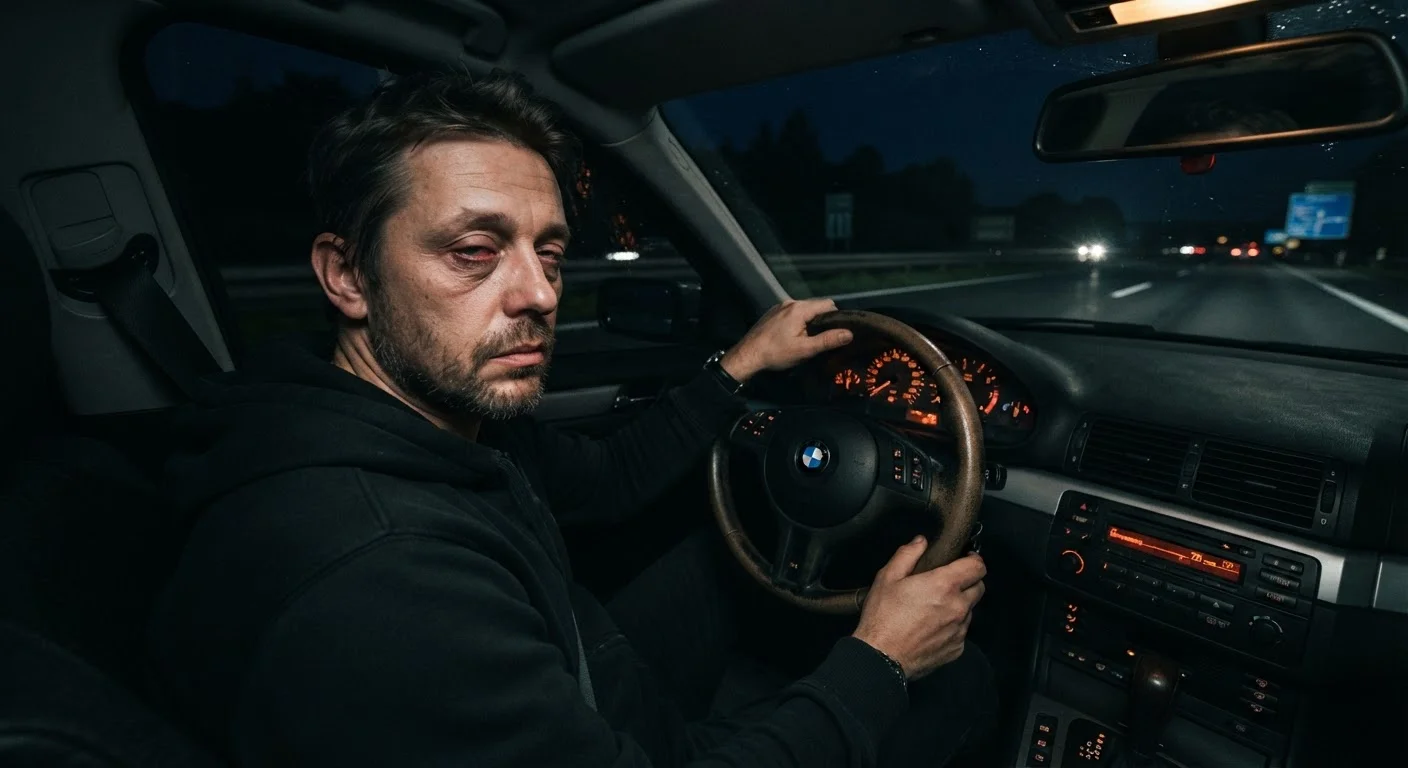
Why Fatigue Behind the Wheel Is Underestimated
Most drivers readily accept that drunk driving is dangerous. Far fewer take drowsy driving as seriously - even though fatigue produces measurable impairment across the same cognitive functions that safe driving depends on: reaction time, hazard detection, lane-keeping, and judgment. The AAA Foundation for Traffic Safety has estimated that drowsy driving is a factor in roughly 9.5% of all crashes, a figure researchers believe is significantly undercounted because there is no roadside test for fatigue the way there is for alcohol.
The core problem is perception. When you're fatigued, your brain's ability to accurately assess its own performance degrades. Drivers who are dangerously tired often report feeling "fine" or only slightly tired - right up until a microsleep occurs. A microsleep is an involuntary lapse in consciousness lasting between one and five seconds. At highway speeds, one second of unconsciousness means your vehicle travels approximately 88 feet without any input from you. At five seconds, that's nearly half the length of a football field.
Normalized driving habits - including the habit of pushing through fatigue on long trips - are among the underappreciated contributors to preventable crashes.
~9.5%
Of all crashes involving drowsy driving
According to the AAA Foundation for Traffic Safety, which notes this figure is likely an undercount due to the difficulty of detecting fatigue at crash scenes.
88 ft
Distance covered in one second at highway speed
At 60 mph, a one-second microsleep means approximately 88 feet traveled with no driver input - the length of a large semi-truck.
17-18 hrs
Wakefulness linked to notable impairment
Sleep research indicates that staying awake 17-18 hours can produce cognitive performance declines comparable to a blood alcohol concentration around 0.05%.
1-5 sec
Duration of a typical microsleep episode
Microsleeps are involuntary and occur without driver awareness, making them especially dangerous at highway speeds.
The Science of Sleep Deprivation and Driving Performance
Human alertness is governed by two biological systems: the circadian rhythm, which cycles roughly every 24 hours and promotes sleep at predictable times, and sleep pressure, which accumulates the longer you remain awake. When these two forces align - such as during nighttime hours after a long day - impairment can be severe even in people who don't feel dramatically tired.
Studies published in peer-reviewed sleep research journals have consistently demonstrated that sustained wakefulness degrades reaction time in a dose-dependent manner. After 17-18 hours without sleep, performance on tasks requiring sustained attention declines to levels associated with moderate alcohol impairment. After 24 hours, performance may approach levels seen with higher blood alcohol concentrations, though the exact equivalencies vary by individual and study methodology.
Drowsy driving is particularly dangerous because fatigued drivers often fail to brake before impact - meaning crashes tend to be high-speed collisions rather than lower-speed incidents where some braking occurred. This partly explains why drowsy driving crashes carry a disproportionately high rate of fatalities relative to other crash types. For context on how reaction time interacts with crash severity more broadly, see our coverage of how speed multiplies crash severity.
Recognizing the Warning Signs Before It's Too Late
Because drowsiness impairs self-monitoring, drivers need to act on early, objective warning signs rather than waiting until they feel severely impaired. Recognizable indicators include:
- Frequent, uncontrolled yawning - the body's attempt to boost oxygen intake when arousal is dropping
- Heavy eyelids or difficulty focusing - vision begins to blur or eyes close briefly
- Lane drifting - unintentional movement toward lane lines or rumble strips
- Missing exits or road signs - inattentional blindness increases sharply with fatigue
- Inability to recall the last few miles driven - a strong indicator that microsleeps have already occurred
Acting on any one of these signs is not an overreaction - it is appropriate risk management. Drowsy driving impairs judgment in ways that mirror other forms of distraction. Our explainer on cognitive distraction and driving covers related mechanisms affecting attention behind the wheel.
Act on Early Warning Signs - Don't Wait
If you notice lane drifting, can't recall recent miles, or find yourself yawning repeatedly, treat it as a serious warning rather than something to push through. Pull off at the next safe exit, rest stop, or parking area. Telling yourself you'll stop "in just a few more miles" is a rationalization that fatigued judgment produces - and it is exactly when crashes happen.
Who Is Most at Risk and When
Drowsy driving risk is not evenly distributed. Certain groups face substantially elevated exposure:
- Shift workers, whose sleep schedules conflict with natural circadian rhythms
- Commercial drivers operating long routes, despite Hours of Service regulations designed to limit fatigue
- Young drivers, particularly males aged 16-25, who are overrepresented in drowsy driving crash statistics
- People with untreated sleep disorders such as obstructive sleep apnea, which fragments sleep quality even when total hours appear adequate
- Adults consistently sleeping fewer than seven hours per night, a level of sleep restriction the CDC considers common in the U.S.
Timing also matters significantly. Crashes linked to drowsy driving cluster heavily between midnight and 6 a.m. - when circadian pressure to sleep peaks. A secondary danger window occurs between roughly 2 p.m. and 4 p.m., coinciding with a natural post-lunch dip in alertness that exists independent of meal size. Night driving compounds all of these risks; the reduced visibility and altered perception covered in our guide on night driving hazards makes fatigue even more consequential after dark.
A nurse finishes a 12-hour overnight shift and drives home on a familiar highway route in the early morning hours.
A college student drives several hours home for a holiday weekend, departing after a late-night exam and stopping only for gas.
A parent notices they have no memory of the last ten minutes of their commute home from work on a Wednesday afternoon.
What Actually Helps - and What Doesn't
A number of widely used countermeasures provide less protection than drivers assume. Turning up the radio, opening a window, or splashing cold water on your face are not supported by research as reliable methods of restoring safe driving alertness. They may interrupt a drowsy moment but do not reverse the underlying physiological impairment.
Caffeine - typically consuming the equivalent of two cups of coffee - can temporarily reduce subjective sleepiness and may modestly improve alertness for a short period. It is most useful as a brief bridge, not a solution: effects generally peak within 30-60 minutes and are less effective in people with chronic sleep debt or those who are severely fatigued.
The only evidence-based countermeasure is stopping and resting. Pulling into a safe, well-lit location and taking a 20-minute nap before caffeine takes effect - sometimes called a "nap-a-caffeine" approach in sleep research literature - has shown benefits in small studies. Longer-term, the most effective protection is prioritizing adequate sleep - generally seven or more hours for most adults - before anticipated driving demands. Impaired driving of any kind carries serious safety and legal consequences; for a broader view of how different impairment types compare, see our article on how alcohol, cannabis, and prescription drugs each affect driving.
Frequently Asked Questions
Research suggests that severe sleep deprivation can produce impairment levels comparable to legally drunk driving in terms of reaction time and decision-making. The AAA Foundation for Traffic Safety and academic researchers have drawn these parallels. However, the two types of impairment have different profiles - drowsy drivers often fall asleep entirely, while drunk drivers remain awake but impaired.
Key warning signs include frequent yawning or blinking, difficulty keeping eyes open, drifting out of your lane, missing exits or traffic signs, and having no memory of the last few miles. If you experience any of these, you should pull over safely as soon as possible.
Caffeine can temporarily increase alertness and may help bridge a short gap, but its effects are limited and unreliable - especially in severely sleep-deprived individuals. It is not a substitute for actual sleep. The only reliable solution is to stop driving and rest.
Shift workers, commercial truck drivers, young drivers (especially males aged 16-25), people with untreated sleep disorders like sleep apnea, and anyone sleeping fewer than seven hours per night face higher risk. Long-distance drivers on monotonous highways are also particularly vulnerable.
Often, no. One of the most dangerous aspects of drowsiness is that it impairs self-awareness. Studies show that people frequently underestimate how impaired they are, and microsleep episodes - brief unconscious lapses - occur without the driver noticing them in the moment.
Drowsy driving crashes cluster most heavily between midnight and 6 a.m., when circadian rhythms push the body toward sleep. A secondary peak occurs in the mid-afternoon, roughly between 2 p.m. and 4 p.m., linked to natural dips in alertness that occur regardless of how much sleep a person got the previous night.
The content on this site is for informational purposes only and is not a substitute for professional advice. Always consult a qualified professional for guidance specific to your situation.