

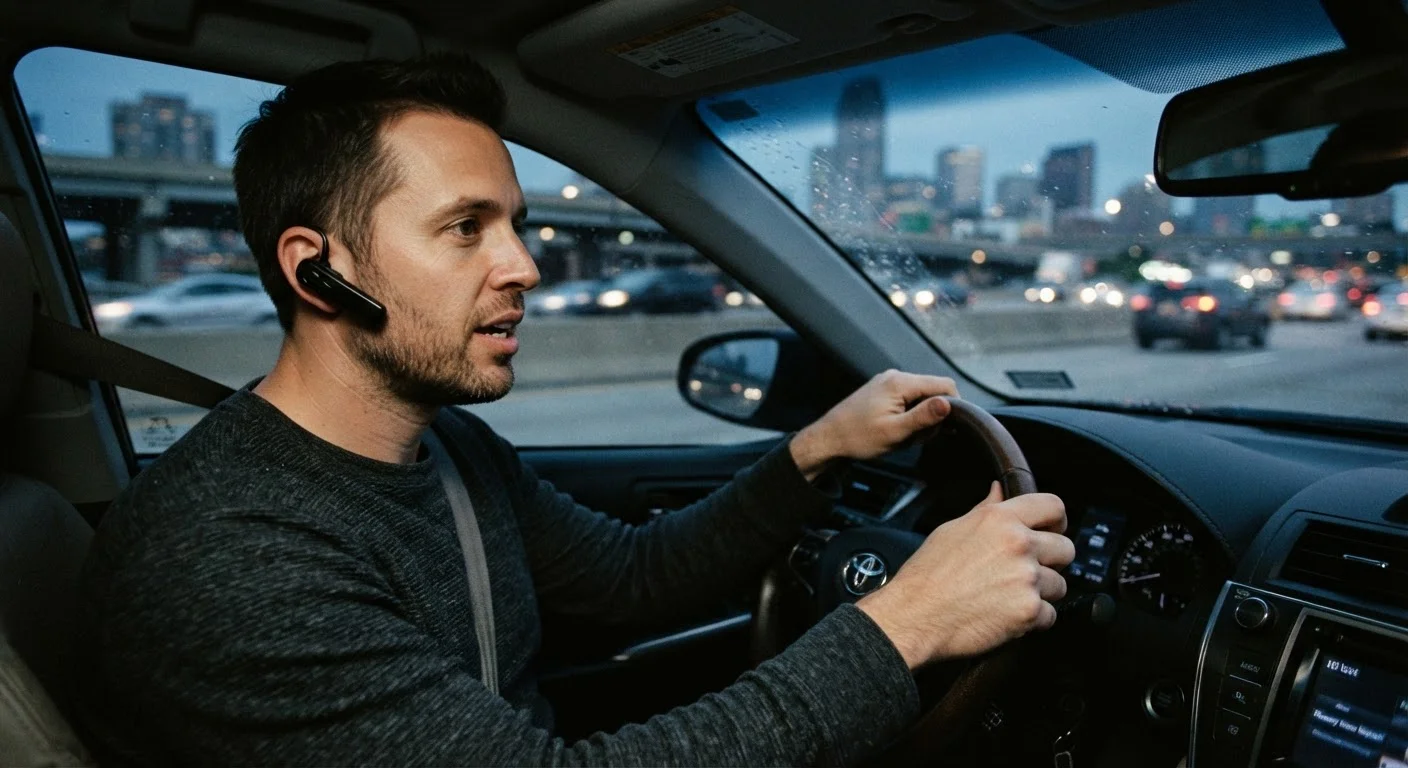
Why the Hands-Free Assumption Falls Short
Most American drivers have accepted a simple mental shortcut: if both hands are on the wheel and eyes are on the road, a phone call is safe. Legislators reinforced this idea by banning handheld phone use while allowing hands-free alternatives. But the underlying science tells a more complicated story - one with real consequences every time you merge onto a freeway mid-conversation.
Driving is not a single task. It is a continuous stream of visual scanning, speed management, gap judgment, and split-second decision-making. When a phone conversation occupies working memory, the cognitive resources available for that stream are reduced - regardless of whether the phone is in your hand. Researchers refer to this as inattention blindness: your eyes point forward, but the brain processes less of what they see.
This article walks through the most persistent myths about distracted driving, corrects them with current evidence, and offers practical perspective on managing risk behind the wheel. For a look at another underappreciated hazard, see our coverage of drowsy driving and impaired reaction time.
Myth
As long as both hands are on the wheel, a phone call won't affect my driving.
Fact
Manual distraction is only one of three distraction types. Cognitive distraction - the mental engagement of a conversation - impairs driving even with hands on the wheel.
Traffic safety researchers classify distraction in three categories: visual (eyes off road), manual (hands off wheel), and cognitive (mind off driving). Hands-free calling eliminates the first two but preserves the third in full. Studies show that cognitively distracted drivers scan the road less systematically, miss peripheral events, and react more slowly to sudden hazards - all without ever glancing at a screen.
Myth
Talking on the phone while driving is no different from having a conversation with a passenger.
Fact
Passenger conversations are meaningfully safer because passengers naturally pause, monitor road conditions, and adjust the conversation when driving demands increase.
A passenger shares the driving environment. They instinctively go quiet in heavy traffic, alert the driver to hazards, and read body language that signals stress. A caller on the phone has none of this context - they continue speaking through a school zone, a merge, or an emergency stop, keeping the driver's working memory engaged at the worst moment. Research consistently finds higher crash-risk association with phone calls than with equivalent in-vehicle conversations.
Myth
Voice commands and dictation are safe because I'm not looking at my phone.
Fact
Composing messages or issuing complex voice commands generates high cognitive demand that persists for several seconds after the task ends.
The AAA Foundation for Traffic Safety evaluated multiple production voice systems and found that tasks like composing a text message by voice produced mental workload ratings in the "high" to "very high" range. More critically, the cognitive demand does not end the moment the driver stops speaking - a residual distraction window of up to 27 seconds was observed in some studies, during which attentiveness remained measurably reduced. At 65 mph, that window represents nearly half a mile traveled with degraded awareness.
Myth
Experienced drivers can multitask better behind the wheel because they've automated most driving skills.
Fact
Automation of routine driving does not free up enough cognitive capacity to safely conduct a phone conversation, especially in variable or complex traffic.
While experienced drivers do execute familiar maneuvers with less conscious effort, driving in real traffic constantly surfaces non-routine events - a child stepping into the road, a car braking suddenly, a light changing unexpectedly. These events require full attentional resources. A phone conversation occupies exactly the working memory capacity needed to respond quickly to unpredictable situations. Experience reduces some baseline cognitive load but does not create spare capacity sufficient for sustained conversation.
Myth
If distracted driving were truly dangerous, crash rates would be far higher given how many people do it.
Fact
Distracted driving does contribute to tens of thousands of crashes annually; many incidents go underreported because distraction is difficult to confirm after a crash.
The NHTSA reports thousands of distraction-related fatalities each year, and safety researchers consider that figure an undercount because post-crash investigations rely on phone records, witness accounts, and driver self-reporting - all imperfect. Near-miss events and minor crashes involving distraction are largely invisible in official data. The relatively low probability of a crash on any given trip can create a false sense of safety that compounds over time as the behavior is reinforced without consequence.
What the Research Actually Shows
Studies conducted by the University of Utah and replicated by the AAA Foundation for Traffic Safety found that hands-free callers showed significantly slower reaction times, more missed signals, and reduced awareness of surrounding vehicles compared to undistracted drivers. Some trials found hands-free performance comparable to driving at or above the legal blood alcohol limit of 0.08%.
4x
Increased crash risk while using a phone while driving
The National Safety Council cites research indicating drivers using a phone are approximately four times more likely to be involved in a crash than undistracted drivers.
27 sec
Residual distraction window after a voice task
AAA Foundation for Traffic Safety research found cognitive distraction can persist up to 27 seconds after completing a voice-command task in some vehicle systems.
~3,500
Distraction-related traffic fatalities per year (US)
NHTSA data consistently attributes roughly 3,000-3,500 annual US traffic fatalities to distracted driving, though researchers regard this as an underestimate.
Voice-activated infotainment systems - marketed as a safer alternative - introduce their own cognitive load. Research from the AAA Foundation rated several in-vehicle voice systems as generating "high" or "very high" mental demand, particularly when composing text messages by voice. The task duration and mental engagement can extend for several seconds after the driver stops speaking, a period researchers call the residual distraction window.
It is also worth noting that distracted driving is not limited to phones. Eating, adjusting controls, animated conversations with passengers, and emotional stress all divert cognitive resources. Normalizing one form of distraction tends to lower a driver's overall vigilance - a pattern explored further in our guide to driving habits that feel safe but quietly raise your risk.
No Call Is Worth the Risk
If a call cannot wait, the safest action is to pull over safely and stop before answering or dialing. Silencing notifications and enabling do-not-disturb driving modes before setting off removes the temptation entirely. Even brief cognitive engagement with an incoming notification has been shown to disrupt driving performance for several seconds.
The content on this site is for informational purposes only and is not a substitute for professional advice. Always consult a qualified professional for guidance specific to your situation.