

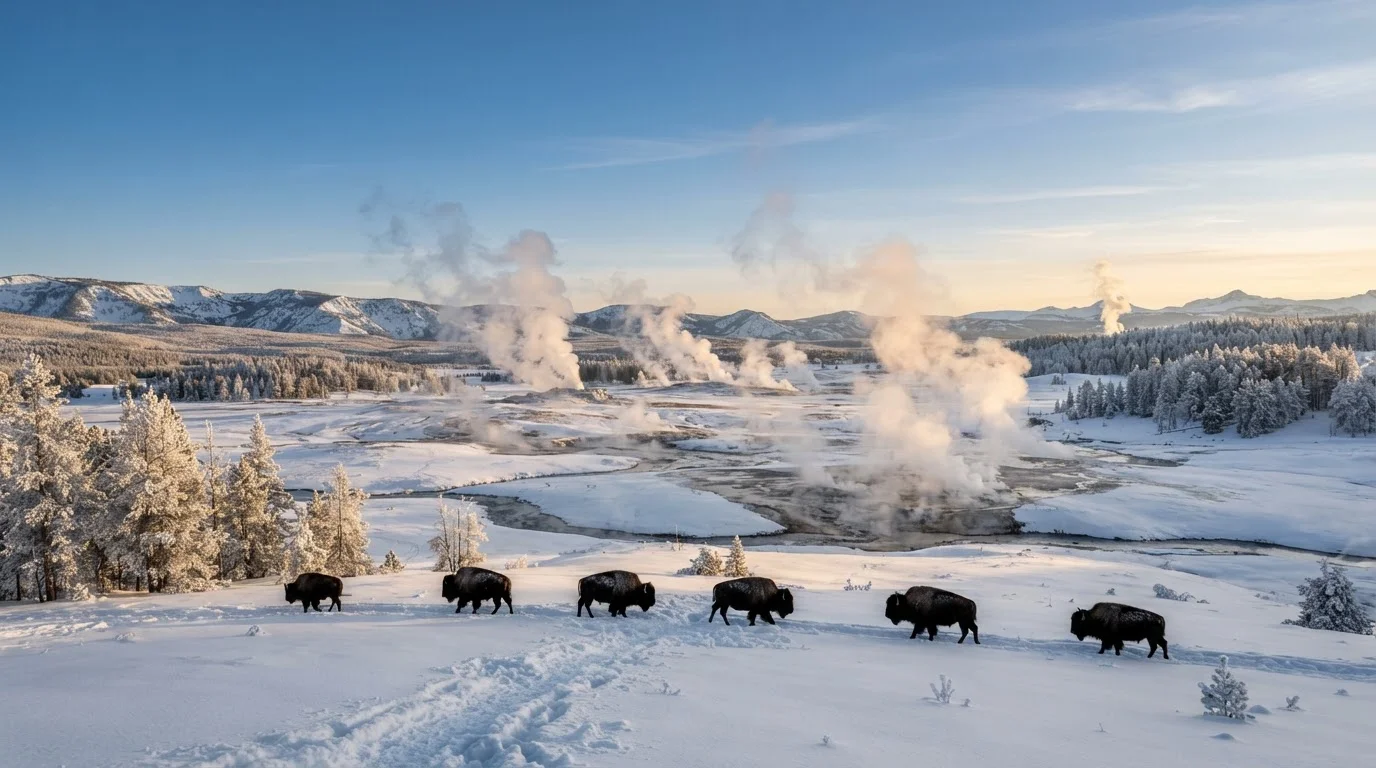
What Winter Actually Does to Yellowstone
Imagine Old Faithful erupting against a steel-gray sky, the superheated column dissolving into a cloud that hangs frozen in air that's barely 10 degrees. The surrounding boardwalk? Empty except for a handful of bundled visitors staring up in genuine disbelief. That's the version of Yellowstone most Americans never see - and it's arguably the better one.
Summer draws upwards of four million visitors annually to Yellowstone. Winter brings that number down to a comparative whisper. The park's thermal features - geysers, hot springs, mud pots, fumaroles - don't change with the seasons, but they look entirely different when surrounded by ice and snow. Steam that's barely visible on a warm July afternoon becomes dense, theatrical, almost surreal in subzero cold. Grand Prismatic Spring's vivid blue and orange rings pop against white snowfields with a clarity that photographs can barely capture.
The sensory experience of winter Yellowstone is hard to overstate. The silence is profound. The smell of sulfur drifts across pristine snowscapes. And with the summer RVs gone, there's space to actually think and absorb what you're looking at.
4M+
Annual summer visitors to Yellowstone
According to National Park Service data, Yellowstone typically receives over four million visitors during peak summer months combined.
~150K
Estimated winter season visitors
NPS visitation reports consistently show winter months attract a small fraction of annual totals, dramatically reducing crowds throughout the park.
10,000+
Hydrothermal features in Yellowstone
Yellowstone hosts roughly half of all the world's hydrothermal features, all of which remain active and visually striking throughout winter.
Wildlife in Winter: A Different Kind of Viewing
Winter concentrates Yellowstone's wildlife in predictable ways that work in a visitor's favor. Bison - the park's iconic megafauna - gravitate toward geothermal areas where the ground stays warm enough to forage. Spotting a herd of several hundred bison moving in slow, steam-exhaling procession across a white meadow is a moment that sticks with people for decades.
The Lamar Valley in the park's northeast corner becomes especially compelling. Often called "America's Serengeti," it's a prime corridor for wolves - reintroduced to Yellowstone in 1995 - as well as elk, pronghorn, and coyotes. Winter's bare sightlines make spotting these animals considerably easier than dense summer vegetation allows. Many serious wildlife watchers specifically schedule winter trips for this reason.
Bring Binoculars - Seriously
Wildlife spotting in winter Yellowstone rewards preparation. A quality pair of binoculars (or a spotting scope if you're serious about wolves) dramatically improves your experience in the Lamar Valley and Hayden Valley. Many experienced visitors consider them as essential as warm boots for a winter trip.
Compared to more crowded domestic parks year-round, the contrast is stark. If you've visited America's most-visited national park, you already know how crowds can dilute a wildlife encounter. Yellowstone in January operates in an entirely different register.
Getting Around: Snow Coaches, Snowmobiles, and Skis
Access is the biggest practical shift for winter visitors. With the exception of the road between Gardiner and Cooke City, interior roads close to private vehicles in November and don't reopen until spring. Getting deeper into the park means booking a guided snow coach - enclosed vehicles on tracks that traverse groomed routes - or joining a guided snowmobile tour. Both options depart from gateway towns, primarily West Yellowstone and Gardiner.
For those who want a more active experience, cross-country skiing and snowshoeing are permitted on unplowed roads and trails. The park offers ranger-led snowshoe walks on some days, which provide context and expertise that independent exploration can't match. Verify current program availability directly with the National Park Service before your trip, as schedules shift seasonally.
This constraint - the inability to simply drive wherever you want - is actually part of what makes the experience feel so different. You're not checking off a list of pullouts from a car window. You're moving through the landscape more deliberately, which suits a place this wild. State parks with similar solitude can scratch a similar itch closer to home, but nothing quite replicates Yellowstone's scale in winter.
Planning Essentials: What You Actually Need to Know
Preparation for a winter Yellowstone trip is non-negotiable. Temperatures can plunge well below -20°F overnight, and wind chill pushes conditions colder still. Layering systems - moisture-wicking base layers, insulating mid-layers, and a waterproof outer shell - are standard-issue. Hand warmers, insulated boots rated for extreme cold, and balaclava-style face coverage aren't luxuries here.
Lodging inside the park during winter is limited to two properties: Old Faithful Snow Lodge and Mammoth Hot Springs Hotel. Both are well-regarded and genuinely atmospheric, but they fill up fast - sometimes months in advance. Gateway towns including Gardiner, Cooke City, and West Yellowstone offer motels and rental cabins at various price points if inside-park stays aren't available.
Always check road and weather conditions through official NPS channels before and during your trip. Entry requirements, road closures, and guided tour availability can shift with weather. Given the remote, cold environment, verifying current conditions directly with park authorities before departure is essential - not optional.
The payoff for doing the logistical homework? A version of one of America's greatest natural wonders that feels genuinely earned - and genuinely unforgettable.
Frequently Asked Questions
Yes, Yellowstone is open year-round. However, most interior roads close to standard vehicles from early November through late April. Visitors access the park's interior via guided snow coaches, snowmobile tours, or on skis and snowshoes during this period.
Mid-January through February is considered the heart of winter season. Snow is typically deep and reliable, wildlife is active along thermal corridors, and park services are running. Late December and early March offer slightly milder conditions but similar scenery.
Temperatures in Yellowstone can drop to -20°F or colder overnight, with daytime highs often remaining below 20°F. Wind chill can make it feel significantly colder. Proper insulated layering, waterproof outerwear, and hand and foot warmers are strongly advised.
Private vehicles can only drive the road between the North and Northeast entrances year-round. All other interior roads are closed to cars and groomed for over-snow travel. Guided snow coach tours depart from gateway towns like West Yellowstone and Gardiner.
Many experienced wildlife watchers prefer winter precisely because animals concentrate near thermal areas and are more visible against the snow. Wolves, bison, elk, and coyotes are commonly spotted. The Lamar Valley remains a particularly productive corridor.
Old Faithful Snow Lodge and Mammoth Hot Springs Hotel are the two lodging options open inside the park during winter. Both fill up quickly, so reservations well in advance are strongly recommended. Gateway towns like Gardiner and West Yellowstone offer additional options.
The content on this site is for informational purposes only and is not a substitute for professional advice. Always consult a qualified professional for guidance specific to your situation.