

Why One Bag Changes the Whole Trip
Multi-city domestic travel is one of the most rewarding ways to experience the US - but dragging a checked bag through three airports, three hotels, and three sets of rideshares adds real friction to the adventure. Living out of a carry-on removes that friction almost entirely.
Beyond the obvious perk of skipping baggage claim, a single carry-on forces a kind of disciplined simplicity that actually makes travel more enjoyable. When every item in your bag earns its place, you spend less time managing your stuff and more time exploring. If you're still deciding whether a carry-on is the right call for your trip length and airline, weighing the carry-on vs. checked bag trade-offs is a useful place to start.
For multi-stop US itineraries specifically, the case for carry-on travel is particularly strong. Domestic flights are shorter, laundry access is easy, and most US cities have everything you might need if you forget something. The strategy below works for trips covering 3-5 cities over 7-14 days.
What you will need
What to Pack (and What to Leave Behind)
The most common carry-on mistake isn't packing too much of one category - it's packing just in case items that never get used. A second pair of dress shoes, a fourth top, a full-size umbrella: these are the items that make bags too heavy without adding genuine value to the trip.
The principles of packing light come down to versatility over volume. Every item you pack should serve at least two purposes or pair with at least two other items. If it doesn't clear that bar, leave it behind.
Carry-on bag (hard or soft shell)
Primary luggage - must meet your airline's size restrictions for overhead bin storage.
Packing cubes (set of 3-4)
Compress and organize clothing by category, making retrieval easy at each stop.
Personal item bag (daypack or tote)
Holds in-flight essentials and doubles as your daily exploration bag at each destination.
Compression dry bags or packing pouches
Shrink bulky layers like a fleece or light jacket to reclaim space in your carry-on.
Refillable silicone toiletry bottles
Transfer your preferred products into TSA-compliant containers to avoid buying duplicates.
Laundry detergent sheets or pods
Allow mid-trip sink washing so you can re-wear clothes without needing more items.
Follow the steps below to build your bag systematically - starting with your destination research and ending with a bag that zips easily and stays manageable city to city.
Map your cities and their climate ranges
Before touching your bag, list every city on your itinerary and look up the expected temperature range and precipitation for your travel dates. A trip from Chicago to New Orleans to Denver in spring covers wildly different conditions. Knowing this upfront prevents both overpacking and being caught underprepared.
Group cities by temperature band - cool, mild, warm - and note if rain is likely. This exercise shapes every clothing decision that follows.
Build a neutral, layerable clothing core
Stick to a palette of two or three neutrals - navy, grey, olive, or black work well - so every item pairs with every other. Your core wardrobe for a 7-10 day trip should include:
- 3-4 tops (mix of short and long sleeve depending on climate data)
- 2 bottoms (one casual, one slightly dressier - trousers that double as smart-casual are ideal)
- 1 lightweight mid-layer (merino cardigan or thin fleece)
- 1 packable outer shell if rain or cold is expected
- 3-4 pairs of underwear and socks (merino wool dries quickly and resists odor)
- 1 pair of versatile shoes worn on travel days, plus 1 pair of lightweight sandals or alternate shoes if needed
Shoes consume the most space - wear the bulkiest pair on every flight day.
Handle toiletries and medications strategically
TSA's 3-1-1 rule limits liquids, gels, and aerosols to containers of 3.4 oz (100 ml) or less, all fitting in a single quart-sized clear bag. Transfer your products into refillable silicone bottles rather than buying travel sizes repeatedly.
Solid alternatives - shampoo bars, solid conditioner, bar soap - eliminate liquid concerns entirely and often last longer per use. For medications, keep them in original labeled packaging in your personal item for easy access during security screening.
Pack using a system, not a pile
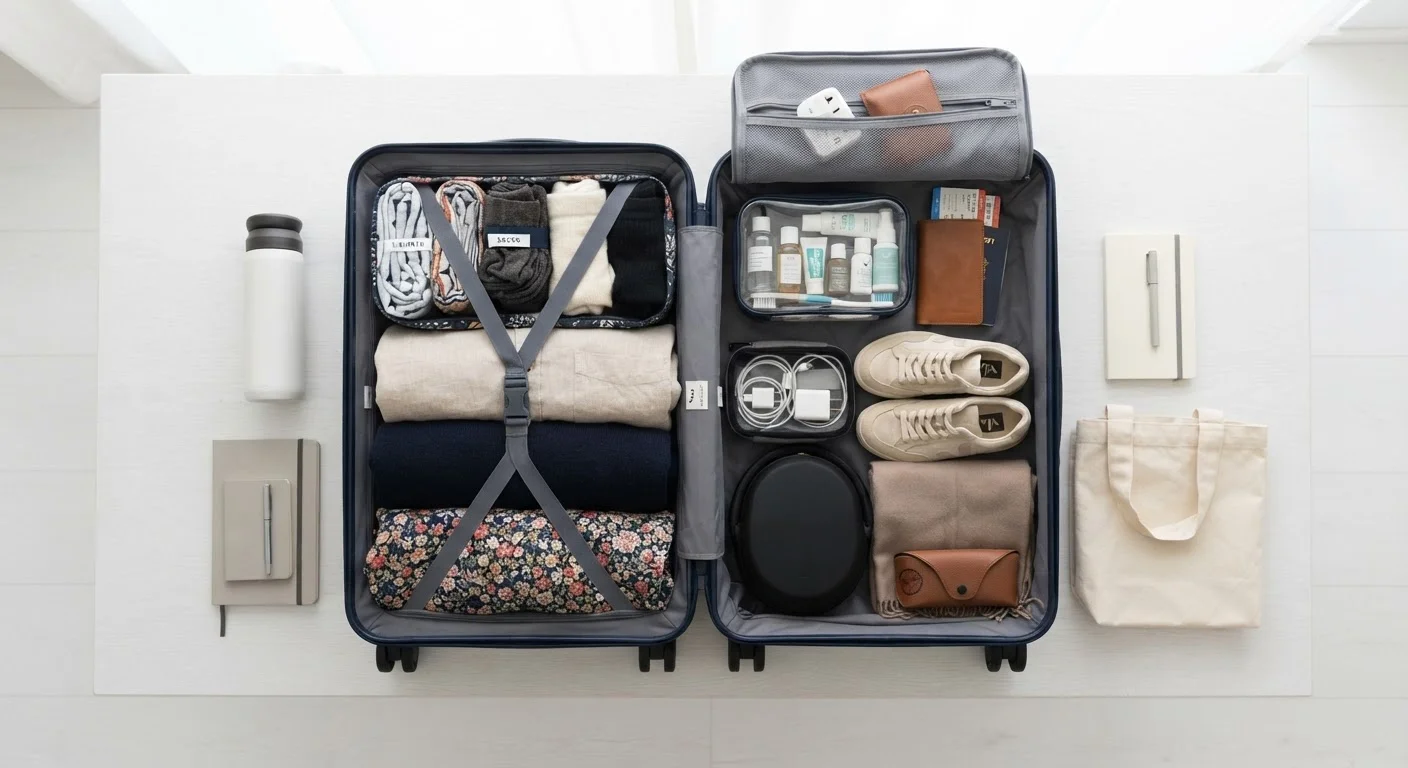
Use packing cubes to group items by category: one for tops, one for bottoms, one for underwear and socks. Roll clothing rather than folding flat - rolling reduces wrinkles and takes up less vertical space in a cube.
Place heavier items (shoes, toiletry bag) at the wheel end of the suitcase so weight distributes evenly when rolling. Your personal item should hold everything you need during the flight: charger, headphones, a layer, snacks, and any valuables.
Plan for laundry between cities
For trips longer than 5 days, plan at least one laundry session. Many hotels offer in-room sink washing or coin-operated laundry; urban laundromats are easy to find in most US cities and usually cost $5-$10 per load.
Laundry detergent sheets are compact, lightweight, and work in both machines and sink washing. Wash items after your second or third day in a city so they have time to dry before you pack up and move on.
Adapt your bag as you move between cities
At each stop, reassess what's working. If you haven't touched an item after two cities, consider shipping it home via a flat-rate USPS box rather than hauling it further. Conversely, if you need something you left behind - a rain shell in an unexpectedly wet city, for example - buy a reasonably priced version locally and consider it a travel investment.
Keeping your bag light enough to lift easily into an overhead bin also means faster boarding, faster deplaning, and zero checked-bag fees - real advantages when you're moving between cities every few days.
Making It Work Across Different US Climates
The US is enormous, and a domestic multi-city trip can span climates that feel nothing alike. A spring itinerary hitting Seattle, Austin, and New York in the same week means packing for cool drizzle, warm humidity, and unpredictable northeastern swings - all in one bag.
The layering system described in Step 2 is your primary tool for handling this. A base layer, mid-layer, and packable shell can be combined or shed depending on conditions, covering a range roughly from 40°F to 80°F without adding bag bulk. When temperatures genuinely diverge beyond that range, wear your heaviest layer on the flight day and pack lighter items.
Climate Gaps Wider Than Expected
If your itinerary spans destinations with a temperature difference greater than 40°F, a single layering system may not fully cover you. In that case, consider shipping a heavier item ahead to your coldest destination via a hotel hold, rather than compromising your carry-on space. Always verify current weather conditions closer to your departure date - historical averages don't guarantee what you'll encounter.
One underrated strategy: use your personal item as a climate buffer. A lightweight packable jacket lives in your daypack during warm city days and moves to your carry-on at night, so you're not digging through your main bag at every stop.
For more on making the most of each city once you've arrived light and ready, getting the most out of US city travel covers how to explore efficiently once you're on the ground.
The content on this site is for informational purposes only and is not a substitute for professional advice. Always consult a qualified professional for guidance specific to your situation.