

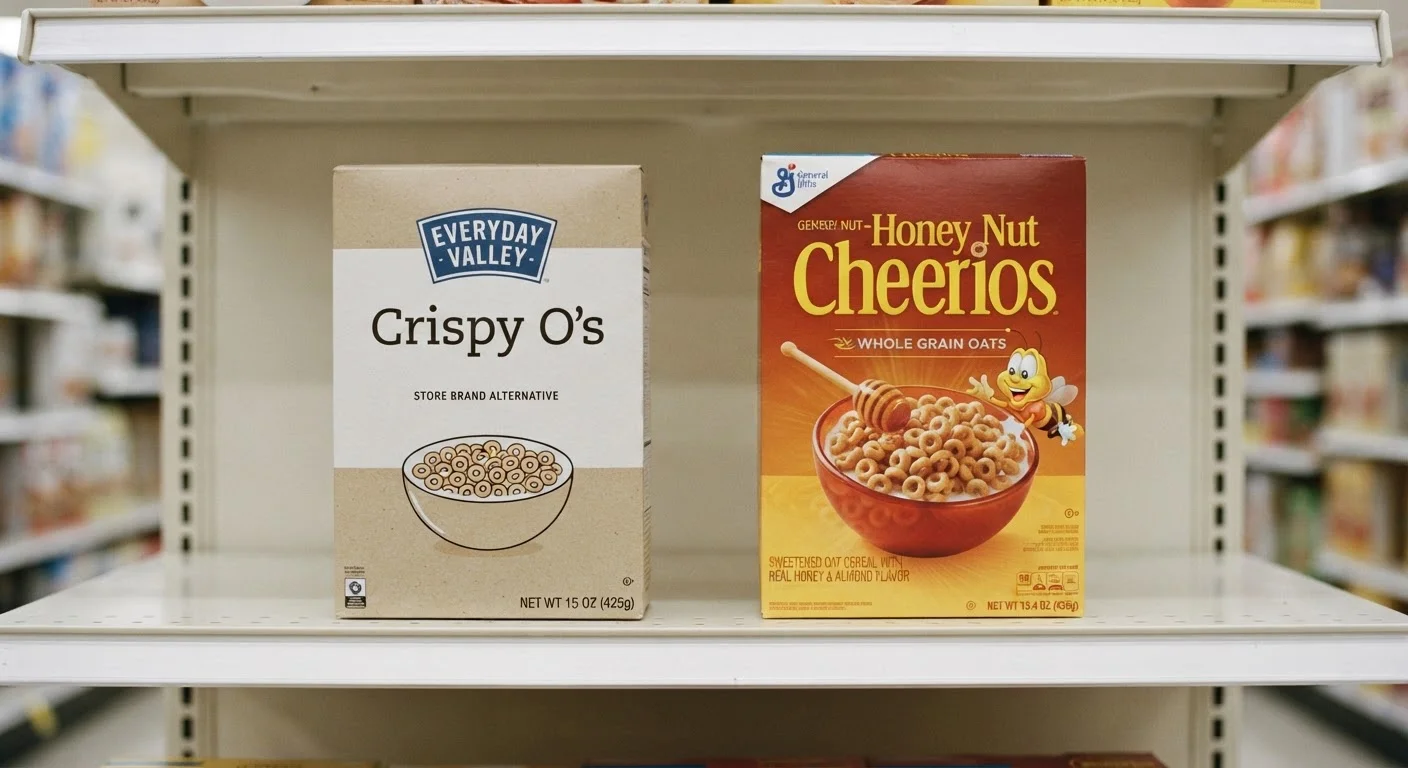
Why the Generic vs. Name-Brand Question Matters
Americans spend billions of dollars annually choosing name-brand products over store-brand alternatives. The assumption driving many of those decisions is straightforward: higher price signals better quality. But decades of consumer research, regulatory oversight, and independent product testing complicate that assumption considerably.
Understanding where real differences exist - and where they exist only in the mind - is one of the most practical skills a consumer can develop. This article applies that lens to the most common myths about generic and name-brand products, using evidence rather than marketing logic.
For a broader look at how price and quality relate more generally, see our analysis of price versus quality.
Common Myths - and What the Evidence Shows
The myths below represent the most persistent misconceptions consumers carry into purchasing decisions. Each one has a measurable, evidence-based correction.
Myth
Generic medications are weaker or less effective than their name-brand equivalents.
Fact
The U.S. Food and Drug Administration requires generic drugs to demonstrate bioequivalence - meaning they must deliver the same active ingredient at the same dosage and absorption rate as the brand-name version.
Bioequivalence standards are strict: a generic must perform within a narrow statistical range of the original's pharmacokinetic profile. The FDA's generic drug approval process is a regulatory requirement, not a voluntary guideline. Differences in inactive ingredients (fillers, dyes, coatings) can occasionally affect tolerability for some individuals, but the therapeutic effect of the active ingredient is required by law to be equivalent. For most people, in most situations, a generic medication delivers the same clinical outcome at a fraction of the cost.
Myth
Store-brand food products are made in inferior facilities with lower-quality ingredients.
Fact
Many store-brand food products are manufactured in the same facilities as name-brand equivalents - sometimes on the same production line, with the same ingredients, simply packaged differently.
Co-manufacturing is a standard, widespread practice in the food industry. Large manufacturers often produce private-label versions of their products for retailers as a separate revenue stream. While this isn't universal - some categories involve distinct suppliers - it means that assuming a store-brand item comes from a lesser source is frequently incorrect. When the underlying specifications are identical, the only meaningful difference is the label. Independent consumer organizations have repeatedly confirmed product-level equivalence across many pantry staples, dairy products, and packaged goods through blind testing.
Myth
Consumers can reliably taste or detect the difference between generic and name-brand food products.
Fact
Controlled blind taste tests consistently show that consumers perform close to chance when asked to distinguish between generic and name-brand equivalents in many food categories.
When brand cues - logos, packaging colors, price tags - are removed, preference patterns shift significantly or disappear entirely in numerous food categories, including canned goods, bottled water, frozen vegetables, and basic condiments. This phenomenon is well-documented in consumer behavior research. What people often report as a taste difference is partly a label effect: the expectation of quality created by familiar branding influences perceived experience. This doesn't mean every product tastes identical, but it does mean that subjective preference is an unreliable guide to actual ingredient or production differences.
Myth
Name-brand products always undergo more rigorous quality control than generics.
Fact
Quality control standards are largely determined by regulatory frameworks and industry certifications, not by whether a product carries a national brand name.
In regulated industries - pharmaceuticals, packaged foods, personal care products - both name-brand and generic manufacturers are subject to the same regulatory oversight. The FDA, USDA, and other agencies inspect facilities and enforce standards regardless of brand status. In unregulated or lightly regulated categories, quality control can vary widely among all manufacturers, branded or otherwise. Brand recognition is not a reliable proxy for quality assurance rigor. Checking for third-party certifications and reviewing independent testing results - rather than assuming a brand name guarantees a standard - is a more reliable approach. See why independent testing matters for more context.
Myth
Paying more for a name brand is always worth it because you're getting something extra.
Fact
Much of the name-brand price premium funds advertising, packaging design, and retail positioning - not product development or superior materials.
Brand marketing costs are real expenditures that get built into product pricing. A significant portion of what consumers pay for in a name-brand product is the recognition value of the brand itself - its familiarity, its advertising reach, and the psychological comfort it provides. That's a legitimate commercial reality, but it's distinct from paying for better ingredients, tighter tolerances, or more durable construction. When evaluated against independent benchmarks rather than brand identity, many premium-priced name-brand products offer no measurable performance advantage. Consumers who understand this are better positioned to allocate spending where differences are genuine. Understanding how to separate brand perception from actual build quality is a useful complement to this analysis.
Where Real Differences Can Exist
Acknowledging that many generic products match name-brand performance doesn't mean every difference is imaginary. In categories where brands invest heavily in proprietary research, engineering tolerances, or unique formulations - such as high-performance electronics, specialty power tools, or patented pharmaceutical compounds still under exclusivity - meaningful quality gaps can exist.
The distinction worth drawing is between differences rooted in product engineering and differences rooted in marketing investment. The former may justify a price premium; the latter does not. Learning to tell them apart requires looking past packaging and advertising to independent test data. Understanding why manufacturer claims and third-party results often diverge is an essential part of that process.
Don't Conflate 'Regulated' with 'Unregulated' Categories
The strength of the generic equivalence argument varies significantly by product category. It is most robust in heavily regulated spaces like pharmaceuticals, where bioequivalence is legally required. In lightly regulated categories - certain supplements, electronics accessories, or off-brand tools - there is less independent verification of claims, and quality variability can be genuine. Apply proportionate skepticism based on the regulatory environment of the product you're evaluating.
Similarly, brand perception is a real psychological phenomenon - but recognizing it doesn't mean brands are inherently dishonest. Separating genuine build quality from brand reputation gives you a practical framework for doing exactly that.
Making Better Decisions at the Point of Purchase
The most useful takeaway from the research isn't "always buy generic" - it's to make category-specific, evidence-informed decisions rather than defaulting to either extreme. For regulated categories like OTC medications, where the FDA mandates bioequivalence, the generic case is strong. For commodity pantry items, blind taste tests frequently show no preference. For complex products with proprietary features, scrutiny of independent benchmarks is warranted.
~30%
Average generic drug discount vs. brand-name
The FDA has reported that generic drugs typically cost 80-85% less than their brand-name counterparts, though savings vary widely by drug and market.
~40%
Typical store-brand grocery savings
Consumer research has consistently found that private-label grocery products are priced roughly 20-40% below comparable national brands in most categories.
When evaluating any product, probe beyond the label. Marketing language like "premium" and "advanced" carries no standard definition - knowing that protects you from paying for words rather than substance. And when price is genuinely low, it's worth asking whether "affordable" and "cheap" are being conflated. The distinction matters more than most shoppers realize.
The content on this site is for informational purposes only and is not a substitute for professional advice. Always consult a qualified professional for guidance specific to your situation.