

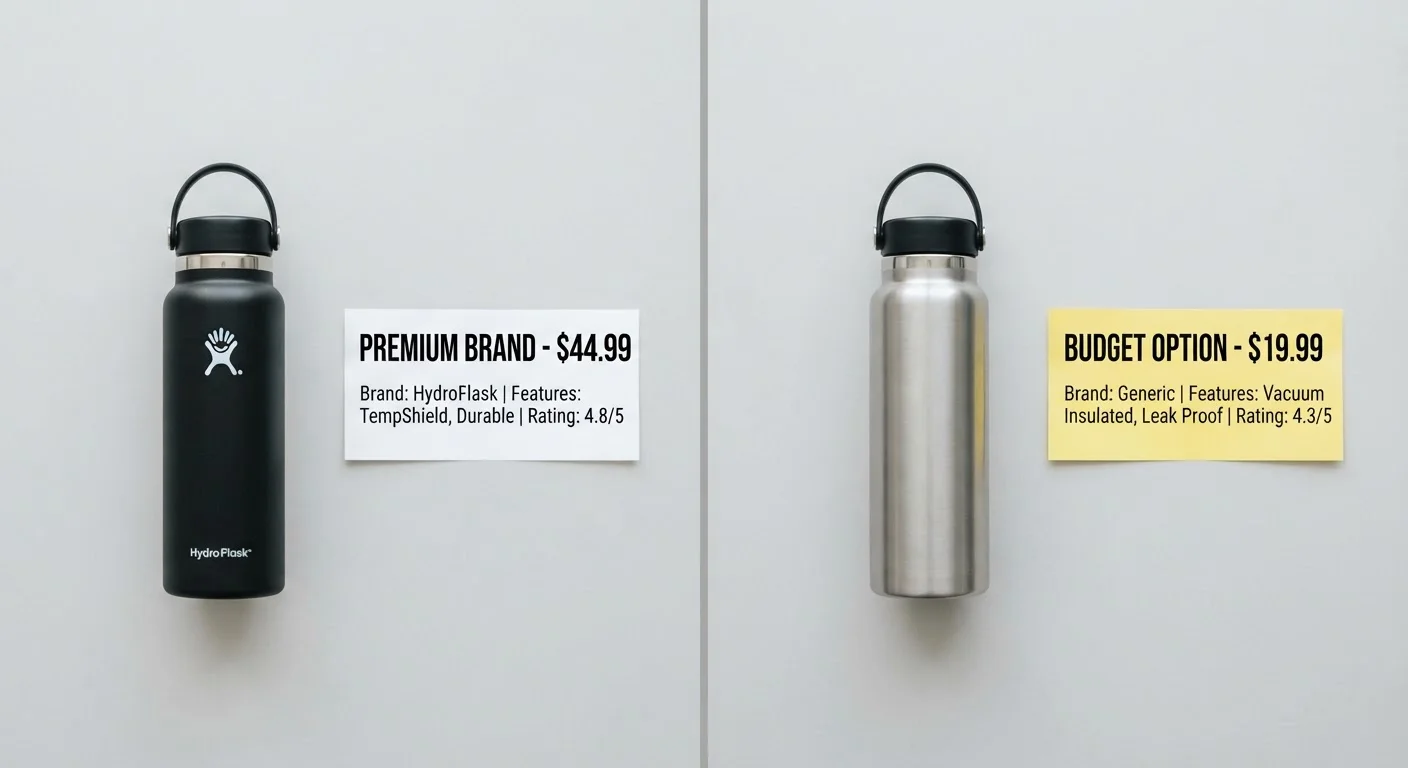
The Psychology Behind the Price-Quality Assumption
The idea that you get what you pay for is deeply embedded in consumer culture. It's intuitive, it's widely repeated, and - in some contexts - it contains a grain of truth. But taken as a universal rule, it leads shoppers to make predictably poor decisions.
Behavioral economists have documented a well-replicated effect: when people are told a product costs more, they often report higher satisfaction with it, even when the product is physically identical to a cheaper alternative. This isn't irrational in isolation - price sometimes does track real quality differences - but the relationship is far weaker and less consistent than most shoppers assume.
The problem is compounded by how pricing actually gets set. A product's retail price reflects manufacturing costs, yes, but also brand investment, distribution markups, retail margins, advertising spend, and market positioning strategy. None of these factors have a direct bearing on whether the product will perform well or last long.
Price Is a Signal, Not a Guarantee
No price point reliably guarantees quality. Premium pricing can reflect genuine craftsmanship, but it can equally reflect advertising budgets, retail markups, or brand positioning. Always cross-check price with verifiable quality indicators before committing to a purchase.
Understanding that price is a market signal - not a quality certificate - is the foundation of smarter consumer decision-making. It doesn't mean always buying the cheapest option, but it does mean verifying before assuming.
Common Mistakes That Inflate What You Pay Without Improving What You Get
Treating price as the primary quality signal when evaluating a purchase.
Why it happens: Price is the most immediately visible piece of information, and decades of marketing have reinforced the idea that cost correlates with quality. It feels like a reliable shortcut.
Assuming generic or store-brand products are inferior without checking the evidence.
Why it happens: Brand familiarity creates a powerful halo effect. Consumers associate the established name with trustworthiness, even when the underlying product is functionally identical.
Confusing brand perception with build quality or product performance.
Why it happens: Heavy advertising investment creates strong mental associations between a logo and reliability, even when those associations aren't backed by independently verified quality differences.
Ignoring total cost of ownership and focusing only on the sticker price.
Why it happens: Upfront cost is concrete and immediate; ongoing costs - maintenance, consumables, energy use, eventual replacement - are abstract and easy to underestimate at the point of purchase.
Equating a higher price with a safer or more ethical supply chain.
Why it happens: Consumers reasonably assume premium brands invest more in responsible sourcing, but pricing structures rarely reflect supply chain ethics in any transparent or standardized way.
Across almost every product category, these errors cost consumers real money without delivering corresponding value. The antidote isn't cynicism - it's a structured approach to evaluation. And it's worth noting that sometimes higher prices are justified: spending more upfront can cost less over time when durability or efficiency genuinely differs.
Equally, it helps to understand the distinction between genuinely affordable products and merely cheap ones. Cheap and affordable are not the same thing - a low price can signal poor value just as easily as a high price can signal inflated marketing.
Prestige Pricing Can Exploit Cognitive Bias
Some manufacturers deliberately raise prices to trigger quality associations in consumers' minds - a strategy known as prestige pricing. Recognizing this tactic helps you separate perceived value from real value. If a product's higher price isn't backed by measurable differences in materials, performance, or warranty, the premium may exist mainly on paper.
How to Evaluate Quality Without Relying on Price
Developing a price-independent quality evaluation habit takes a little practice but pays dividends across every category of purchase.
- Use category-specific benchmarks. In electronics, look at independent lab test results. In apparel, examine fabric weight and construction. In food products, compare ingredient panels. Each category has its own reliable quality signals.
- Seek third-party verification. Certifications from recognized independent bodies carry more weight than manufacturer claims or price positioning. These vary by industry but are usually discoverable with a brief search.
- Read warranty and return terms carefully. A genuinely high-quality product is typically backed by a meaningful warranty. Short warranties or highly restrictive return policies on expensive items are worth noting.
- Consult independent reviews - not promotional ones. Look for sources with no financial relationship to the products they cover. Professional testing organizations and consumer advocacy publications tend to be the most reliable.
For car buyers specifically, the same principles apply: price and trim level don't always predict reliability or long-term satisfaction. The car buying guides on this site walk through how to evaluate vehicles more objectively.
The goal isn't to distrust every premium product - it's to make the case for each purchase on its own merits rather than its price tag.
The content on this site is for informational purposes only and is not a substitute for professional advice. Always consult a qualified professional for guidance specific to your situation.