

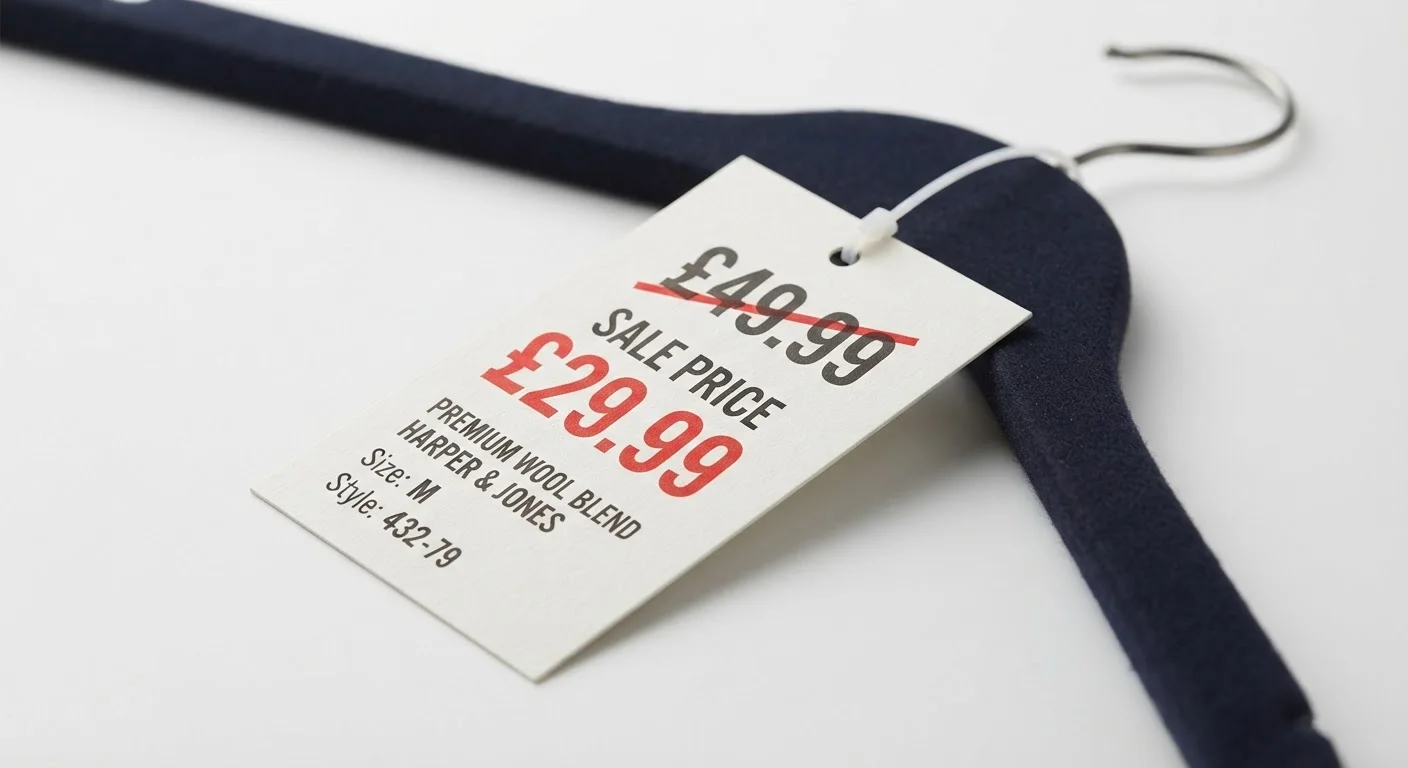
The Psychology Behind the Crossed-Out Price
When you walk into a store and see a jacket marked "Was $200, Now $89," your brain doesn't evaluate the $89 in isolation. Instead, it measures the $89 against the $200 - and the gap between those two numbers is what registers as a "deal." That $200 is the anchor, and it has already done its job before you've examined the product at all.
This is price anchoring: the cognitive tendency to rely heavily on the first piece of numerical information encountered when making a judgment. In retail contexts, the first price is almost always the higher one. Whether it appears as a "regular price," a "manufacturer's suggested retail price," or a crossed-out figure on a tag, its purpose is the same - to make what follows look favorable.
The anchor doesn't have to be accurate or relevant to have an effect. Decades of behavioral research have shown that people anchor to numbers even when they know those numbers are arbitrary. Once a figure enters your mind as a reference point, it reshapes how you interpret everything that follows.
“The mind does not work like a calculator. When we evaluate a price, we are not measuring it against some objective standard - we are measuring it against whatever number happens to be nearby.”
— Dan Ariely, Behavioral economist and author of Predictably Irrational
How Retailers Set Anchors - and Why It Works
Anchors in retail take several forms. A "list price" or "MSRP" (manufacturer's suggested retail price) is a manufacturer-set reference figure that individual retailers are free to undercut. A "was" price may reflect an actual former selling price - or a price the item was briefly listed at to establish a legal anchor before being "discounted." Understanding the distinction matters. See our breakdown of retail pricing terminology for a closer look at what each label actually means.
Anchoring also appears in product line architecture. When a retailer offers three tiers of a product - basic, standard, and premium - the premium version often serves as an anchor that makes the mid-range option feel like the sensible, value-conscious choice. You weren't planning to buy the mid-range, but it now seems reasonable compared to the high-end version you never seriously considered.
60%+
Shoppers influenced by initial price presentation
Consumer behavior research consistently finds that a majority of buyers adjust their willingness to pay based on the first price they encounter, even when that price is acknowledged as arbitrary.
3-tier
Product lineup structure that amplifies anchoring
Marketing researchers have documented that three-option product presentations reliably shift consumers toward middle or higher tiers, with the top tier functioning as an anchor that reframes mid-range pricing as a bargain.
It's also worth recognizing that a higher anchor price can trigger a secondary bias: the assumption that higher price signals higher quality. Research in consumer psychology has long documented this effect. As explored in why a higher price doesn't always mean higher quality, that relationship is far less reliable than most shoppers assume.
What a 'Deal' Actually Means - and What It Doesn't
A sale price is only a genuine saving if the anchor price was real and fair in the first place. Judging value by the size of the discount is a form of circular reasoning: the retailer sets the anchor, then rewards you for accepting it as legitimate.
A more grounded approach to evaluating price is to ask independent questions: What does this item typically sell for across multiple sellers? What is it worth given how often I'll use it and for how long? What are the costs I'm not seeing on the tag - shipping, maintenance, accessories, or disposal?
Reset Your Reference Point Before You Shop
Before evaluating any sale price, spend a few minutes searching for the item's typical selling price across multiple independent sources. This gives you a market-based anchor of your own - one that isn't set by the retailer. When you compare the sale price to real market data instead of a crossed-out number, you're far better positioned to judge whether a discount is meaningful.
It's also worth distinguishing between something being cheap and something being genuinely affordable for your situation. A heavily discounted item you don't need, won't use, or can't maintain is not a financial win, regardless of how large the markdown looks. Cheap and affordable are not the same thing - and anchoring often blurs that line by focusing your attention on relative price rather than absolute value.
Anchoring in High-Stakes Purchases
The stakes of anchoring rise considerably with major purchases. In car buying, the window sticker price functions as a powerful anchor that frames the negotiation before it begins. A buyer focused on how much they've "saved" off sticker may lose sight of whether the final number reflects fair market value at all. The car buying guidance hub offers useful context for approaching vehicle transactions with a clearer framework.
Similarly, in real estate, listing prices set anchors that shape offers, appraisals, and seller expectations - sometimes decoupled from underlying market conditions. Anchoring is one reason negotiation in high-value purchases requires independent market research rather than relying on the seller's stated starting point.
The broader principle is consistent: in any negotiation or purchase decision, the number introduced first carries outsized psychological weight. Recognizing this gives you the ability to consciously reset your reference point to one grounded in actual market data rather than a figure someone else chose for you. That shift - from anchor-relative thinking to value-relative thinking - is one of the most practical habits a careful spender can develop.
Frequently Asked Questions
Price anchoring is when a retailer displays a high initial price - often called the "original" or "list" price - to make a lower sale price seem like a better deal by comparison. The first number you see becomes your mental reference point. It's a psychological technique rooted in the cognitive bias called anchoring, which affects how we perceive value.
Not necessarily. Some retailers set artificially high "original" prices that products were rarely or never actually sold at. This practice has attracted regulatory scrutiny in several states. Understanding what list price and MSRP actually mean helps you evaluate whether a marked-down price reflects genuine savings.
Research the item's typical market price independently before shopping. Look up what the product sells for across multiple sellers and over time. Ask yourself what the item is worth to you based on your needs and budget - not based on a crossed-out number on a tag.
Yes, significantly. In high-stakes purchases like vehicles, the sticker price often serves as an anchor that shapes the entire negotiation. A buyer who focuses on discount from sticker rather than the actual transaction price relative to market value can end up paying more than necessary.
Cognitive biases like anchoring operate at a largely automatic level of thinking. Awareness reduces their influence but doesn't eliminate it entirely. Behavioral economists have found that even people who understand anchoring are still affected by it, which is why deliberate strategies - like doing price research before you shop - are more effective than willpower alone.
The content on this site is for informational purposes only and is not a substitute for professional advice. Always consult a qualified professional for guidance specific to your situation.