

Option A
Mortgage Rates
The borrowing cost that determines what you can afford monthly.
Best for: Understanding how much you'll pay over the life of a loan, regardless of the home's sticker price.
Option B
Home Prices
The purchase price that shapes your down payment, equity, and loan size.
Best for: Understanding the upfront cost of entry and the long-term asset value of homeownership.
Two Forces, One Affordability Equation
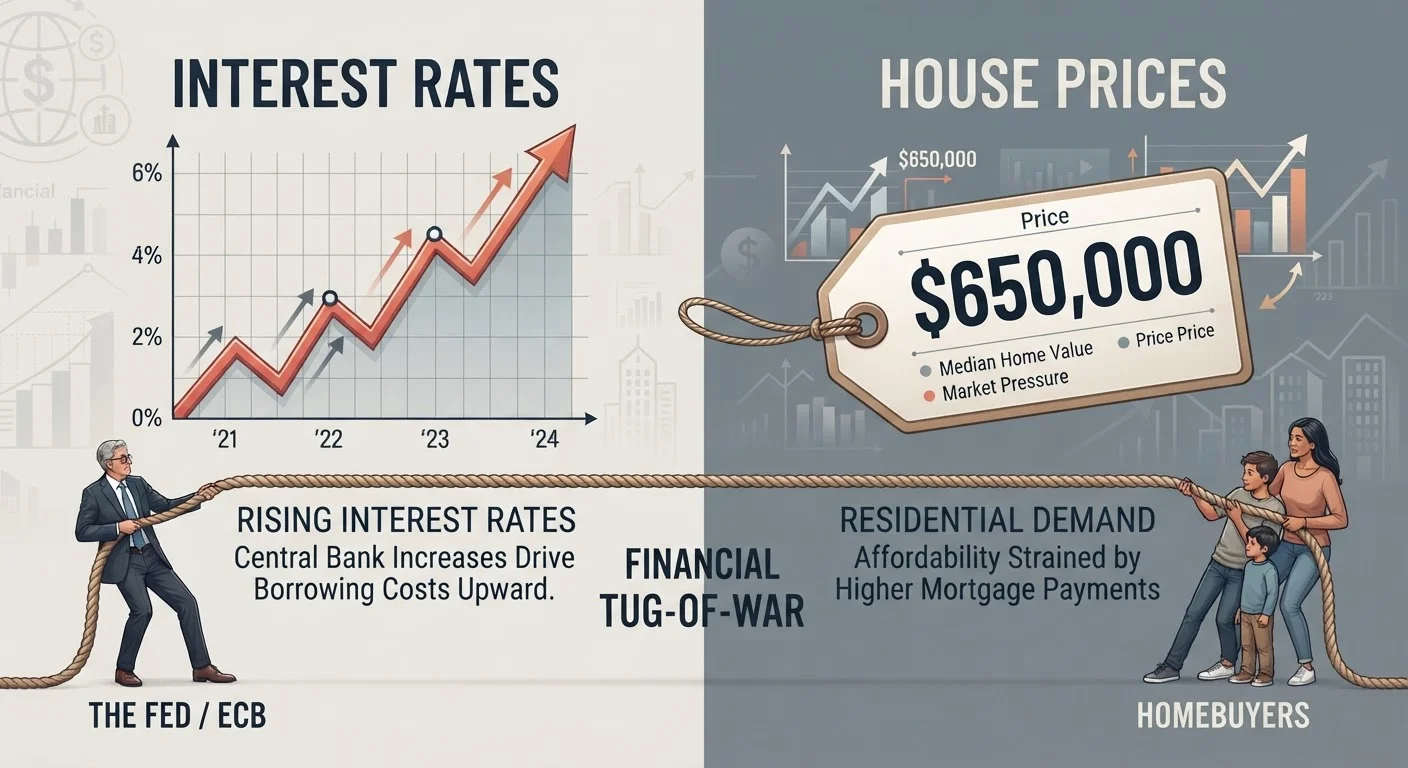
When people talk about whether it's a good time to buy a home, they often focus on either mortgage rates or home prices - rarely both at once. But affordability is never determined by one factor alone. It's the product of both working together, and they frequently pull in opposite directions.
Think of it this way: mortgage rates determine what you pay each month to borrow money, while home prices determine how much money you need to borrow in the first place. When one rises and the other falls, the net effect on your wallet can be surprisingly modest. When both rise simultaneously, affordability deteriorates sharply. Understanding this relationship is central to reading the housing market clearly. See our plain-language breakdown of how the housing market works for broader context on what moves prices over time.
| Criterion | Mortgage Rates | Home Prices |
|---|---|---|
| What it affects directly | Monthly payment amount | Loan principal and down payment |
| Who controls it | Lenders, influenced by Fed policy | Sellers, shaped by supply and demand |
| How quickly it changes | Can shift week to week | Slower to adjust, often sticky downward |
| Impact on total interest paid | High - compounds over loan term | Moderate - affects principal only |
| Refinanceable later? | Yes, if rates fall in future | No - purchase price is locked in |
| Effect on down payment | No direct effect | Direct - percentage of purchase price |
| Typical buyer focus | Monthly affordability | Upfront cost and equity potential |
Why Rates and Prices Don't Always Move Together
Economic theory suggests that rising mortgage rates should push home prices down: higher borrowing costs reduce demand, and with fewer buyers competing, sellers must accept lower offers. In practice, this correction is slower and less complete than many buyers hope.
The primary reason is what economists sometimes call the lock-in effect. Homeowners who secured mortgages at historically low rates in earlier years are reluctant to sell and trade into a new, higher-rate mortgage on their next purchase. This reduces the number of homes listed for sale, which constrains supply and prevents prices from falling as steeply as demand might otherwise warrant. Low inventory drives prices up even when buyer demand has softened - a dynamic that's been clearly visible in recent US market cycles.
~$700/mo
Extra monthly cost from a 3-point rate rise
On a $360,000 loan, moving from a 4% to a 7% 30-year fixed rate adds roughly $677 in monthly principal and interest payments.
10%+
Typical inventory decline after rate spikes
Housing economists have documented significant listing reductions when owners with low fixed-rate mortgages choose not to sell, constraining available supply.
30 years
Time horizon over which rate differences compound
A one-percentage-point difference in rate on a $300,000 loan results in tens of thousands of dollars in additional total interest over a standard loan term.
The result is a market where rates rise but prices stay stubbornly elevated, compressing affordability from both ends simultaneously. This is an unusual and particularly difficult environment for buyers, because neither variable is offering relief.
What This Means for Monthly Payments
To see why both variables matter, consider a concrete illustration. On a $400,000 home with a 10% down payment, the loan amount is $360,000. At a 4% fixed rate on a 30-year mortgage, the principal and interest payment is roughly $1,718 per month. At a 7% rate on the same loan, that payment rises to approximately $2,395 - an increase of nearly $700 per month, with no change in the home's price.
Now suppose prices fall 10%, bringing the home to $360,000 and the loan to $324,000 - but rates stay at 7%. The payment drops to around $2,156 per month. The price fell by $40,000, but the payment only decreased by about $239 compared to the high-rate, high-price scenario. This illustrates why a price correction, if it comes, may offer less relief than buyers expect if rates remain elevated. For more on structuring the loan itself, our guide on fixed-rate vs. adjustable-rate mortgages explains the trade-offs in detail.
These Numbers Are Illustrative, Not Guaranteed
The payment figures used in this section are based on principal and interest only and do not include property taxes, homeowners insurance, or private mortgage insurance (PMI), which can add several hundred dollars per month. Actual rates and payments vary by lender, credit profile, loan type, and market conditions. Always get a formal loan estimate from a licensed lender before making financial decisions.
Navigating the Trade-Off as a Buyer
Buyers often wonder whether to wait for prices to fall or lock in before rates rise further. The honest answer is that predicting either variable with confidence is not possible - and acting on forecasts alone carries real risk. What buyers can control is their own financial preparation and clarity about their priorities.
If minimizing the loan principal is the priority - perhaps because a large down payment is tight or long-term interest costs matter most - then price sensitivity makes sense. If monthly cash flow is the bigger constraint, then the rate environment is more immediately relevant. These aren't mutually exclusive concerns, but ranking them helps clarify when and whether to act.
It's also worth remembering that local conditions can override national trends. In high-demand cities with persistently low inventory, prices may hold firm even as rates rise. In slower markets with more supply, buyers may find more negotiating room. For a nuanced take on how different property types respond differently even within the same area, see why condos and single-family homes can diverge in the same neighborhood.
Ultimately, the rent-or-buy question also intersects with this dynamic. Renting vs. buying isn't purely a financial calculation - but the rate-price relationship is a key input to making that comparison honestly.
This article is for general informational and educational purposes only and does not constitute financial, investment, or legal advice. Readers should consult a qualified financial professional before making decisions about home purchases or mortgage financing.
The content on this site is for informational purposes only and is not a substitute for professional advice. Always consult a qualified professional for guidance specific to your situation.