

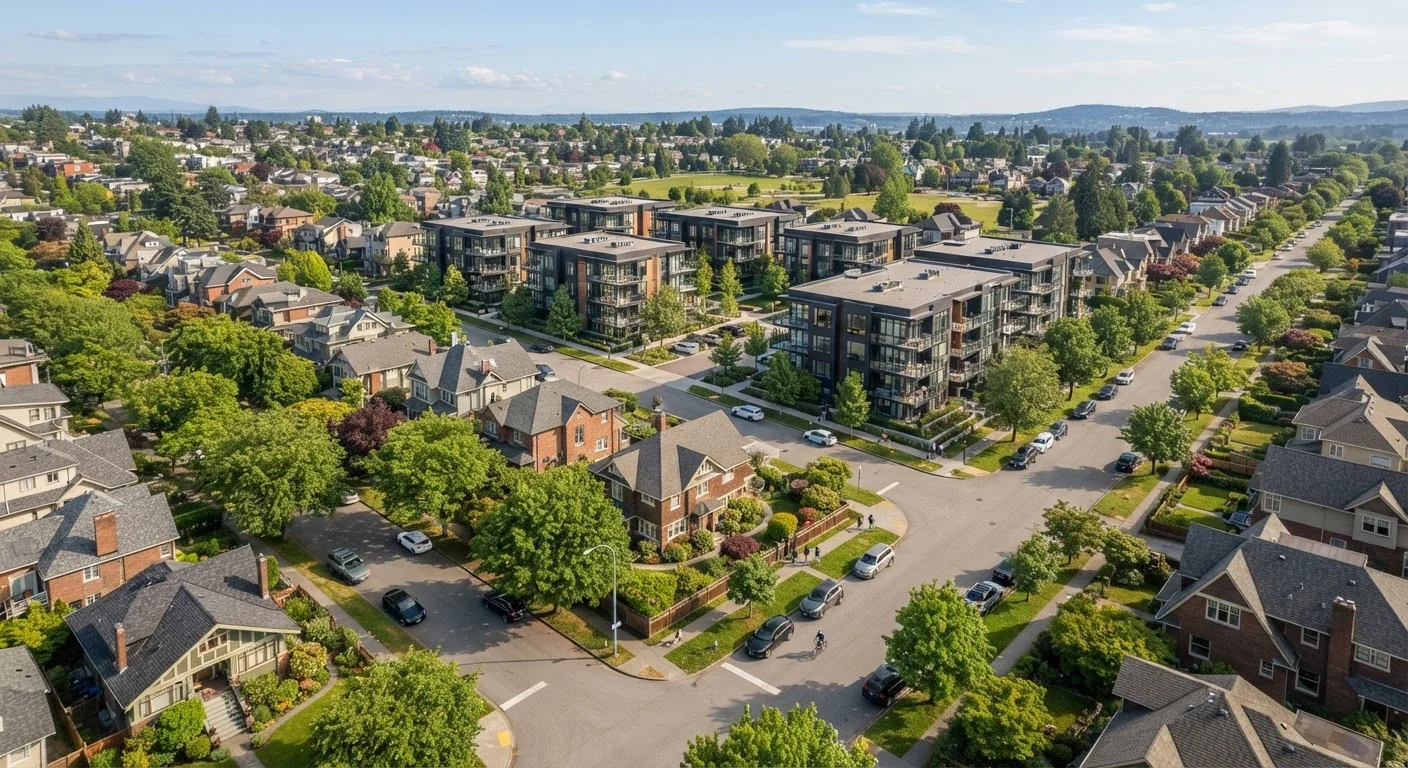
Option A
Condo Market
The denser, more regulation-sensitive housing segment.
Best for: Buyers seeking lower maintenance, urban proximity, or an entry-level price point in competitive areas.
Option B
Single-Family Home Market
The land-driven, family-oriented housing segment.
Best for: Buyers prioritizing space, privacy, yard ownership, and fewer shared-building restrictions.
Same Street, Different Story
Housing market conversations tend to treat a neighborhood as a single entity - one set of trends, one direction for prices, one level of competition. In practice, that's rarely true. Condos and single-family homes within the same zip code routinely move in different directions at the same time, and understanding why can change how buyers, sellers, and renters interpret the market around them.
The core reason is straightforward: they serve different buyers, face different supply constraints, and operate under different rules. When one of those variables shifts - say, mortgage rates rise sharply - it can hit one property type far harder than the other. To understand this clearly, it helps to look at what separates these two segments of any local market. For a broader grounding in how housing markets work generally, see how the housing market works.
| Criterion | Condo Market | Single-Family Home Market |
|---|---|---|
| Supply flexibility | Higher - new buildings can add units vertically | Lower - limited by available land and permitting |
| Typical buyer profile | First-timers, downsizers, investors | Families, move-up buyers, long-term owners |
| Mortgage qualification | Building-level review required by lenders | Standard borrower and property review only |
| HOA influence on price | High - fees and rules affect value and demand | Low or none in most cases |
| Land appreciation factor | Minimal - shared lot, no individual land title | Significant - land scarcity supports long-term value |
| Investor activity | Common, but often restricted by HOA rules | Common with fewer structural restrictions |
| Rate sensitivity | Higher - buyer pool is more cost-sensitive | Moderate - broader buyer pool absorbs rate shifts |
Why Supply Works Differently for Each Property Type
One of the most important distinctions between condos and single-family homes is how supply responds to demand. In a neighborhood where house prices rise, builders can't simply add more houses - land is fixed, permitting is slow, and construction costs are high. That scarcity tends to sustain or push prices upward over time.
Condo supply is more elastic, at least in urban and suburban areas with available vertical space. A developer can build a new mid-rise building that adds dozens or hundreds of units to a neighborhood without consuming more land footprint. When a lot of new condo inventory enters the market simultaneously, it can moderate or depress prices - even when single-family home prices nearby are still rising.
~30%
Share of new housing units that are condos or co-ops in dense metros
In high-density urban markets, condos and co-ops can represent a substantial portion of new residential construction, according to U.S. Census Bureau housing start data.
50%+
Condo buildings that may fail FHA lending guidelines
The Federal Housing Administration has reported that a large share of existing condo buildings do not meet its approval requirements, limiting financing options for buyers in those buildings.
Wider gap
Price divergence between condos and houses in rising-rate environments
Real estate analysts have observed that condo price growth tends to slow more sharply than single-family home prices when mortgage rates rise significantly, reflecting the more rate-sensitive buyer pool.
This dynamic explains why two people living across the street from each other - one in a house, one in a condo - can have very different experiences of the same market moment. As local vs. national housing data illustrates, the numbers that matter are often far more granular than most headlines suggest.
How Buyer Pools and Financing Rules Drive the Gap
Condos and single-family homes don't just differ in structure - they attract meaningfully different buyers. Single-family homes draw a broad pool: families seeking school districts, buyers prioritizing yard space, and move-up purchasers trading from a smaller home. Condos tend to attract first-time buyers looking for affordability, downsizers shedding maintenance responsibilities, and investors building rental portfolios.
When interest rates climb, these buyer pools don't shrink equally. Condo buyers - often more cost-sensitive and frequently first-time purchasers - may exit the market faster. At the same time, lenders apply additional scrutiny to condo buildings: factors like the percentage of owner-occupied units, HOA financial reserves, and pending litigation against the association can all affect whether a buyer can even get a conventional loan for a specific building. A single-family home faces none of that building-level review.
HOA rules add another layer. Some associations cap the share of units that can be rented out, which limits investor demand and can soften prices in buildings with those restrictions. Understanding buyer's and seller's market conditions in each segment separately is essential - what looks like a seller's market for houses might simultaneously be a buyer's market for condos in the same neighborhood.
Blended Neighborhood Data Can Mislead
Many public market reports combine condo and single-family home sales into a single median price figure for a neighborhood or zip code. This can make a market appear stable when one segment is rising sharply while the other is softening. When researching a specific area, ask your agent or look for data sources that separate the two property types. The distinction matters for both pricing strategy and negotiation leverage.
Buyers focused on long-term decisions - whether to purchase in the home-buying process or assess resale risk - benefit from tracking each property type's inventory and price trends independently rather than relying on blended neighborhood statistics.
The content on this site is for informational purposes only and is not a substitute for professional advice. Always consult a qualified professional for guidance specific to your situation.