

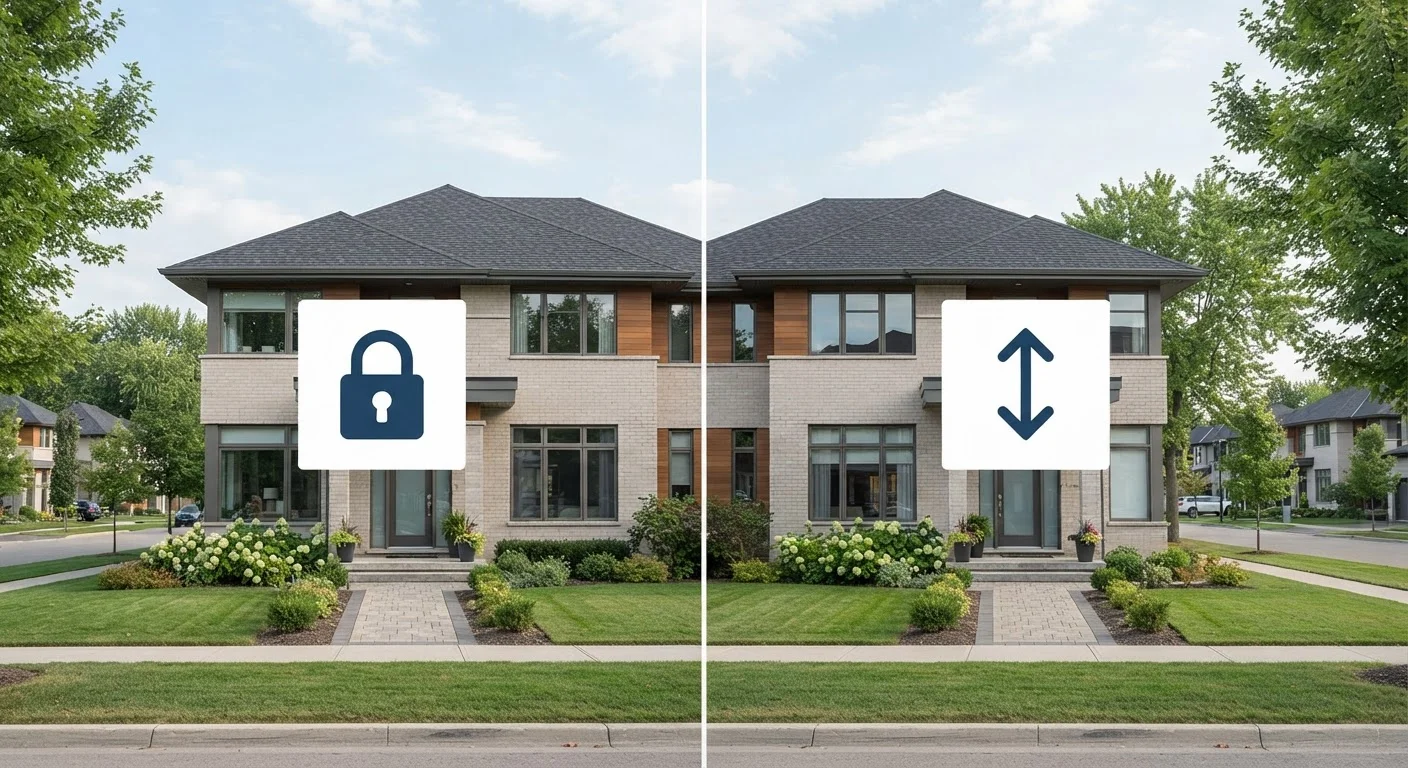
Option A
Fixed-Rate Mortgage
The predictable, long-term stability choice.
Best for: Buyers who plan to stay in their home long-term and want consistent, unchanging monthly payments.
Option B
Adjustable-Rate Mortgage (ARM)
The flexible, lower-entry-cost alternative.
Best for: Buyers who expect to move or refinance within a few years and can tolerate some payment variability.
How Each Mortgage Structure Works
A fixed-rate mortgage sets your interest rate at the time of closing, and that rate never changes for the life of the loan - whether it's a 15-year or 30-year term. Every monthly payment covers the same split of principal and interest, making budgeting straightforward. This is the most common mortgage type for US homebuyers, partly because of that built-in predictability.
An adjustable-rate mortgage (ARM) works differently. It begins with a fixed introductory rate - often for 5, 7, or 10 years - and then adjusts periodically based on a benchmark interest rate index, such as the Secured Overnight Financing Rate (SOFR). After the introductory period, your rate (and payment) can go up or down at each adjustment interval, typically annually. ARMs are described with shorthand like "5/1 ARM," meaning 5 years fixed followed by annual adjustments.
For a broader overview of all loan types available to homebuyers, see our mortgage types reference guide.
| Criterion | Fixed-Rate Mortgage | Adjustable-Rate Mortgage (ARM) |
|---|---|---|
| Interest rate | Locked for life of loan | Fixed initially, then adjusts periodically |
| Starting rate (typical) | Slightly higher | Lower introductory rate |
| Monthly payment | Always the same | Can rise or fall after intro period |
| Best loan term | 15 or 30 years | 5/1, 7/1, or 10/1 ARM common |
| Rate risk | None - lender absorbs it | Borrower assumes rate-change risk |
| Predictability | High | Low after adjustment period |
| Ideal timeline | 10+ years in home | Under 7 years in home |
| Refinancing need | Rarely necessary | Often used as exit strategy |
The Real Trade-Offs: Cost, Risk, and Timeline
The core tension between these two structures comes down to certainty versus cost. Fixed-rate mortgages typically carry a slightly higher starting interest rate than ARMs because lenders are absorbing the risk of future rate changes. You pay a premium for that guaranteed stability.
ARMs, by contrast, offer lower initial rates that can translate to meaningfully lower monthly payments during the introductory period. However, once adjustments begin, your payment is subject to market conditions. Most ARMs include caps - limits on how much the rate can increase at each adjustment and over the life of the loan - but a rate that rises from 5% to 8% would substantially increase what you owe each month.
~1-1.5%
Typical ARM vs. fixed rate discount at origination
Historically, ARM introductory rates have run roughly 1 to 1.5 percentage points below comparable fixed rates, though the gap varies with market conditions.
5/2/5
Common ARM rate cap structure
Many ARMs include a 5/2/5 cap: no more than 5% increase at first adjustment, 2% per subsequent adjustment, and 5% over the life of the loan.
~13 years
Median time Americans stay in a home
According to National Association of Realtors data, the median tenure in a home has historically hovered around 13 years, often favoring the fixed-rate structure for most buyers.
Your expected time in the home is arguably the most decisive factor. If you're confident you'll sell or refinance before the ARM's fixed period expires, you may pocket the interest savings without ever facing an adjustment. If your plans are less certain, a fixed rate eliminates one major variable. It's also worth considering how the mortgage decision fits into your broader financial picture - including how you're managing savings and debt, which our Saving & Debt hub covers in depth.
What the Numbers Look Like in Practice
To understand the difference concretely, consider a $400,000 loan. At a 30-year fixed rate of 7%, the monthly principal-and-interest payment would be roughly $2,661. A 5/1 ARM at an initial rate of 6% would start at approximately $2,398 per month - saving around $263 each month during the introductory period. Over five years, that's more than $15,000 in potential savings before any adjustment.
But if that ARM adjusts upward to 8.5% in year six, the payment climbs to approximately $3,000 - now more expensive than the fixed option would have been. The math favors the ARM only if you exit the loan before rates move significantly against you, or if you can refinance into a better rate later.
It's worth noting that the rate environment at the time you buy matters too. When fixed rates are already relatively low, the gap between fixed and ARM starting rates narrows, reducing the ARM's upfront advantage. For context on how rates interact with home prices and affordability, see our analysis of mortgage rates and home prices.
ARM Rate Caps: Built-In Protections
Most adjustable-rate mortgages include rate caps that limit how much your interest rate can increase at any single adjustment and over the life of the loan. A typical cap structure might allow no more than a 2% increase per adjustment period and a 5-6% increase over the loan's life. These caps provide a ceiling on worst-case scenarios, but they don't eliminate rate risk entirely. Always ask your lender to walk through the maximum possible payment under the cap structure before signing.
Making the Decision That Fits Your Situation
There is no universally correct answer between a fixed-rate and adjustable-rate mortgage. The right structure depends on your financial stability, how long you realistically plan to stay, your tolerance for payment variability, and broader market conditions when you're buying.
Questions worth working through before you decide: How secure is my income over the next decade? Do I have financial reserves to absorb a higher payment if my ARM adjusts upward? Is there a realistic chance I'll move within five to seven years? These aren't abstract questions - they directly shape which structure serves you better.
If you're still weighing whether homeownership itself is the right move, our comparison of renting vs. buying trade-offs can help you think through the broader decision first. Once you're committed to buying, understanding mortgage structure is one of the most impactful choices in the entire process.
This article is for general informational purposes only and does not constitute personalized financial or mortgage advice. Consult a licensed mortgage professional or financial adviser before making decisions about your home loan.
The content on this site is for informational purposes only and is not a substitute for professional advice. Always consult a qualified professional for guidance specific to your situation.