

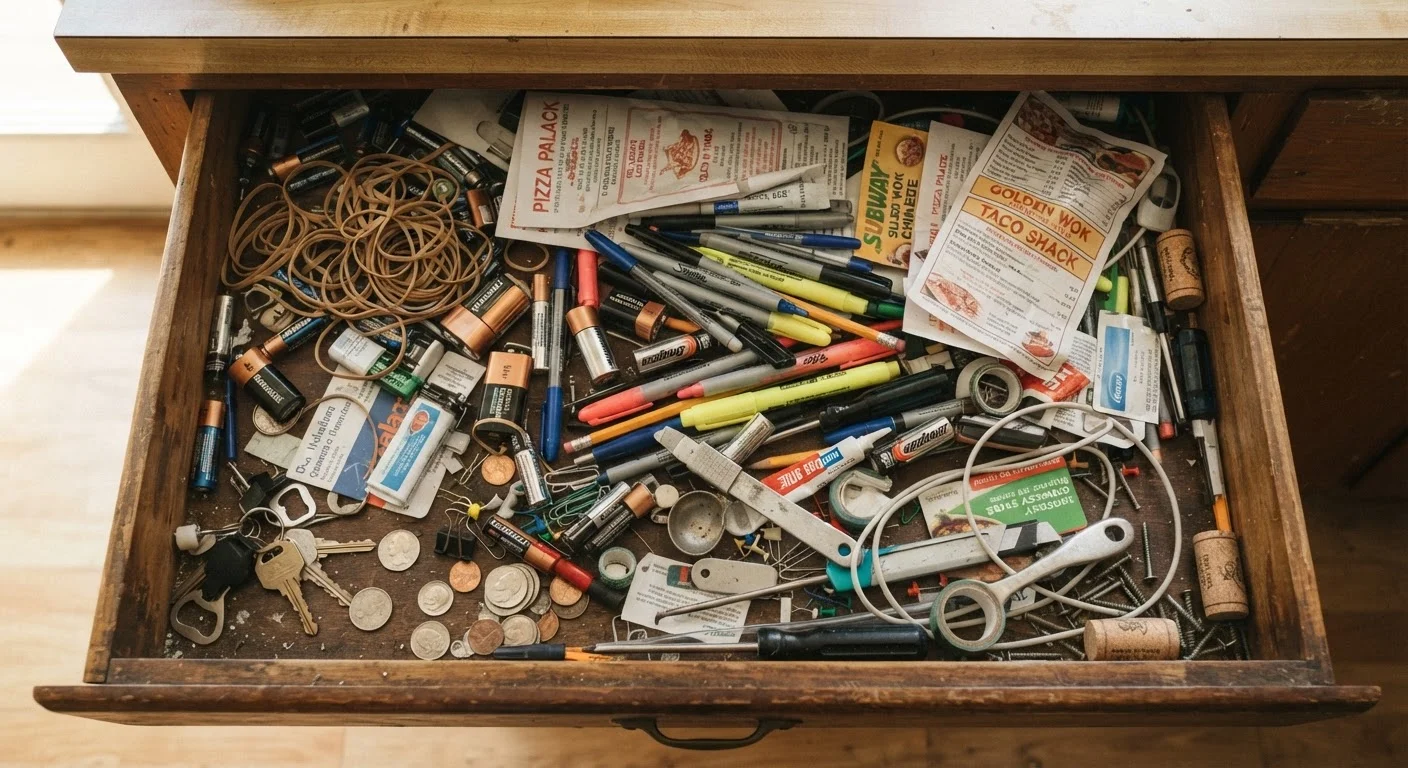
Why the Junk Drawer Is a Feature, Not a Bug
Every household generates a small, steady stream of items that don't belong anywhere specific: a loose battery, a takeout menu, a mystery key, a rubber band. These objects need somewhere to land, and in the absence of a better system, they land in whatever drawer is closest to the front door or kitchen counter. The junk drawer isn't a failure of discipline - it's a predictable response to how real households actually function.
The problem isn't the drawer's existence. The problem is when it becomes so chaotic that you can't find anything useful inside it, or when its overflow mentality spreads to countertops, bags, and other drawers. Understanding why clutter affects your brain can help explain why a disorganized catch-all space creates low-level stress even when you're not actively looking at it.
The goal, then, isn't to eliminate the junk drawer - it's to keep it intentional, bounded, and functional.
Common Mistakes That Keep the Drawer Unmanageable
Most people approach the junk drawer the same way every few months: they dump it out, throw some things away, and put the rest back in some rough order. Then, within a few weeks, it's chaotic again. This cycle happens because the cleanup addressed the symptoms, not the underlying causes. Below are the most frequent mistakes homeowners make - and how to break the pattern for good.
Organizing the drawer without changing what goes into it.
Why it happens: Cleaning feels like solving the problem, but it only resets the clock. If the same items keep landing in the drawer with no new system to redirect them, the chaos returns on schedule.
Clearing the drawer too aggressively, discarding things that still have value.
Why it happens: Purge momentum can feel energizing, and it's tempting to throw out anything whose purpose isn't immediately obvious. But some items in junk drawers are genuinely useful - just infrequently needed.
Relying on a single large drawer to hold too many unrelated categories.
Why it happens: It's convenient to have one catch-all spot, but a drawer that holds everything - from craft supplies to first aid items to hardware - quickly becomes unsearchable and frustrating.
Skipping any form of routine maintenance between major clean-outs.
Why it happens: Most people wait until the drawer is completely unworkable before addressing it, which makes the task feel large and discouraging - reinforcing the tendency to delay it further.
Not communicating the drawer's system to everyone in the household.
Why it happens: One person organizes the drawer with a clear logic in mind, but other household members - including children - don't know the rules and continue depositing items randomly.
It's also worth noting that junk drawers rarely exist in isolation. Related trouble spots - like paper piles and garage storage - follow the same behavioral patterns. If your drawer tends to collect mail, receipts, and forms, our guide to managing paper clutter covers where that paper originates and which containment approaches work best.
Building a System That Actually Holds
A functional junk drawer isn't about buying the perfect organizer tray - it's about defining what the drawer is for and enforcing that boundary consistently. Start by deciding which categories of items genuinely belong there: things used occasionally, don't fit elsewhere, and are needed at a moment's notice. Everything else either needs a home elsewhere or needs to leave.
Avoid Buying Storage Before Decluttering
It's tempting to pick up drawer organizers or dividers as a first step, but purchasing containers before you know what you're keeping is a common and costly misstep. You'll likely end up with the wrong sizes or too many compartments for the items that actually belong. Declutter and define the drawer's purpose first - then measure and shop for organization tools only if needed.
Once you've defined the drawer's purpose, do a brief scan every month or two - not a full purge, just a five-minute pass. Remove anything that's drifted in that shouldn't be there. Over time, this small habit prevents the buildup that makes the drawer feel overwhelming and unusable.
If you're also rethinking larger catch-all spaces in your home, the same principles apply at a bigger scale. Our structured approach to reclaiming a garage that's become a dumping ground walks through how to set up zones and habits that hold over time - without requiring a weekend-long overhaul.
Finally, if you've tried organizing before and felt like it didn't stick, it may be worth examining the assumptions you're working from. Many widely held tidying beliefs actively backfire - see common organizing myths that make homes messier for a closer look at what actually works versus what just feels productive.
The content on this site is for informational purposes only and is not a substitute for professional advice. Always consult a qualified professional for guidance specific to your situation.