

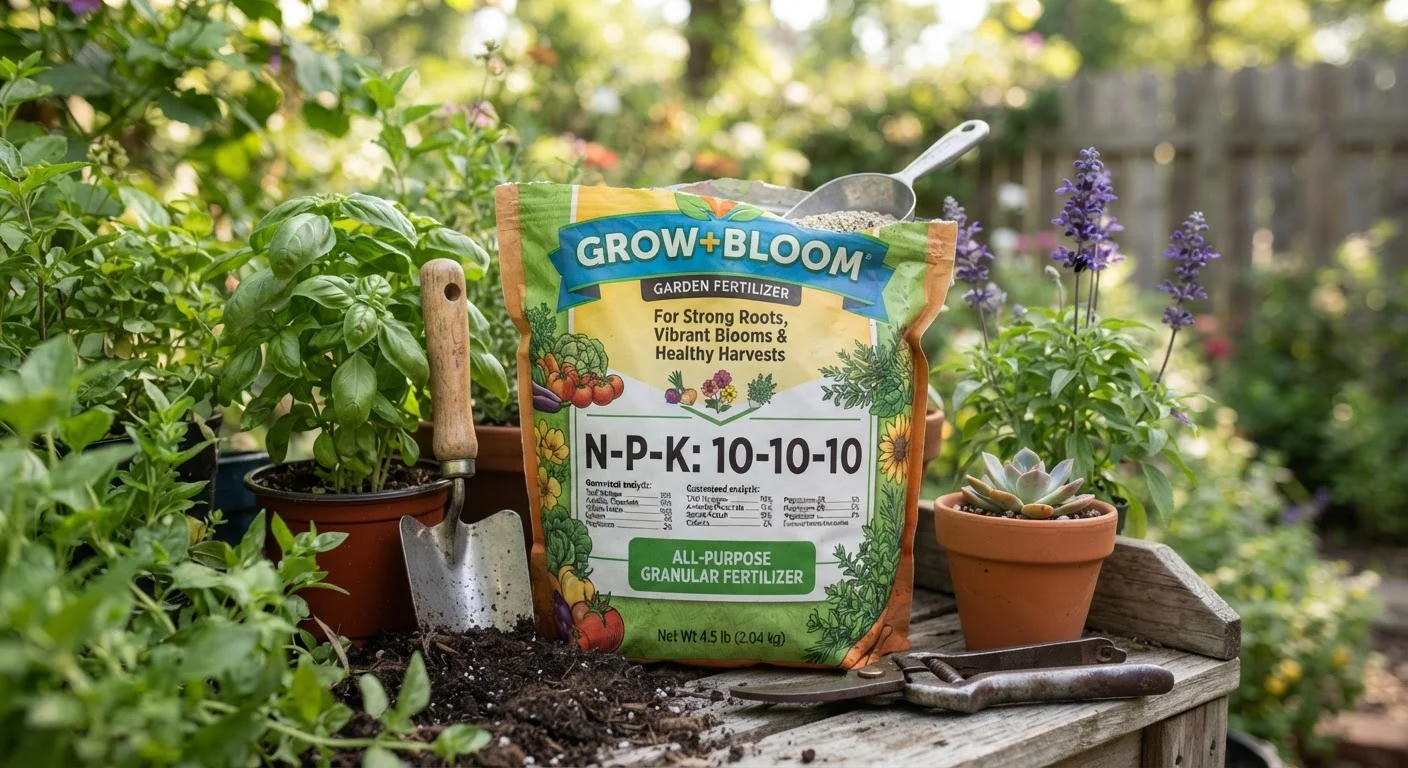
The N-P-K Ratio: What Those Three Numbers Mean
Every fertilizer bag sold in the U.S. is required by law to display a guaranteed analysis - a set of three numbers separated by dashes, such as 10-10-10 or 5-10-5. These numbers represent the percentage by weight of three primary macronutrients: nitrogen (N), phosphorus (P), and potassium (K), always listed in that order.
| First number (N) | Nitrogen - promotes leafy, green growth |
| Second number (P) | Phosphorus - supports roots and flowering |
| Third number (K) | Potassium - strengthens plant resilience and water regulation |
| Filler content | The remainder after N-P-K percentages is typically inert carrier material |
| Key slow-release indicator | Water Insoluble Nitrogen (WIN) percentage on the label |
| Organic certification to look for | OMRI Listed seal - independently reviewed for organic use (Organic Materials Review Institute) |
Each nutrient performs a distinct job in plant health. Nitrogen drives leafy, green growth - it's why lawn fertilizers tend to have a high first number. Phosphorus supports root development and flowering, making it critical during transplanting or bloom cycles. Potassium strengthens overall plant resilience, helping regulate water uptake and disease resistance.
A bag labeled 20-5-10 contains 20% nitrogen, 5% phosphorus, and 10% potassium. The remaining 65% is filler material - typically inert carriers that help distribute nutrients evenly during application. Higher numbers don't automatically mean better results; matching the ratio to your plants' actual needs matters far more than chasing a big number on the label.
Secondary Nutrients, Micronutrients, and What's Below the Big Three
Below the guaranteed analysis headline, many labels list secondary nutrients - calcium (Ca), magnesium (Mg), and sulfur (S) - as well as micronutrients such as iron, manganese, zinc, and boron. Plants need these in smaller quantities, but deficiencies can still cause visible problems like yellowing leaves or poor fruit set.
If your label lists "derived from" information, that section tells you the actual source materials - for example, ammonium nitrate, bone meal, or kelp meal. This matters especially if you're choosing between organic and synthetic options. Worth noting: how available any nutrient is to your plants depends heavily on soil pH. Even a well-stocked fertilizer won't perform if soil chemistry is locking nutrients out. Our article on soil pH and plant struggles covers this dynamic in depth.
Fertilizer labels can also carry vague marketing language - words like "professional-grade" or "advanced formula" carry no regulated definition. Learning to read between the lines of product marketing helps you focus on the guaranteed analysis rather than the packaging claims.
Slow-Release vs. Fast-Release: Reading the Fine Print
One of the most practically important distinctions on a fertilizer label is whether nutrients are fast-release (also called water-soluble) or slow-release (also called controlled-release). This affects both how quickly you'll see results and how often you need to reapply.
N-P-K Ratio
The three-number sequence on every fertilizer label representing the percentage by weight of nitrogen (N), phosphorus (P), and potassium (K), always in that order. It's the primary tool for matching a fertilizer to your plants' needs.
Guaranteed Analysis
The legally required section of a U.S. fertilizer label that discloses minimum nutrient percentages. It ensures manufacturers are held accountable for the nutrient content they claim.
Slow-Release Fertilizer
A fertilizer designed to deliver nutrients gradually over an extended period, often weeks to months. It reduces the risk of burning plants and decreases how frequently you need to reapply.
Water Insoluble Nitrogen (WIN)
The portion of nitrogen in a fertilizer that does not dissolve immediately in water. A higher WIN percentage indicates more slow-release nitrogen, which feeds plants gradually and is less prone to leaching.
OMRI Listed
A certification seal from the Organic Materials Review Institute indicating a product has been reviewed and approved for use in certified organic farming and gardening. It's more reliable than the unregulated term "organic" on its own.
Micronutrients
Elements that plants need in very small amounts - including iron, zinc, manganese, and boron. While required in tiny quantities, deficiencies can cause visible plant health problems.
Fast-release fertilizers dissolve quickly in water and deliver nutrients almost immediately, making them useful for correcting visible deficiencies. The tradeoff is a higher risk of nutrient burn if overapplied, and more frequent reapplication since they leach through soil faster.
Slow-release products use coatings, compounds, or microbial processes to break nutrients down gradually over weeks or months. Labels may use terms like "sulfur-coated," "polymer-coated," or "IBDU" (isobutylidene diurea) to describe the delivery mechanism. These are generally more forgiving for beginners and better for the environment since less nutrient runoff occurs.
Look for a section on the label called "Water Insoluble Nitrogen" (WIN) - a higher WIN percentage means a larger share of the nitrogen is slow-release. This single data point is one of the most useful pieces of information on the entire bag.
Organic vs. Synthetic: What the Label Tells You
Federal law does not define "organic" for fertilizers the same way it does for food. When you see "organic" on a fertilizer label, it generally means the product is derived from plant, animal, or mineral sources rather than synthetic chemical manufacturing - but the term can still appear on products that contain mined minerals not everyone would consider truly natural.
The more reliable signal is the OMRI Listed seal (Organic Materials Review Institute), which indicates the product has been independently reviewed for use in certified organic production. If organic gardening is a priority for you, look for this designation rather than relying on the word "organic" alone.
Synthetic fertilizers are manufactured to deliver precise nutrient ratios and tend to act faster. Organic fertilizers typically release nutrients more slowly as soil microbes break down the material, and they often contribute to long-term soil health by feeding microbial communities. Neither type is universally superior - the right choice depends on your soil's current condition, your plants' needs, and your gardening goals.
Labels are dense, but they're also standardized tools designed to protect consumers and give you real data. Once you know where to look - the guaranteed analysis, the nutrient sources, the release type, and recognized certifications - a fertilizer label becomes one of the most useful guides in your garden.
The content on this site is for informational purposes only and is not a substitute for professional advice. Always consult a qualified professional for guidance specific to your situation.