

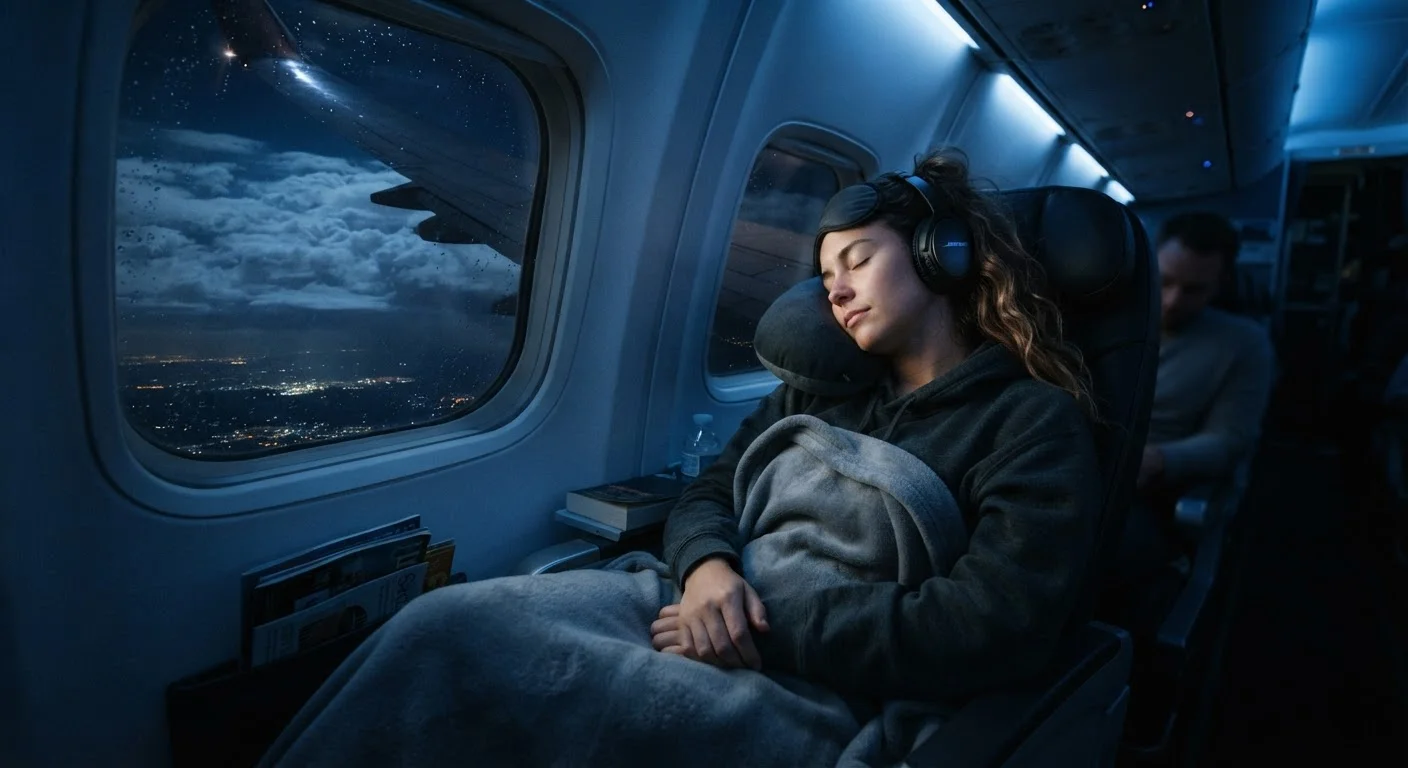
Why Jet Lag Is More Than Just Tiredness
Jet lag isn't simply being sleepy after a long trip. It's a temporary sleep disorder - officially called circadian rhythm disruption - that occurs when your body's internal clock is out of alignment with the local day-night cycle at your destination. Your brain and organs are still operating on home time while the outside world runs on a completely different schedule.
The result is a cluster of symptoms: fragmented sleep, daytime fatigue, difficulty concentrating, digestive issues, and even mood changes. The severity depends on how many time zones you cross, the direction of travel, and your individual biology.
Understanding what's actually happening in your body is the first step toward managing it well. For a deeper look at the health dimensions of crossing multiple time zones, see our guide to long-haul flight health.
Myth
The best cure for jet lag is to just stay up until local bedtime, no matter how tired you are.
Fact
Forcing yourself to stay awake for extreme stretches can increase stress hormones and make adaptation harder, not easier.
There's a kernel of truth here - aligning your sleep timing with the destination does help. But staying awake for 20-plus hours in a depleted state stresses the body and can impair your immune response and mood. A smarter approach is to take a short, timed nap (under 30 minutes) if exhaustion is severe, then aim to sleep at a locally appropriate hour rather than simply white-knuckling through the day.
Myth
A glass of wine on the plane helps you sleep and eases the transition.
Fact
Alcohol disrupts sleep architecture, suppresses REM sleep, and accelerates dehydration - all of which worsen jet lag symptoms.
Alcohol at altitude may feel more potent and sedating, but the sleep it produces is fragmented and non-restorative. You may fall asleep faster, but your body cycles through fewer deep and REM sleep stages. Combined with the dry cabin air and reduced oxygen pressure, alcohol reliably deepens post-flight fatigue. Skipping or minimizing it is one of the more evidence-backed in-flight choices you can make.
Myth
Traveling west is just as hard on your body as traveling east.
Fact
Eastward travel typically causes more severe jet lag because it requires advancing your body clock, which most people find harder than delaying it.
The human circadian cycle runs slightly longer than 24 hours for most people, making it naturally easier to stay up late (delay the clock) than to go to bed earlier (advance it). Flying from New York to Paris forces you to advance your sleep by six or more hours - essentially asking your body to feel tired before it's ready. Flying the other direction extends your day, which is generally more manageable. This is why many long-haul travelers find the return trip harder.
Myth
Taking a high dose of melatonin before the flight will prevent jet lag entirely.
Fact
Melatonin dose and timing both matter; large doses taken at the wrong time can actually disrupt your adjustment.
Melatonin is a hormone that signals darkness to the brain - it doesn't knock you out like a sedative. Research suggests that modest doses (often cited in the range of 0.5-1 mg) taken at the appropriate local bedtime at your destination may help shift your circadian rhythm. Taking high doses at random times or during the flight itself can confuse your body clock further rather than correct it. Always discuss supplement use with a healthcare provider, especially if you take other medications.
Myth
Jet lag only affects your sleep - once you've slept, you're fine.
Fact
Circadian disruption affects digestion, cognition, mood, and immune function, not just sleep patterns.
Nearly every cell in your body follows a circadian rhythm. When those rhythms are misaligned, you may notice digestive slowness or irregularity, difficulty concentrating, irritability, and a slight dip in immune resilience. This is why some travelers feel mentally foggy or emotionally flat even after a full night of sleep in a new time zone. Full adjustment typically takes roughly one day per time zone crossed, though this varies by individual.
Practical Steps That Actually Move the Needle
Once you understand the myths, the practical strategies become clearer. Here's what research and travel experience actually support:
~1 day
Recovery time per time zone crossed
Sleep researchers commonly cite roughly one day of adjustment per time zone as a general guideline, though individual variation is significant.
6-8 hrs
Typical circadian phase shift capacity per day
Circadian biology research suggests the human body clock can realign by roughly one to one-and-a-half hours per day under natural conditions.
- Time your light exposure strategically. Bright morning light at your destination helps anchor your body clock. If you're traveling east, get outside early. If traveling west, seek evening light. Avoid bright screens and overhead lights in the hours before your intended local bedtime.
- Shift your sleep schedule before you leave. Even nudging your bedtime by 30-60 minutes over two or three days before an eastward trip can reduce adaptation time.
- Stay hydrated throughout the flight. Cabin air is extremely dry - dehydration compounds fatigue and makes jet lag feel worse. Water is your best in-flight companion.
- Use melatonin with correct timing. Taking a low dose (0.5-1 mg is often cited in research as effective) at your destination's bedtime - not at departure - is more likely to help. Speak with a healthcare provider before using any supplement regularly.
Building a consistent pre-sleep routine also supports faster adjustment. Our wind-down routine guide offers evidence-informed habits that can anchor your sleep wherever you land.
Prescription Sleep Aids on Planes: Proceed Carefully
Some travelers use prescription sedatives to sleep on long flights. These medications can reduce muscle activity during sleep, which may raise the risk of deep vein thrombosis (DVT) on long-haul flights if you remain immobile. They can also leave you groggy and disoriented on arrival, making the first day at your destination harder. Discuss the risks and benefits with your doctor before using any prescription sleep medication for travel.
This article provides general travel and wellness information only and is not a substitute for personalized medical advice. Consult a qualified healthcare professional for any health concerns related to travel.
The content on this site is for informational purposes only and is not a substitute for professional advice. Always consult a qualified professional for guidance specific to your situation.