

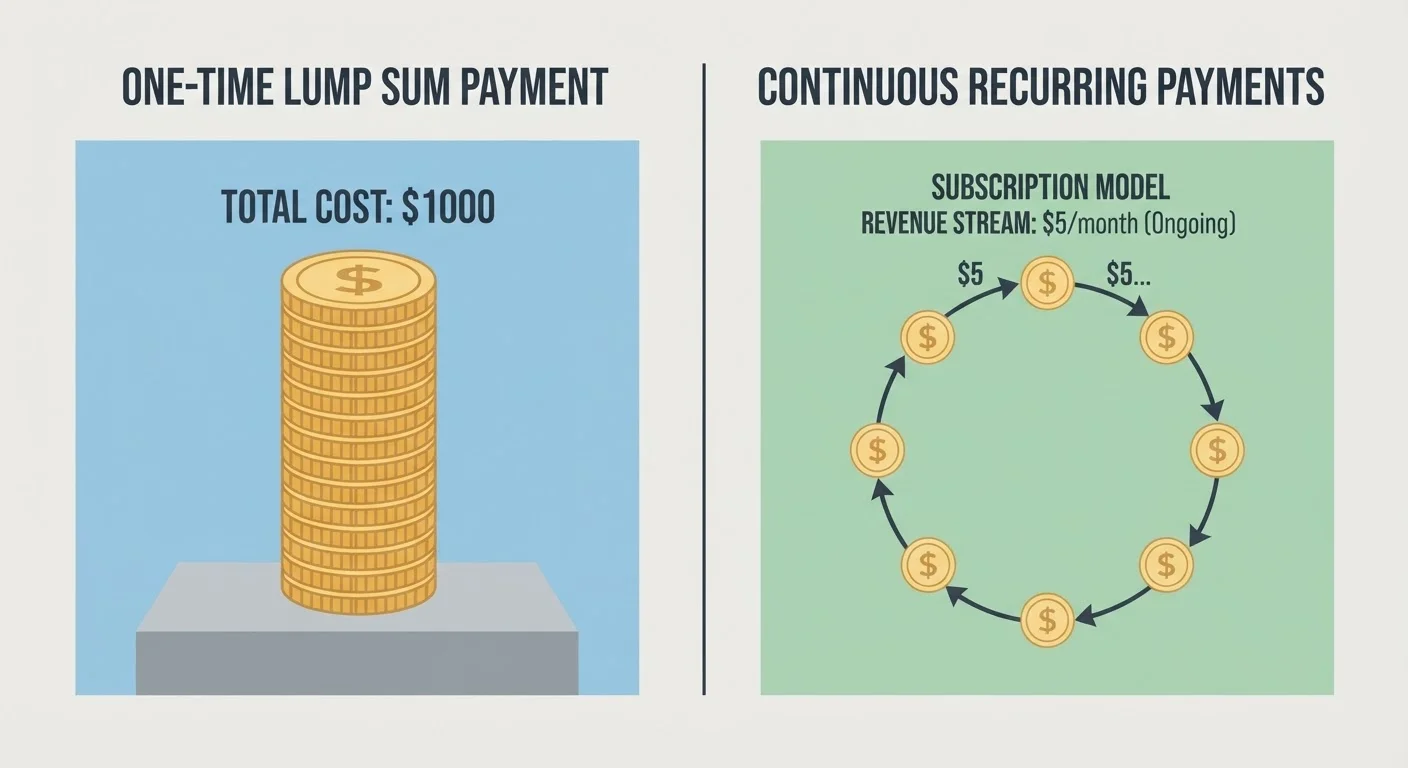
Option A
One-Time Purchase
Pay once, own it outright.
Best for: Consumers who want a defined, predictable cost and plan to use a product or tool long-term.
Option B
Subscription Model
Spread costs in exchange for ongoing access.
Best for: Consumers who need flexibility, frequent updates, or tools they use only occasionally.
The Core Difference: Ownership vs. Access
A one-time purchase transfers ownership to you. You pay a set amount and the product is yours indefinitely - no future payments required, no renewal reminders. A subscription, by contrast, sells you access. The moment payments stop, so does your use of the product or service.
This distinction matters more than most people realize. With ownership, your total cost is fixed from day one. With a subscription, your total cost grows every month you remain a customer - and most people dramatically underestimate how long that turns out to be.
The practical calculation is straightforward: divide the one-time purchase price by the monthly subscription rate. The result is the break-even month - the point at which a subscriber has paid as much as a buyer. Beyond that month, the subscriber is paying more. Understanding this number is the foundation of any honest comparison. For a deeper look at how usage patterns affect value judgments, see the cost-per-use framework - it applies directly here.
What Subscriptions Include That Purchases Often Don't
The comparison isn't purely about price. Subscriptions frequently bundle in services that a one-time purchase excludes: automatic software updates, cloud storage, customer support, cross-device access, and new features added after the initial release. For software, in particular, a perpetual license often freezes you at one version while subscribers receive improvements continuously.
This is a genuine value difference - not marketing language. If the updates are meaningful to how you use the product, they're worth factoring into the cost comparison. Conversely, if you've never used most of a subscription's features, those bundled extras aren't adding real value to your situation.
| Criterion | One-Time Purchase | Subscription |
|---|---|---|
| Total cost structure | Fixed, defined upfront | Ongoing, open-ended |
| Ownership | Full ownership | Access only |
| Updates & new features | Version at time of purchase | Typically included continuously |
| Upfront cash required | Higher | Lower |
| Risk of paying for unused access | Low - cost is sunk, not recurring | High - easy to forget and keep paying |
| Flexibility to stop | N/A - already purchased | High - cancel anytime (typically) |
| Best break-even scenario | Long-term, heavy usage | Short-term or infrequent usage |
The hidden costs shoppers overlook are relevant here too: one-time purchases can carry their own ongoing costs - maintenance, compatibility upgrades, or eventual replacement - that subscriptions absorb within their fee structure.
The Subscription Accumulation Problem
Individual subscriptions are priced to feel manageable. A few dollars per month rarely triggers scrutiny. But households now commonly hold streaming services, software suites, fitness apps, cloud storage plans, news publications, and more - each individually minor, collectively significant.
$273/mo
Average US household subscription spend
A 2022 survey by C+R Research found US consumers spend an average of $273 per month on subscription services, often underestimating their total by more than half.
~42%
Subscribers paying for unused services
The same C+R Research survey found roughly 42% of respondents were actively paying for at least one subscription they had forgotten about.
The practical risk is twofold. First, low monthly prices make it easy to forget you're subscribed at all - paying for access you stopped using months ago. Second, commitments that feel temporary often persist far longer than intended. A subscription rationalized as "just for now" has a tendency to quietly renew indefinitely.
Periodic audits - reviewing bank and credit card statements to catalog active subscriptions - are one of the most effective tools for household budget management. This connects to broader principles in budgeting basics: small recurring costs deserve the same scrutiny as large one-time expenses.
Running the Numbers: A Practical Framework
When facing a one-time vs. subscription decision, three questions structure an honest comparison:
- What is the break-even month? Divide the perpetual price by the monthly subscription cost. If the answer is 18 months, and you expect to use the product for three years, the one-time purchase likely saves money.
- How certain are your usage plans? Longer time horizons favor purchases; shorter, uncertain ones favor subscriptions. Spending more upfront can pay off - but only when you're confident in sustained use.
- What does the subscription include that the purchase doesn't? Assign real value (or zero value) to each bundled feature based on your actual habits, not theoretical ones.
Neither model is inherently wasteful. A subscription used daily for years may cost far less per use than a one-time purchase used sporadically. These trade-offs are structurally similar to the rent-vs.-own decisions consumers face in other domains - see how those dynamics play out in renting vs. buying a home for a comparable framework applied to real estate.
This article is for general informational and educational purposes only and does not constitute personalized financial advice. Consult a qualified financial professional for guidance specific to your circumstances.
The content on this site is for informational purposes only and is not a substitute for professional advice. Always consult a qualified professional for guidance specific to your situation.