

Our Verdict
Each of these three budgeting systems works best in a different context. The envelope method excels at curbing overspending in problem categories, zero-based budgeting suits those who want deliberate control over every dollar, and percentage methods provide an accessible framework for those who find detailed tracking burdensome. Your income structure, financial goals, and willingness to track spending closely should guide your choice.
| Best for | Recommended |
|---|---|
| Overspenders who need firm category limits | Envelope Method |
| Those who want complete visibility and intentionality over every dollar | Zero-Based Budgeting |
| Budgeting beginners or those with variable income seeking simplicity | Percentage Method (50/30/20) |
| People with irregular income or multiple financial goals | Hybrid approach combining elements of each |
How the Envelope Method Works
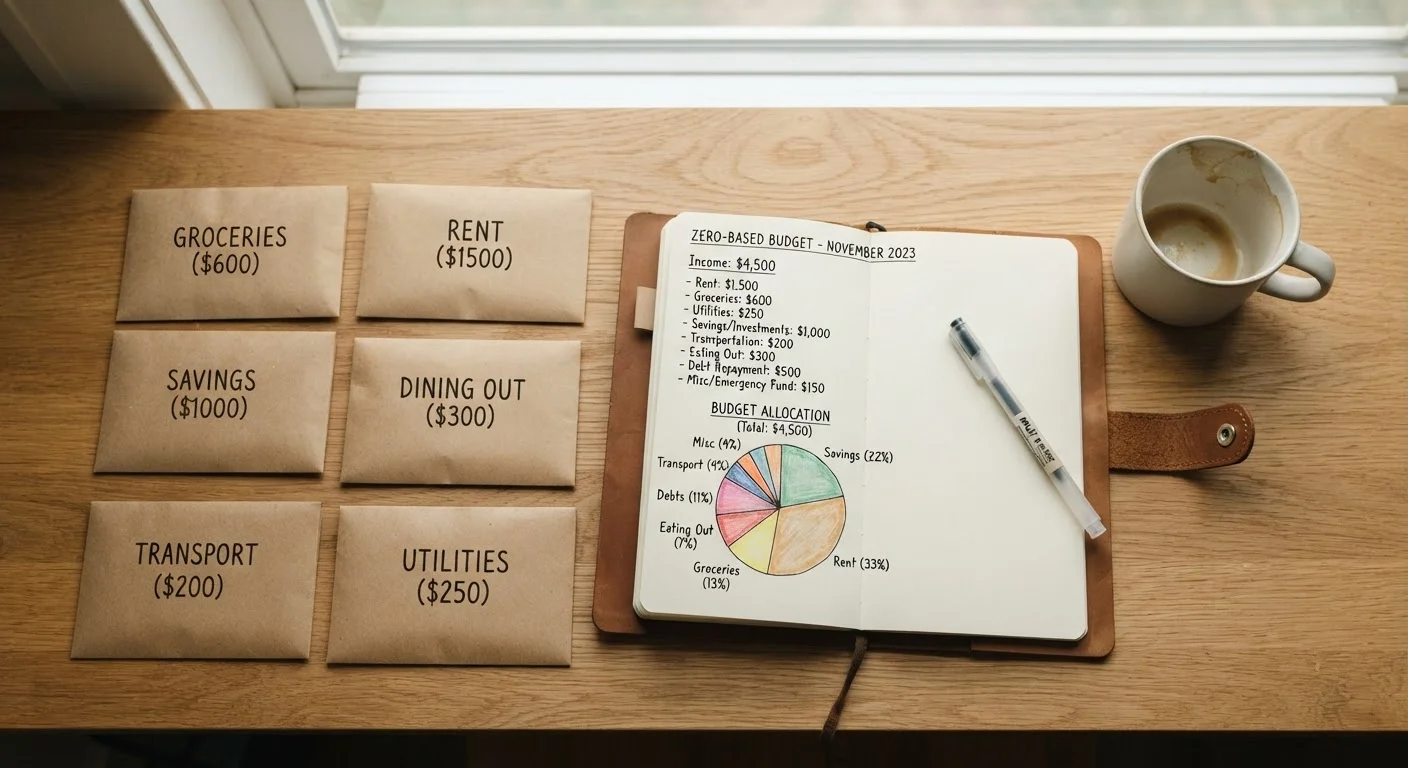
The envelope method divides your take-home income into discrete spending categories - groceries, gas, dining out, entertainment - and allocates a fixed cash amount to each. Traditionally, you place actual cash in labeled envelopes; when the envelope is empty, spending in that category stops until the next budgeting period. Digital versions replicate this logic using sub-accounts or budgeting apps.
This system's core strength is its tangible, real-time feedback. Spending physical cash activates a psychological awareness that card transactions often bypass. Research in behavioral economics consistently finds that people spend less when using cash compared to card payments, largely because the transaction feels more immediate.
The drawbacks are practical. Cash management is inconvenient for online purchases, subscriptions, and bill autopay. It also requires consistent replenishment and envelope sorting - a time commitment that can feel burdensome. For people with irregular incomes, setting fixed envelope amounts each cycle adds a layer of complexity.
Trying the Envelope Method Digitally
You don't need physical cash to use the envelope method. Many budgeting apps allow you to create virtual spending envelopes or sub-accounts that function identically. This preserves the psychological discipline of category limits while remaining compatible with card payments and online transactions. If you're curious how different tracking tools support this, see Tracking Your Spending: Spreadsheet, App, or Pen and Paper?.
How Zero-Based Budgeting Works
Zero-based budgeting (ZBB) starts with one rule: income minus all planned expenses, savings, and debt payments must equal zero. You're not aiming to spend everything - you're assigning every dollar a named job before the month begins. A dollar allocated to an emergency fund is as accounted for as one earmarked for rent.
This approach demands upfront effort. You map out all anticipated expenses at the start of each period, which forces genuine reflection on spending priorities. If a new expense arises mid-month, something else must be reduced - a built-in discipline mechanism. ZBB is particularly effective when saving toward a specific goal, paying down debt aggressively, or recovering from a period of financial disorganization.
The method's main friction point is time. Revisiting and adjusting the budget when income or expenses shift - which is routine for households with variable pay - can become tedious. Irregular expenses like car repairs or medical bills also require a dedicated buffer category, otherwise the entire budget can unravel. For a deeper look at what makes this approach effective and where it struggles, see The Case for a Zero-Sum Budget and Its Real Limitations.
How Percentage-Based Methods Work
Percentage methods divide income into broad buckets using fixed ratios. The most widely referenced framework is the 50/30/20 guideline: roughly 50% of after-tax income toward needs (housing, utilities, groceries), 30% toward wants (dining, subscriptions, hobbies), and 20% toward savings and debt repayment. The specific percentages aren't rigid prescriptions - they serve as a starting reference that households can adjust based on their situation.
The appeal is simplicity. There's no envelope to refill, no line-by-line accounting. A rough monthly calculation tells you whether your broad categories are proportionate. This makes the method accessible for people new to budgeting or those who find granular tracking unsustainable.
The limitation is precision. Grouping all "needs" into one large bucket can mask overspending within that category. Someone spending 48% of income on housing and utilities alone may technically be within the needs bucket while having almost nothing left for food. Without subcategory visibility, problems can accumulate quietly. Those new to this structure may find Building Your First Budget From a Blank Slate a useful starting point before applying any framework.
| Envelope Method | Zero-Based Budgeting | Percentage Method (50/30/20) | |
|---|---|---|---|
| Core mechanic | Fixed cash per category | Every dollar assigned a job | Income split by broad ratios |
| Setup effort | Moderate - fill envelopes each period | High - plan all expenses upfront | Low - calculate broad percentages |
| Ongoing maintenance | Moderate - track per envelope | High - adjust throughout month | Low - periodic check-ins |
| Best income type | Steady, predictable income | Steady or goal-driven income | Any income type |
| Spending visibility | High - per category | Very high - per dollar | Low - broad buckets only |
| Flexibility | Low - hard category limits | Moderate - requires reallocation | High - ratios are guidelines |
| Ideal for | Curbing category overspending | Goal-focused or debt repayment | Beginners or simple households |
Choosing the Right Fit - or Combining Approaches
No budgeting method is inherently superior. The practical question is which system you'll consistently use - because an imperfect budget that you follow produces better results than a theoretically ideal one you abandon. Consider your income structure: salaried workers with predictable monthly pay can plan more reliably than those with freelance or commission-based income, who may need more flexible frameworks.
Consider also your weakest financial habits. If overspending in specific categories is the problem, the envelope method's hard limits offer direct accountability. If you've never tracked spending at all, percentage ratios give you a structure to start with. If you're intensely goal-driven - saving a down payment, eliminating credit card debt - zero-based budgeting's precision keeps goals front and center each month.
Many households find that a hybrid approach works well in practice: using percentage targets for overall structure while applying envelope-style limits to historically problematic categories. For practical tools to implement any of these approaches, the Tracking Your Spending: Spreadsheet, App, or Pen and Paper? comparison covers the trade-offs of each tracking method. You can also explore the full range of budgeting guidance in the Budgeting Basics hub.
This article is for general informational and educational purposes only and does not constitute personalized financial advice. Consult a qualified financial professional for guidance specific to your situation.
The content on this site is for informational purposes only and is not a substitute for professional advice. Always consult a qualified professional for guidance specific to your situation.