

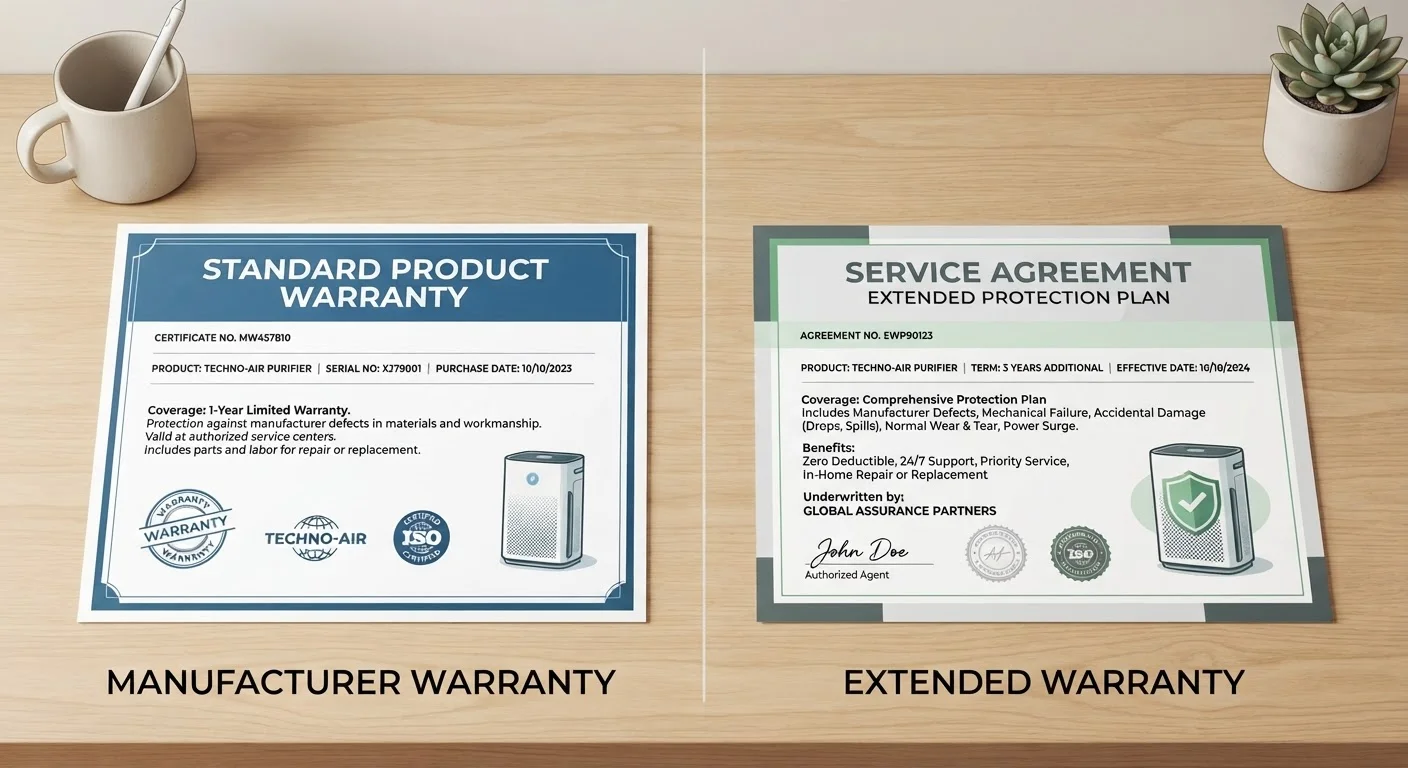
Our Verdict
Manufacturer warranties offer standardized, no-cost protection against defects and are generally straightforward to use. Extended warranties can provide value in specific situations, but only when the contract terms are transparent, the exclusions are minimal, and the cost aligns with realistic repair risk. For most consumers, the decision hinges on reading the fine print carefully rather than relying on sales pitches.
| Best for | Recommended |
|---|---|
| Consumers who want guaranteed baseline protection with no added cost | Manufacturer Warranty |
| Buyers of high-mileage or out-of-warranty used vehicles with complex systems | Extended Warranty (with thorough contract review) |
| Those purchasing certified pre-owned vehicles already carrying extended factory coverage | Manufacturer Warranty |
| Buyers who want repair cost predictability over several years post-warranty | Extended Warranty (if exclusions are limited and provider is reputable) |
How Manufacturer Warranties Work
A manufacturer warranty - sometimes called a factory warranty - is a written promise from the automaker that the vehicle is free from defects in materials or workmanship. It comes with the purchase price and requires no additional payment. Most new vehicles carry two distinct layers:
- Bumper-to-bumper (comprehensive) warranty: Covers most vehicle components, typically for three years or 36,000 miles, whichever comes first.
- Powertrain warranty: A longer, narrower guarantee - commonly five years or 60,000 miles - focused on the engine, transmission, and drivetrain components.
Some automakers extend separate coverage for emissions-related parts or battery systems in hybrid and electric vehicles, driven in part by federal regulatory requirements. Coverage terms vary by manufacturer, so the exact duration and scope should be confirmed in the vehicle's warranty booklet.
A key practical advantage: factory warranty repairs are performed at authorized dealerships using manufacturer-approved parts, and there are typically no deductibles or claim paperwork involved for covered failures.
For context on how this plays out with certified pre-owned vehicles - which often carry extended or transferred factory warranties - see what CPO designations actually cover.
What Extended Warranties Actually Are
The term "extended warranty" is widely used in marketing, but the more precise legal term is service contract. Unlike a manufacturer warranty, a service contract is a separately purchased agreement - typically sold by a dealership, automaker, or third-party administrator - that obligates the provider to pay for certain repairs after specified conditions are met.
This distinction matters. Service contracts are regulated differently from warranties in many states, and the entity you're contracting with may not be the automaker. If a third-party provider goes out of business, the contract may become worthless.
Extended warranties vary along several key dimensions:
- Coverage type: "Exclusionary" contracts list what's not covered (generally broader coverage); "inclusionary" contracts list only what is covered (often more limited).
- Deductibles: Many contracts require a per-visit or per-repair deductible, ranging from $0 to $200 or more.
- Repair network: Some contracts restrict where you can have the vehicle serviced; others allow any licensed mechanic.
- Claims process: Pre-authorization requirements and reimbursement timelines differ significantly by provider.
If you're evaluating an extended warranty for a used vehicle specifically, the coverage details and exclusions for used-car extended warranties deserve close attention before signing.
| Manufacturer Warranty | Extended Warranty (Service Contract) | |
|---|---|---|
| Cost to consumer | Included in purchase price | Separate, additional cost |
| Who provides coverage | Automaker directly | Automaker, dealer, or third party |
| Coverage scope | Defects in materials/workmanship | Varies; defined by contract terms |
| Deductibles | Typically none | Often $0-$200 per visit or repair |
| Repair location | Authorized dealerships only | Varies; some allow any licensed shop |
| Exclusions | Maintenance, wear items, owner damage | Maintenance, wear items, plus listed exclusions |
| Financial risk if provider fails | Low - backed by automaker | Higher with third-party providers |
What Neither Type Covers
Both manufacturer warranties and extended service contracts share a set of common exclusions that consumers frequently misunderstand:
- Routine maintenance: Oil changes, tire rotations, brake pad replacements, and scheduled service are almost never covered.
- Wear items: Brake pads, wiper blades, filters, and tires wear out predictably and are excluded from virtually all warranty coverage.
- Owner-caused damage: Accidents, improper fluid use, off-road damage, or neglect-related failures will typically void related warranty claims.
- Pre-existing conditions: Extended warranties purchased after a problem has developed will not cover that condition - and some contracts exclude failures that stem from deferred maintenance.
"Comprehensive" Doesn't Mean Everything Is Covered
Service contract marketing often uses terms like "bumper-to-bumper" or "comprehensive" that are not legally defined in the contract itself. Only the written exclusion list determines actual coverage. Always request the full sample contract before purchasing and review the exclusions section specifically - not just the summary brochure.
Understanding these gaps is as important as understanding what is covered. Consumers who assume a service contract functions like insurance against any mechanical failure are frequently disappointed when a claim is denied on exclusion grounds.
Evaluating Whether an Extended Warranty Makes Financial Sense
The value of an extended warranty depends on several factors specific to the vehicle and the buyer's situation. General questions worth asking before purchasing:
- What is the vehicle's reliability record? Vehicles with lower historical repair frequencies may make extended coverage less cost-effective.
- Does the manufacturer warranty still have time remaining? Purchasing coverage that overlaps with existing factory protection means paying for redundant coverage.
- What is the total cost of the contract, including deductibles? Compare that to the realistic repair costs for the specific vehicle make and model.
- Who backs the contract? Manufacturer-backed service contracts generally carry less financial risk than those from independent third parties.
- What does the exclusion list actually say? Marketing terms like "comprehensive" or "bumper-to-bumper" are not legally defined in service contracts; only the written contract terms bind the provider.
When evaluating a dealer's finance office pitch on extended warranties as part of a broader purchase, a structured look at dealer add-ons at signing provides useful context for the full range of products typically offered.
This article is for general informational purposes only and does not constitute legal or financial advice. Consumers should read all contract terms carefully and consult qualified professionals for guidance specific to their situation.
The content on this site is for informational purposes only and is not a substitute for professional advice. Always consult a qualified professional for guidance specific to your situation.