

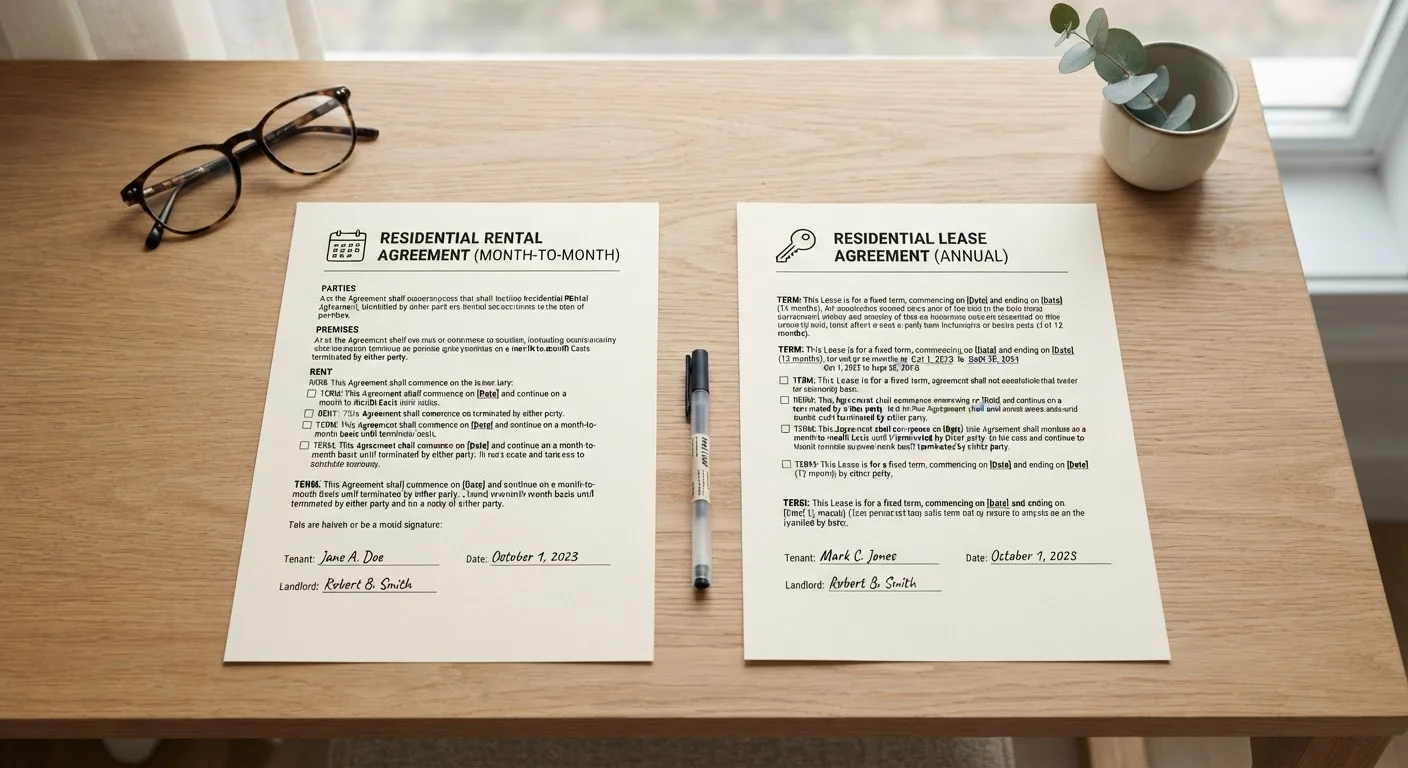
Option A
Month-to-Month Lease
The flexible, short-commitment rental arrangement.
Best for: Renters who need mobility, expect life changes, or are in transitional housing situations.
Option B
Fixed-Term Lease
The stable, predictable long-term rental structure.
Best for: Renters who want locked-in rent, housing security, and plan to stay in one place for at least a year.
What Each Lease Structure Actually Means
A month-to-month lease (also called a periodic tenancy) renews automatically each month unless either party gives written notice to end it. Most states require 30 days' notice from either side, though some require 60 days, particularly for longer-standing tenancies. This structure offers freedom on both sides - but that freedom cuts both ways.
A fixed-term lease - most commonly 12 months - sets a defined start and end date. During that period, the landlord generally cannot raise the rent or end the tenancy without legal cause. At the end of the term, the tenant and landlord must decide: renew, renegotiate, or part ways.
For a deeper look at what the language inside either type of contract actually obligates you to, see what lease clauses actually mean in plain English.
| Criterion | Month-to-Month | Fixed-Term (12-Month) |
|---|---|---|
| Commitment length | Renews each month | Set end date (typically 12 months) |
| Typical monthly cost | Often 10-25% higher | Standard market rate |
| Rent increase risk | Possible with 30-60 days notice | Locked in for lease term |
| Landlord termination notice | 30-60 days (state-dependent) | Cannot end without legal cause |
| Early exit costs | Minimal - standard notice period | Potentially significant penalties |
| Housing security | Lower - can be ended anytime | Higher - protected for lease term |
| Best market condition | Soft or transitional market | Competitive, high-demand market |
The Real Trade-Offs: Flexibility vs. Stability
Month-to-month leases are genuinely flexible - but that flexibility has a cost. Landlords routinely charge a premium of 10-25% above market rate for month-to-month arrangements, since the shorter commitment increases their vacancy risk. A landlord can also end your tenancy with proper notice at any time, for any lawful reason. In tight rental markets, that exposure is significant.
Fixed-term leases, by contrast, protect both parties. You know your rent won't change mid-year. The landlord knows their unit is occupied. But if your circumstances shift - a new job in another city, a family emergency, a relationship change - you may face steep consequences for breaking the lease early. These can include paying rent for the remaining months, a flat fee, or forfeiture of your security deposit. State laws vary widely, and some jurisdictions require landlords to make reasonable efforts to re-rent the unit, which can limit your liability.
If you're thinking ahead to what comes after renting altogether, the financial and lifestyle trade-offs between renting and buying lays out the full picture.
State Law Shapes Your Rights Significantly
Tenant protections around notice periods, rent increases, and early-termination liability vary considerably by state - and sometimes by city or county. California, New York, and Oregon, for example, have stronger tenant protections than many other states. Before signing any lease, it's worth reviewing your state's landlord-tenant statutes or consulting a local tenant rights organization to understand exactly what protections apply to you.
How to Match the Lease Type to Your Life Right Now
The right lease structure is rarely about one being objectively better - it depends on where you are in life and how much certainty you have about the next 12 months.
Choose month-to-month if:
- Your job situation is uncertain or you're between career moves
- You're exploring a new city before deciding where to put down roots
- You're waiting to close on a home purchase and need interim housing
- Your household size may change soon (a new partner, a child, an aging parent)
Choose a fixed-term lease if:
- You're confident you'll stay for at least a year
- You want protection against rent increases in a competitive market
- You need housing stability for school enrollment, childcare, or a commute
- You're building a rental history to support a future mortgage application
Once you've chosen a structure, remember that many terms within the lease itself are negotiable. Learn which lease terms tenants can actually push back on before you sign.
And if you're already in a fixed-term lease and need to leave early, everything renters need to know about breaking a lease early covers your realistic options, costs, and obligations.
~43M
Renter households in the US
According to US Census Bureau data, approximately 43 million American households rent their primary residence, underscoring how consequential lease choices are at scale.
30-60
Days notice to end a month-to-month tenancy
Most US states require 30 days' notice to terminate a month-to-month lease; some require 60 days for tenants who have rented for longer periods.
12 months
Most common fixed-term lease length
One-year leases are the standard in the US residential rental market, though six-month and two-year terms exist in some markets and property types.
The content on this site is for informational purposes only and is not a substitute for professional advice. Always consult a qualified professional for guidance specific to your situation.