

Summary
24 items · 1.5-3 hours
Why Reassess Every Season?
Clutter rarely arrives all at once. It accumulates in slow, invisible layers - a stack of mail here, an outgrown jacket there - until one day a drawer won't close or a closet becomes something you dread opening. Tying a reassessment to the change of each season gives you a natural, built-in prompt to reset before things reach that point.
Each season genuinely brings different needs. Clothing rotates. Holiday supplies come out and need to go back. Kids outgrow gear between school years. Kitchen gadgets used for summer entertaining collect dust by November. Treating your home as a living system - one that requires periodic maintenance just like your yard or your car - keeps it functioning the way you need it to.
If you also do periodic financial check-ins, you may already know this feeling of clarity that comes from a structured review. The same principle applies here. Just as a financial health audit helps you see where resources are going, a seasonal home audit helps you see where space is going.
Four-container sorting system
Use clearly labeled bins or bags for donate, relocate, recycle, and trash to make decisions faster and prevent sorted items from drifting back into the wrong place.
Permanent marker and adhesive labels
Label storage boxes, bins, and shelves so relocated items have a defined home and are easy to find next season.
Handheld scanner or smartphone scanning app
Digitize important paper documents before shredding originals, reducing physical paper storage significantly.
Medication take-back program locator
Use the U.S. DEA's drug disposal resource or your local pharmacy's take-back program to safely discard expired medications rather than flushing them.
Donation bag or box (pre-staged)
Keep a dedicated bag in a closet year-round so items identified for donation between seasonal reviews have an immediate destination.
How to Use This Checklist
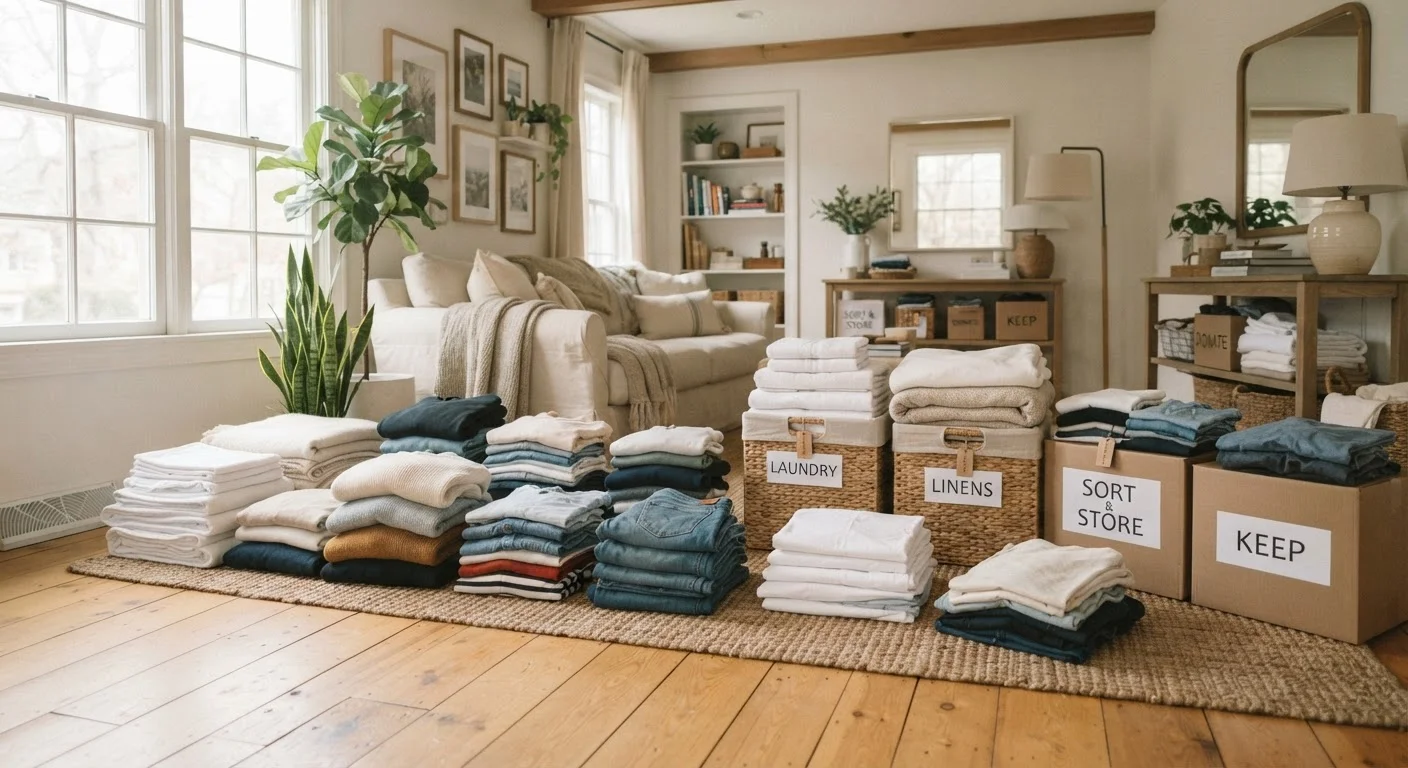
Work through one zone at a time rather than trying to tackle the whole house in a single session. Set a timer for 20-30 minutes per area to keep momentum without burning out. Keep four containers nearby as you go: one for items to donate, one for items to relocate to their proper home, one for recycling, and one for trash.
Paperwork deserves its own focused block of time. It is one of the most persistent sources of household clutter because paper arrives every single day and rarely gets sorted on impact. For a deeper look at where paper clutter originates and how to manage it consistently, see our guide on managing paper clutter at home.
Avoid the 'Maybe' Pile Trap
A maybe pile feels like progress but often becomes a second storage problem. If you cannot make a decision about an item within 30 seconds, ask one clarifying question: 'Would I go out of my way to replace this if it were gone?' If the honest answer is no, it likely belongs in the donate or discard pile. Indefinite indecision is how clutter outlasts the declutter session.
Once you have completed the checklist, schedule your next seasonal reassessment before closing out this one. Adding it to a calendar - even just a rough reminder - dramatically increases the chance you will follow through.
Clothing & Accessories
Kitchen & Pantry
Paperwork & Digital Files
Bathrooms & Medicines
Bedroom & Linens
Common Areas & Storage Zones
After the Declutter: Making It Stick
Finishing a seasonal declutter feels genuinely satisfying, but the habit only compounds in value if the systems you put in place hold between sessions. Assign every category of item a designated home, and return things to that home consistently. When a new item comes in, ask honestly whether something else should leave to make room for it.
If your seasonal reassessment surfaces items in the garage, garden shed, or patio - particularly outdoor gear at the end of summer or winter equipment at the close of cold months - consider pairing this checklist with outdoor seasonal prep. Our fall lawn care checklist covers the outdoor counterpart to this indoor reset.
The goal is not a perfectly minimalist home. It is a home where you can find what you need, where nothing is being kept purely out of habit or guilt, and where the space actively supports how you live right now - not how you lived two or three years ago.
Dispose of Medications Safely
Never flush medications down the drain or throw them in household trash unless the label specifically instructs it. Many pharmacies and law enforcement agencies participate in safe medication disposal programs. The U.S. Drug Enforcement Administration maintains a searchable database of authorized collection sites at deadiversion.usdoj.gov. Improper disposal can harm water systems and poses risks if accessed by children or pets.
The content on this site is for informational purposes only and is not a substitute for professional advice. Always consult a qualified professional for guidance specific to your situation.