

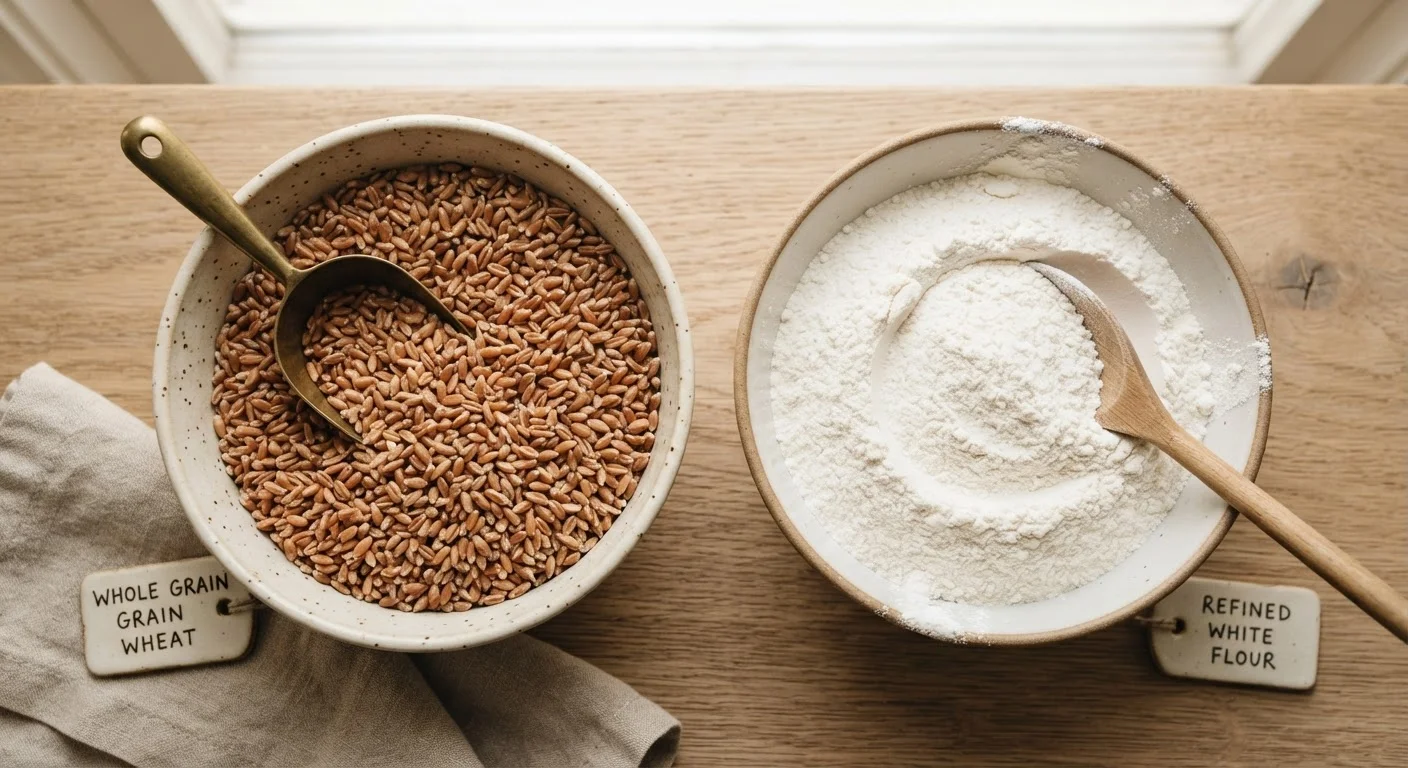
Option A
Whole Grains
The nutritionally complete, minimally processed option.
Best for: People seeking more fiber, vitamins, and minerals from their everyday carbohydrate sources.
Option B
Refined Grains
The widely available, texturally familiar staple.
Best for: Convenience-focused eating where shelf life and texture are priorities, at the cost of some nutritional density.
Anatomy of a Grain Kernel
To understand what processing changes, it helps to know what a grain kernel actually contains. Every whole grain - whether wheat, oats, brown rice, or barley - is made up of three distinct parts:
- Bran: The fibrous outer shell, rich in dietary fiber, B vitamins, and trace minerals such as iron and zinc.
- Germ: The nutrient-dense embryo of the kernel, containing healthy fats, vitamin E, B vitamins, and antioxidants.
- Endosperm: The starchy interior that provides carbohydrates and some protein, but relatively little fiber or micronutrients.
When the U.S. Food and Drug Administration defines a whole grain product, it requires that all three parts be present in their natural proportions. Refined grains, by contrast, are milled to remove the bran and germ entirely - leaving only the endosperm.
What Milling Actually Removes
Milling was developed to improve shelf life and create the smoother textures consumers associate with white flour, white rice, and similar products. The bran and germ contain oils that can turn rancid; removing them makes refined grains more shelf-stable. But the nutritional tradeoffs are significant.
| Criterion | Whole Grains | Refined Grains |
|---|---|---|
| Kernel parts present | Bran, germ, and endosperm | Endosperm only |
| Dietary fiber | High | Low (mostly removed) |
| B vitamins | Naturally present | Mostly removed; some restored via enrichment |
| Vitamin E | Present (in germ) | Essentially eliminated |
| Shelf life | Shorter (germ oils can oxidize) | Longer |
| Blood glucose response | More gradual | Typically faster |
| Common examples | Oats, brown rice, whole wheat bread | White flour, white rice, white bread |
Research published in journals such as the American Journal of Clinical Nutrition consistently shows that refining reduces dietary fiber by roughly 75-80%, along with meaningful losses of magnesium, phosphorus, potassium, and the B vitamins thiamine, riboflavin, niacin, and folate. Vitamin E, found almost exclusively in the germ, is essentially eliminated.
Enrichment - a process required by U.S. law for many refined grain products - adds back iron and four B vitamins: thiamine, riboflavin, niacin, and folic acid. This helps address certain deficiency concerns but does not fully replicate the original nutritional profile. Fiber, vitamin E, magnesium, and phytochemicals are not restored through standard enrichment.
What 'Enriched' Actually Means
In the United States, federal standards require that most refined wheat flour products be enriched with four B vitamins (thiamine, riboflavin, niacin, and folic acid) and iron. This enrichment was introduced partly to address deficiency-related public health concerns. However, enrichment does not restore dietary fiber, vitamin E, magnesium, or the range of phytochemicals naturally found in the bran and germ. It is a partial nutritional restoration, not a full one.
How the Distinction Shows Up in Health Research
The body of evidence linking whole grain consumption to health outcomes is substantial. The CDC and major nutrition bodies such as the Dietary Guidelines Advisory Committee note that diets higher in whole grains are associated with lower risk of cardiovascular disease, type 2 diabetes, and certain digestive conditions.
~3 servings/day
Whole grain intake linked to heart health benefits
The Dietary Guidelines for Americans recommend at least half of all grains consumed be whole grains, roughly equivalent to three or more servings daily.
~25%
Of Americans meet whole grain recommendations
CDC and USDA dietary survey data consistently show that the majority of Americans fall short of recommended whole grain intake.
Up to 21%
Lower type 2 diabetes risk associated with whole grains
A meta-analysis in the journal Diabetes Care found that higher whole grain consumption was associated with a meaningful reduction in type 2 diabetes risk compared to lower intake.
Much of this benefit is attributed to dietary fiber, which slows digestion, supports beneficial gut bacteria, and contributes to more gradual blood glucose responses after meals. The antioxidants and phytochemicals naturally present in the bran and germ may also play a supporting role, though research in this area is ongoing.
It is worth noting that grain type is just one element of an overall dietary pattern. Eating whole grains alongside a varied, balanced diet - rather than treating them as a single solution - is the approach most consistently supported by nutritional science. Just as the source of carbohydrates matters, so does the source of sugars; for a related perspective, see our article on added sugar vs. natural sugar.
Reading Labels to Identify What You're Actually Buying
Food packaging can be misleading. Terms like "multigrain," "made with whole grain," or "wheat bread" do not guarantee that a product contains predominantly whole grains. A few reliable strategies can help:
- Check the ingredient list first: The first ingredient should include the word "whole" - for example, "whole wheat flour" or "whole oat flour." If it simply says "wheat flour" or "enriched flour," the bran and germ have been removed.
- Look for the fiber content: Products genuinely high in whole grains will typically show at least 2-3 grams of dietary fiber per serving.
- Be skeptical of color: Brown color in bread or crackers can come from added molasses or caramel coloring rather than whole grain content.
Understanding these distinctions puts practical knowledge in your hands at the grocery store, without requiring a nutrition degree. As with all dietary decisions, consulting a registered dietitian or qualified healthcare provider can help you apply this information to your specific health needs and goals.
This article is for general informational and educational purposes only and does not constitute medical or dietary advice. Always consult a qualified healthcare professional before making significant changes to your diet.
The content on this site is for informational purposes only and is not a substitute for professional advice. Always consult a qualified professional for guidance specific to your situation.