

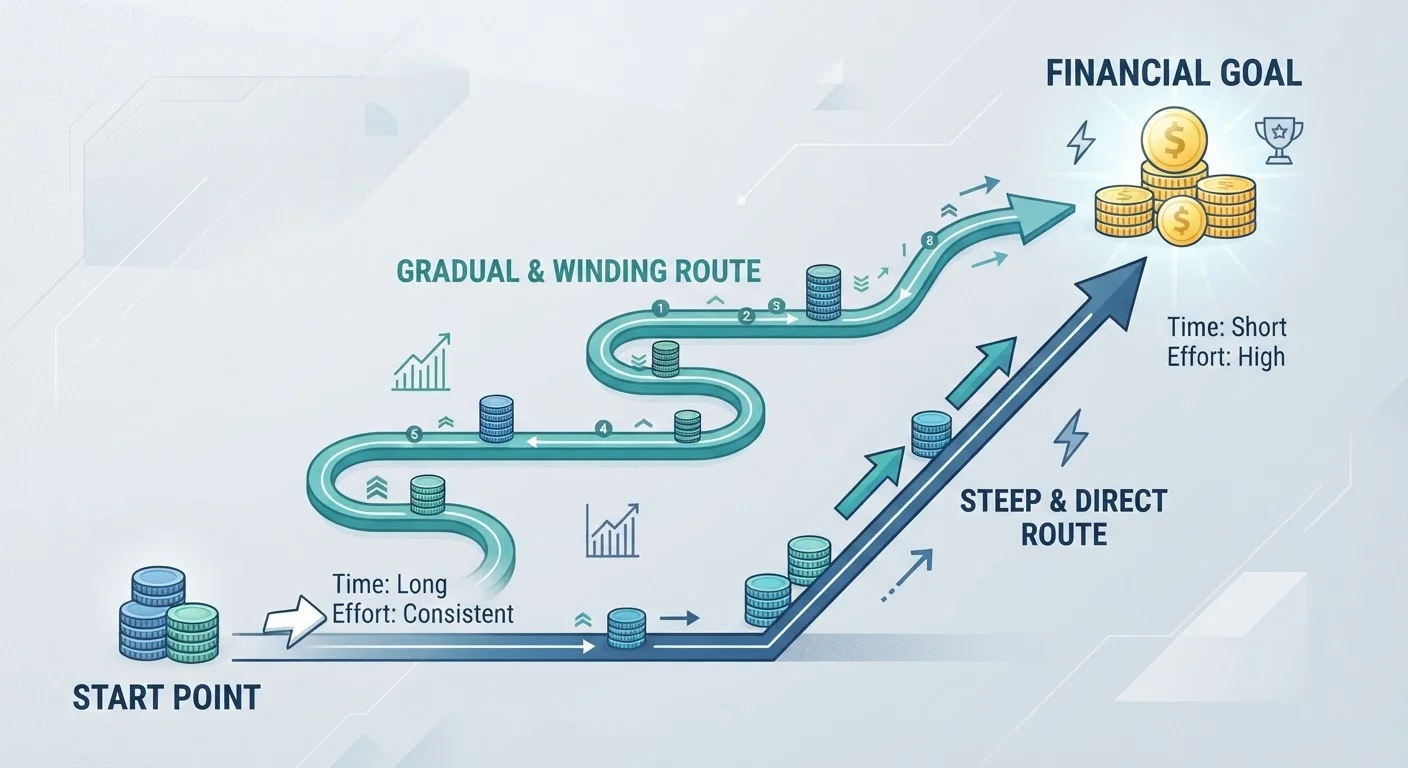
Option A
Debt Avalanche
The mathematically optimal, interest-minimizing approach.
Best for: Readers who are motivated by saving money on interest and comfortable staying the course without quick wins.
Option B
Debt Snowball
The behaviorally driven, momentum-building approach.
Best for: Readers who need early wins to stay engaged and find motivation from seeing accounts closed off one by one.
How Each Strategy Works
Both the debt avalanche and the debt snowball are structured payoff methods that share a common mechanic: you make minimum payments on all debts, then direct any additional available dollars toward one target account. The difference lies entirely in how you choose that target.
With the debt avalanche, you rank your debts by annual percentage rate (APR) - the yearly cost of borrowing - and focus extra payments on the highest-rate debt first. Once that balance reaches zero, you roll its payment amount onto the next-highest-rate debt, and so on. Because interest compounds on your outstanding balance, eliminating the costliest debt first limits how much interest can accumulate overall.
With the debt snowball, you rank debts by balance size and attack the smallest one first, regardless of its interest rate. As each small account is paid off, its payment amount is added to the next-smallest debt's payment - creating a growing "snowball" of money applied to each successive balance. The appeal is speed: smaller balances disappear faster, and every closed account is a tangible milestone.
If you're newer to building a structured payoff plan, the introductory guide to saving and debt management covers the foundational concepts worth understanding first.
| Criterion | Debt Avalanche | Debt Snowball |
|---|---|---|
| Payoff order | Highest APR first | Smallest balance first |
| Total interest paid | Lower (mathematically) | Potentially higher |
| Speed to first win | Slower if highest-rate debt is large | Faster - smallest balance clears first |
| Psychological motivation | Requires patience and discipline | Early wins build momentum |
| Complexity | Low - rank by APR | Low - rank by balance |
| Best suited for | High-rate debt, data-driven personalities | Multiple small debts, motivation-focused |
| Cash-flow flexibility early on | Less, until high-rate debt clears | More, as small accounts close quickly |
Where They Diverge: Cost vs. Commitment
The central trade-off between these two methods is financial efficiency versus behavioral sustainability.
Studies in behavioral economics - including research associated with Harvard Business School - have found that people paying off debt tend to stay more engaged when they can see accounts being eliminated, even if those accounts aren't the most expensive to carry. This supports the snowball's logic: if a method keeps you consistent, it may outperform a theoretically superior strategy you abandon midway through.
That said, the cost difference between the two methods can be meaningful. If you carry a high-APR balance - such as credit card debt in the 20-25% range - leaving it in place while clearing smaller, lower-rate accounts allows significant interest to accumulate. The avalanche directly addresses this.
20-30%
Typical credit card APR range in the U.S.
The Federal Reserve reports that average credit card interest rates have ranged from roughly 20% to over 27% in recent years, underscoring why high-rate balances compound quickly.
77%
Americans carrying some form of debt
According to Experian's annual State of Credit report, the large majority of U.S. consumers carry at least one type of debt, making structured payoff strategies broadly relevant.
A useful framing: think of the avalanche as optimizing for dollars saved, and the snowball as optimizing for psychological momentum. Neither is universally right. For many people, the "best" strategy is simply the one they'll actually stick to - and that depends on individual temperament as much as on the numbers.
For a broader look at how debt payoff strategies fit alongside savings goals, see this complete guide to managing both goals together.
Pairing Debt Payoff with an Emergency Fund
One question that often arises is whether to build an emergency fund before or during debt payoff. This matters because, without any financial cushion, an unexpected expense - a car repair, a medical bill - can force new debt, undermining your progress.
Most personal finance educators suggest having at least a small emergency reserve (commonly cited as $500-$1,000) before aggressively targeting debt, then growing that fund toward three to six months of essential expenses over time. The framework for saving and paying down debt simultaneously offers a structured way to think through this balance.
The snowball can be a natural fit here: as small debts close, the minimum payments that were tied up in those accounts become available - some of which can be directed to savings rather than entirely to the next debt. The avalanche requires patience before that first account closes, which may mean less short-term cash-flow flexibility.
It's also worth noting that debt payoff and emergency savings aren't the only options on the table. Debt consolidation is another approach some borrowers consider, though it comes with its own trade-offs and isn't appropriate for every situation.
This article is for general informational and educational purposes only and does not constitute personalized financial, tax, or legal advice. Consult a qualified financial professional before making decisions about your specific debt or savings situation.
The content on this site is for informational purposes only and is not a substitute for professional advice. Always consult a qualified professional for guidance specific to your situation.