

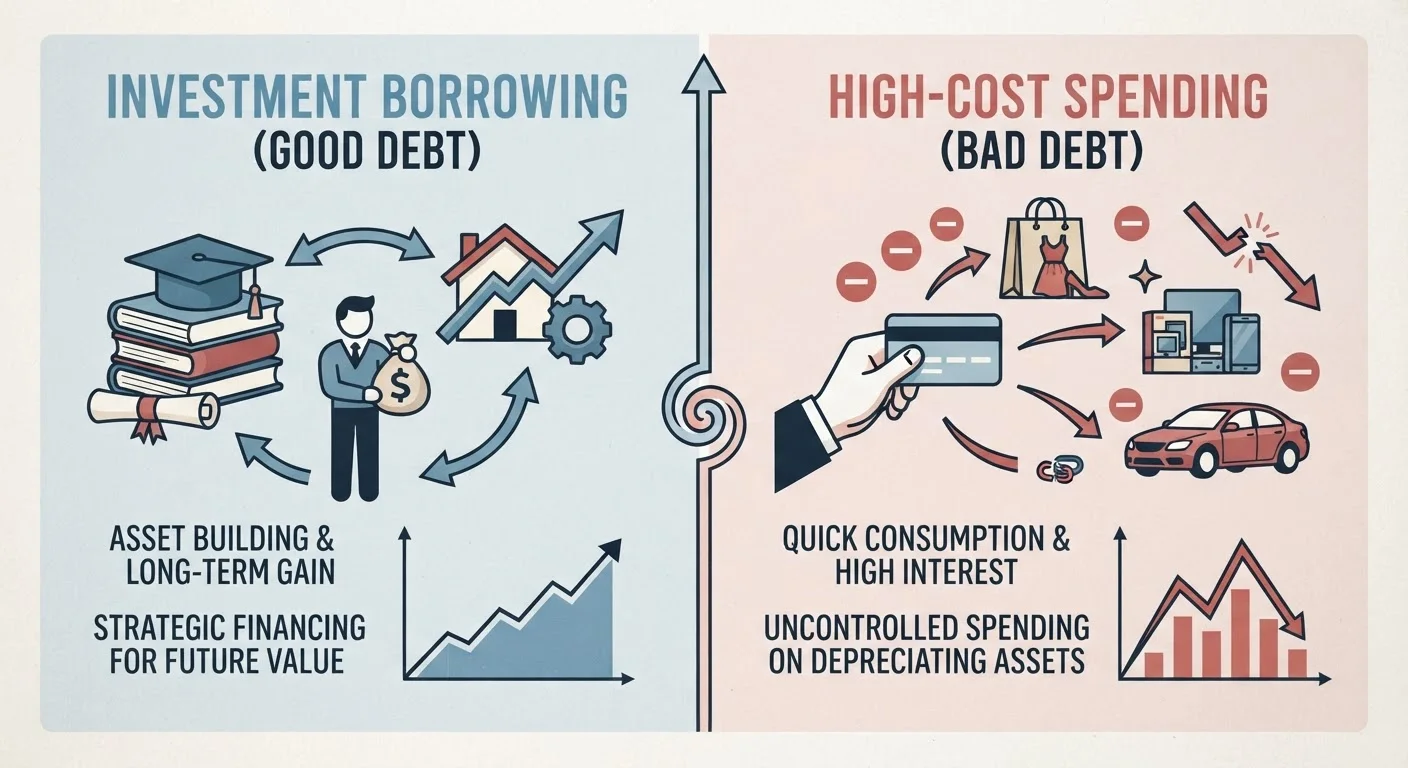
Where the Good/Bad Framework Comes From
The idea that some debt is "good" and some is "bad" became widely popular through personal finance books and media in the late 20th century. At its core, the framework tries to answer a simple question: does this borrowing make you financially better off over time, or does it make things worse?
Financial educators typically define good debt as borrowing that either finances an asset likely to appreciate - such as a home - or that increases your long-term earning capacity, such as a degree in a field with strong employment prospects. Bad debt, by contrast, tends to finance consumption: things you use up, things that lose value quickly, or things purchased primarily on impulse.
The interest rate is a central variable. Debt at a rate lower than what you might reasonably expect to earn on invested capital has a different economic character than debt at 24% APR. That rate gap is part of why revolving credit card balances are so consistently cited as damaging - the cost of carrying the balance typically exceeds any reasonable investment return.
That said, the labels are shorthand. Common myths about paying off debt often stem from treating these categories as rigid rules rather than rough guides.
What Makes Debt "Good" - and the Caveats
Mortgages, federally subsidized student loans, and small business loans are the most frequently cited examples of good debt. Each can, under the right conditions, generate returns that outpace the cost of borrowing. A mortgage builds equity in an asset that historically appreciates, and the interest may offer tax advantages. A student loan can pay off when it leads to meaningfully higher lifetime earnings. A business loan can fund revenue growth that exceeds the debt service cost.
~$1.14T
Total U.S. credit card debt outstanding
According to the Federal Reserve Bank of New York's consumer credit data, revolving credit card balances have reached historically elevated levels in recent years.
20%+
Average credit card APR in the U.S.
The Federal Reserve's consumer credit data has tracked average credit card interest rates rising well above 20% for accounts assessed interest, underscoring the cost of carrying balances.
36%
Common debt-to-income ceiling used by lenders
Many conventional mortgage lenders use a 36% total debt-to-income ratio as a general guideline, though individual underwriting standards vary by institution and loan type.
But the "good" label comes with real conditions. A mortgage stretched beyond your budget is not good debt - it is a liquidity risk. A student loan taken for a credential with limited job prospects at a salary that won't cover repayment is not good debt. A business loan for a venture with no viable revenue model is not good debt.
Your debt-to-income ratio - the share of your gross monthly income consumed by debt payments - is one concrete way to assess whether even low-rate debt is becoming a strain. Lenders generally prefer to see this figure below 36%, though individual circumstances vary.
This article is for general informational and educational purposes only and does not constitute personalized financial, investment, tax, or legal advice. Consult a qualified financial professional before making decisions about your own situation.
What Makes Debt "Bad" - and Why Context Still Matters
High-interest consumer debt - primarily credit card balances and some personal loans - fits the "bad debt" category most cleanly. The interest rates are high, the purchases financed rarely appreciate, and minimum payments are structured to keep balances outstanding for years. The compounding interest erodes purchasing power in the opposite direction from compounding investment returns.
A household carries a $6,000 credit card balance at 21% APR from a combination of holiday spending and a home appliance replacement.
A first-generation college graduate takes out federal student loans at a fixed rate of 5.5% to complete a nursing degree, then secures employment in the field.
A self-employed contractor takes out a high-fee, short-term payday loan to cover a gap between client payments.
A family purchases a home with a 30-year fixed mortgage at a rate below the historical average return on diversified equity investments.
Auto loans occupy a nuanced space. A car is a depreciating asset, so the loan technically finances something losing value. But for many Americans, reliable transportation is necessary for employment - meaning the loan indirectly supports earning capacity. The interest rate, loan term, and whether the vehicle cost is proportionate to your income all influence how damaging or manageable the debt is.
Payday loans and certain high-fee installment products represent the most costly end of the spectrum, where fees can equate to triple-digit annual rates. These are almost universally described by consumer finance researchers as harmful to long-term financial health.
If you're carrying multiple debt types and trying to decide where to focus repayment effort, the debt avalanche and debt snowball strategies offer two structured approaches worth understanding.
Using the Framework Practically While Building Your Emergency Fund
The good/bad distinction matters most when you're deciding where to direct limited dollars. If you carry both a low-rate mortgage and high-interest credit card debt simultaneously, the framework suggests prioritizing the credit card - the cost of that debt is almost certainly outpacing any return you'd get elsewhere. The math on high-rate debt payoff is unusually reliable: eliminating a 22% APR balance is a guaranteed 22% return on those dollars.
Start With a Small Emergency Buffer
Before aggressively targeting even high-interest debt, consider setting aside a modest emergency reserve - many financial educators suggest $500 to $1,000 as an initial goal. This cushion helps prevent a single unexpected expense from sending you back to high-cost borrowing. Once that buffer is in place, redirect freed-up dollars toward your highest-rate debt first.
At the same time, building an emergency fund while reducing what you owe is a legitimate dual goal - and one that requires honesty about which debts are which. A small, accessible reserve in a savings account prevents the cycle where an unexpected expense lands on a credit card, undoing payoff progress. Most financial educators suggest even a modest starter emergency fund - covering one to three months of essentials - before redirecting all available cash to debt.
For a structured approach to this balancing act, see our guide to saving and paying down debt at the same time. And if you're exploring whether consolidating multiple debts into one payment makes sense, the full picture on debt consolidation covers the mechanics and trade-offs clearly.
Ultimately, "good" and "bad" are starting points for thinking - not verdicts. Every borrowing situation involves a specific rate, a specific purpose, and a specific financial context. The goal is to be clear-eyed about what each debt is costing you and what, if anything, it's returning.
Frequently Asked Questions
A mortgage is commonly cited as good debt because real estate can appreciate over time and mortgage interest may be tax-deductible. However, borrowing more than you can sustainably repay - or purchasing in a declining market - can turn a mortgage into a financial burden. Context and your personal budget matter significantly.
Student loans occupy a middle ground. When they fund credentials that meaningfully raise earning potential, they can be worthwhile. When loan balances significantly exceed future income prospects in a chosen field, the calculus shifts. The degree program, graduation likelihood, and resulting salary all factor into this judgment.
Credit card debt typically carries high annual percentage rates - often well above average investment returns - and finances consumption rather than assets. Carrying a balance means you're paying a premium for purchases that provide no lasting financial return, which steadily erodes wealth.
Yes. A loan that was manageable can become harmful if your income drops, interest rates adjust upward, or the underlying asset loses value. The quality of debt is not fixed at origination; it changes with your circumstances.
Most financial educators recommend establishing a basic emergency fund first - typically enough to cover a few months of essential expenses - before aggressively targeting even low-interest debt. Without a cushion, an unexpected expense can force you back into higher-cost borrowing. See our <a href="/finance/saving-and-debt/saving-and-paying-down-debt-at-the-same-time-how-to-prioritize">guide to prioritizing saving and debt repayment</a> for a fuller framework.
Responsibly managed debt - on-time payments, low credit utilization - does contribute positively to your credit history. However, taking on debt primarily to build credit is generally not a sound strategy. Good credit is a byproduct of responsible borrowing, not a reason to borrow.
The content on this site is for informational purposes only and is not a substitute for professional advice. Always consult a qualified professional for guidance specific to your situation.