

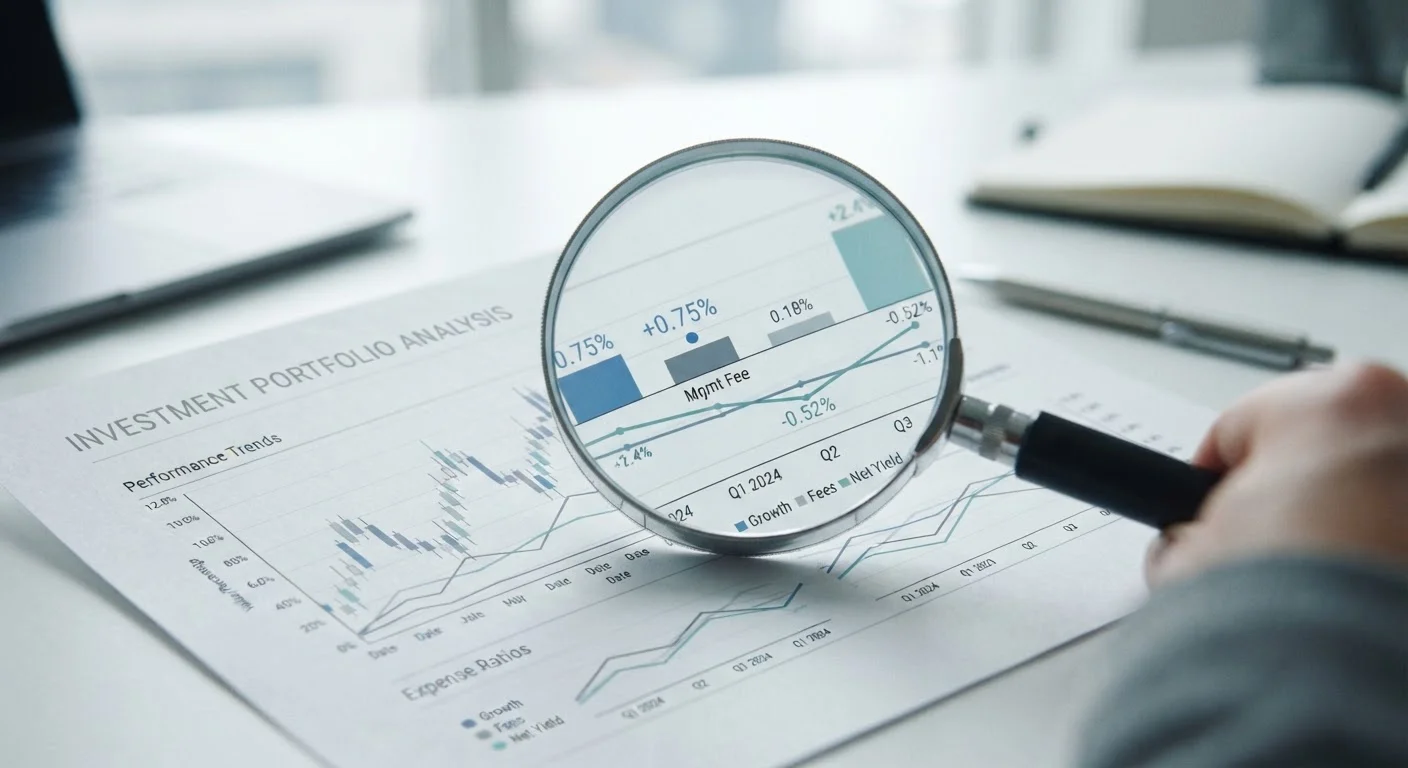
Why a Small Percentage Is a Big Deal
When you invest in a mutual fund or ETF, you're not just paying for access to a basket of securities - you're also paying for the cost of running that fund. That cost is the expense ratio, and it compounds against you every year, whether markets go up or down.
The math is straightforward but easy to underestimate. Suppose you invest $10,000 and earn an average gross return of 7% annually over 30 years. With a 0.10% expense ratio, you'd end up with roughly $74,500. With a 1.00% expense ratio, that figure drops to around $57,400 - a difference of more than $17,000, on an initial investment of just $10,000. The fund took the same market risk; fees alone account for the gap.
This is sometimes called the compounding cost effect: fees reduce the base on which future growth is calculated, so their impact multiplies over time. The longer your investment horizon, the more damaging a high expense ratio becomes.
~$17,000
Lost to fees on a $10,000 investment over 30 years
Illustrative comparison between a 0.10% and 1.00% expense ratio at a 7% average gross annual return - compounding amplifies even small annual differences.
Over 80%
Active U.S. large-cap funds underperforming their benchmark (15-year)
According to S&P Dow Jones Indices' SPIVA reports, the majority of actively managed large-cap U.S. equity funds trail the S&P 500 over 15-year periods on a net-of-fee basis.
< 0.10%
Typical expense ratio for broad market index funds
Many of the most widely held U.S. total-market and S&P 500 index funds charge less than one-tenth of a percent annually, according to fund prospectus disclosures.
Active vs. Passive: Where Expense Ratios Differ Most
The sharpest contrast in fund costs falls between actively managed funds and passively managed index funds. Actively managed funds employ research teams and portfolio managers who make ongoing buy-and-sell decisions, and those costs get passed to investors through higher expense ratios - often in the 0.50% to 1.25% range, sometimes higher.
Index funds and most ETFs, by contrast, simply track a market index like the S&P 500. Because there's no active stock-picking, operating costs are minimal. Many broad-market index funds charge less than 0.10% annually. For a comprehensive look at how these structures differ, see ETFs vs. mutual funds compared.
The uncomfortable truth for active fund investors is that higher fees don't reliably buy better performance. Multiple long-term studies - including regularly published data from S&P Dow Jones Indices - show that the majority of actively managed funds underperform their benchmark index over 10- and 15-year periods, after fees are accounted for. Fees are one of the few predictors of future relative performance that investors can actually control.
“In investing, you get what you don't pay for. Costs matter enormously in investing over the long term.”
— John C. Bogle, Founder of Vanguard and pioneer of index fund investing
How to Evaluate Expense Ratios When Choosing a Fund
When assessing a fund's costs, context matters. A 0.75% expense ratio on a specialized sector or international fund might be reasonable given higher research costs; the same fee on a plain S&P 500 index fund would be difficult to justify when comparable products charge under 0.10%.
Here's a practical framework for evaluating fees:
- Compare within category: Judge expense ratios against similar funds tracking the same index or asset class, not across unrelated strategies.
- Look at total cost: Factor in any sales loads or transaction fees your brokerage charges, not just the expense ratio.
- Consider tax efficiency: In taxable accounts, funds that generate less turnover typically distribute fewer taxable capital gains - another hidden cost of high-activity strategies.
Understanding expense ratios is one piece of building a resilient long-term portfolio. See how to construct a portfolio you can stick with for a broader framework. Also worth noting: behavioral mistakes can cost just as much as fees - why investors underperform the markets they're in explores that dynamic in depth.
If you're newer to how index funds work in the first place, what an index fund actually is provides a solid foundation before comparing costs.
This article is for general informational and educational purposes only and does not constitute personalized investment, tax, or legal advice. Consult a qualified financial professional before making decisions about your own investments.
Frequently Asked Questions
Broadly speaking, expense ratios below 0.20% are considered low, particularly for index funds and ETFs. Many broad market index funds charge less than 0.10%. Actively managed funds often charge 0.50% to over 1.00%, which can significantly erode returns over time.
It's deducted automatically from the fund's assets - not from your brokerage account directly. The fund's published daily price (NAV) already reflects this deduction, so you won't see a line-item charge, but the cost reduces your effective return each year.
Research consistently shows no reliable relationship between higher fees and better net-of-fee performance. In fact, costs are one of the few factors that reliably predict future relative returns - funds with lower costs tend to outperform higher-cost peers on a net basis over time.
No. Some funds also charge sales loads (front-end or back-end commissions), redemption fees, or 12b-1 marketing fees - the last of which is actually included within the stated expense ratio. Always review a fund's full fee disclosure, typically found in its prospectus or fund fact sheet.
Every fund is required to disclose its expense ratio in its prospectus and on financial data sites. You can also find it in your brokerage platform's fund detail page, usually listed alongside other key statistics.
The content on this site is for informational purposes only and is not a substitute for professional advice. Always consult a qualified professional for guidance specific to your situation.