

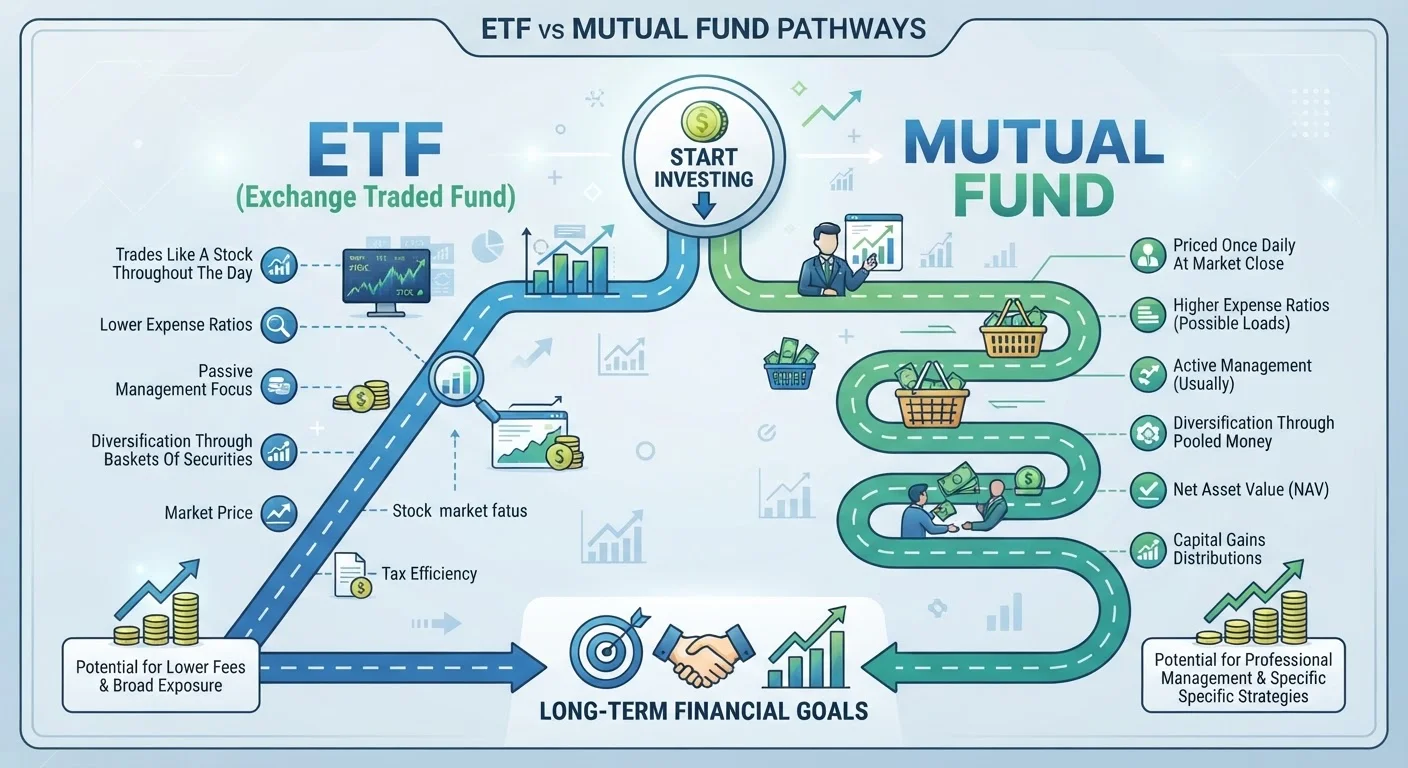
Option A
Exchange-Traded Funds (ETFs)
The flexible, trade-anytime pooled investment.
Best for: Investors who want intraday trading flexibility, typically lower costs, and tax efficiency in a taxable brokerage account.
Option B
Mutual Funds
The traditional, professionally managed pooled fund.
Best for: Investors using employer retirement plans or those who prefer automatic contributions and end-of-day pricing without managing trades.
The Core Idea: Pooled Investments, Different Wrappers
Both ETFs and mutual funds are pooled investment vehicles - they collect money from many investors and use it to buy a basket of securities such as stocks or bonds. The key difference isn't what they hold; it's how they're structured, priced, and traded.
Think of the underlying portfolio as the same kitchen pantry. An ETF and a mutual fund can stock that pantry with identical ingredients - say, every stock in the S&P 500. But the packaging, the checkout process, and the receipt you get at the end of the day look very different.
To understand why this matters, it helps to start with how each one is bought and sold. For a broader foundation on the kinds of funds that track market indexes, see our explainer on index funds.
How Trading and Pricing Work
ETFs trade on a stock exchange just like shares of Apple or Ford. You place a buy or sell order through a brokerage account, and the transaction executes at the current market price - which fluctuates second by second while markets are open. This gives ETF investors real-time price visibility and the ability to act quickly.
Mutual funds work differently. You submit a purchase or redemption order during the day, but your trade isn't filled until after the market closes. The price you receive - called the net asset value (NAV) - is calculated once daily based on the closing prices of every security the fund holds. There's no intraday pricing.
For most long-term investors, this distinction rarely matters. A retirement saver contributing monthly doesn't need second-by-second pricing. But for someone managing a taxable account who wants precise entry or exit points, the ETF structure offers more control.
| Criterion | ETFs | Mutual Funds |
|---|---|---|
| Trading | Intraday on exchange | Once daily at NAV |
| Minimum investment | Price of one share (or fractional) | Often $500-$3,000 minimum |
| Automatic contributions | Limited; requires trade placement | Easy; exact dollar amounts |
| Tax efficiency (taxable accounts) | Generally higher | Generally lower |
| Availability in 401(k) plans | Uncommon | Standard |
| Expense ratios (index funds) | Often very low | Can also be very low |
| Bid-ask spread cost | Yes (usually minimal) | None |
Fees, Costs, and What You Actually Pay
Both ETFs and mutual funds charge an expense ratio - an annual fee expressed as a percentage of your investment that covers the fund's operating costs. A 0.10% expense ratio on a $10,000 investment costs roughly $10 per year. As our deep dive on expense ratios shows, even small percentage differences compound significantly over decades.
Passive index ETFs frequently carry very low expense ratios. Index mutual funds can also be extremely competitive. Actively managed funds - where a portfolio manager selects securities rather than tracking an index - tend to charge higher expense ratios in both categories.
One cost unique to ETFs: because they trade like stocks, you may pay a brokerage commission per trade (though many brokers have eliminated this). You also encounter a small bid-ask spread - the gap between the price buyers will pay and the price sellers will accept. In liquid, high-volume ETFs this spread is typically negligible.
0.16%
Average ETF expense ratio (asset-weighted)
According to Morningstar's annual fund fee study, the asset-weighted average expense ratio for ETFs has declined steadily over the past decade.
0.44%
Average mutual fund expense ratio (asset-weighted)
Morningstar data shows mutual funds carry a higher average expense ratio than ETFs, though passive index mutual funds can rival ETF costs.
$7T+
U.S. ETF assets under management
The Investment Company Institute has reported that U.S.-listed ETFs collectively hold trillions in assets, reflecting broad adoption among retail and institutional investors.
Tax Efficiency: A Meaningful Structural Difference
This is where ETFs hold a notable structural edge for taxable brokerage accounts. When investors in a mutual fund sell their shares, the fund may need to sell underlying securities to raise cash - generating capital gains that are distributed to all remaining shareholders, even those who didn't sell. You can owe taxes on gains you never personally realized.
ETFs use an in-kind creation and redemption process involving large institutional traders called authorized participants. This mechanism generally allows ETFs to avoid triggering capital gains distributions internally, making them more tax-efficient on a year-to-year basis.
Inside a tax-advantaged account like a traditional IRA or 401(k), this distinction largely disappears - gains aren't taxed until withdrawal regardless of the fund type. For guidance on how fund choice fits into a broader portfolio strategy, our asset allocation reference covers the fundamentals.
This article is for general informational and educational purposes only and does not constitute personalized investment, tax, or financial advice. Consult a qualified financial professional before making decisions about your own investments.
The content on this site is for informational purposes only and is not a substitute for professional advice. Always consult a qualified professional for guidance specific to your situation.