

Why Timing the Market Is Harder Than It Sounds
Even professional fund managers struggle consistently to predict when markets will rise or fall. For everyday investors, trying to buy at the perfect low and sell at the perfect high is an exercise in frustration - and research shows it often leads to worse outcomes than simply staying invested.
The alternative isn't luck or guesswork. It's a disciplined process. Dollar-cost averaging removes the pressure of timing decisions entirely by tying your investment activity to a calendar rather than market headlines. You contribute on schedule - weekly, biweekly, monthly - and let the math work in the background.
This matters especially for first-time investors, who are most susceptible to the emotional pull of waiting for the "right moment" that rarely arrives. As we explore in investing myths that keep people on the sidelines, the belief that you must time the market perfectly is one of the most common barriers to getting started at all.
“The stock market is a device for transferring money from the impatient to the patient.”
— Warren Buffett, Chairman and CEO of Berkshire Hathaway, widely cited on long-term investing principles
How Dollar-Cost Averaging Works in Practice
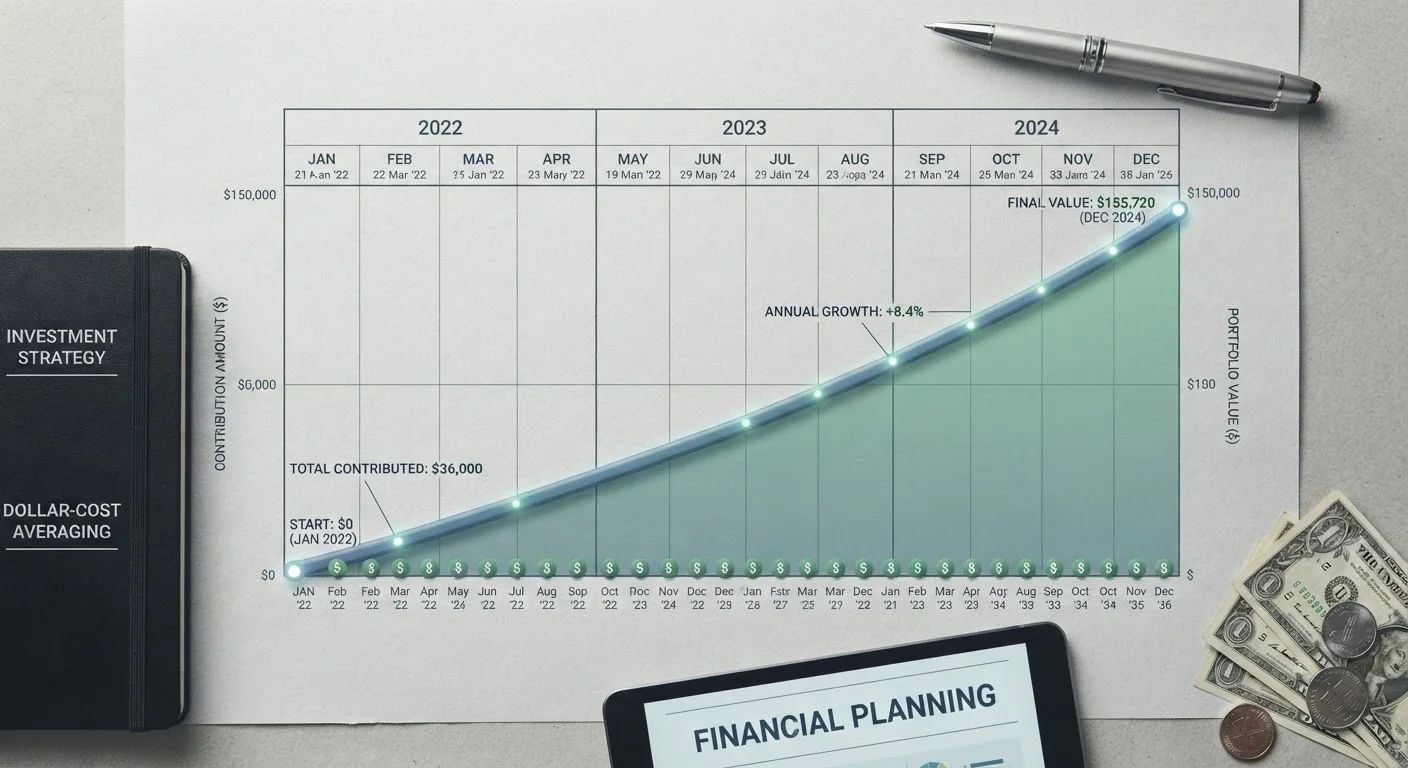
The mechanics are straightforward. Suppose you commit to investing $200 every month into a broad index fund. In Month 1, shares cost $20 each - you buy 10 shares. In Month 2, the price drops to $16 - your $200 now buys 12.5 shares. In Month 3, prices recover to $25 - you buy 8 shares. After three months you've invested $600 and hold 30.5 shares, with an average cost per share of roughly $19.67, even though prices swung considerably in both directions.
This is the core benefit: your average purchase price is smoothed over time. You didn't need to predict the dip in Month 2 - your fixed schedule captured it automatically.
~57%
U.S. adults who own stock through retirement or brokerage accounts
According to Gallup's annual Economy and Personal Finance survey, a majority of Americans hold investments, many through employer-sponsored plans that use automatic contributions.
Over 20 years
Typical time horizon where DCA discipline pays off most
Financial education resources from institutions like FINRA emphasize that long time horizons allow investors to recover from downturns and benefit from compounding returns.
For many Americans, DCA is already happening through their workplace retirement plan. Every paycheck, a set percentage flows into a 401(k) and gets invested - that's dollar-cost averaging in its most common form. If you don't have access to a workplace plan, the same logic applies to a regular contribution to an IRA or a taxable brokerage account.
Keep in mind that fund costs matter alongside strategy. Even a disciplined DCA approach can be eroded by high fees - our explainer on what expense ratios really cost you breaks down why keeping investment costs low compounds in your favor over time.
The Behavioral Edge: Removing Emotion From Investing
Markets move on news, sentiment, and events that are difficult to predict. Investors who react emotionally - selling after a drop, holding cash waiting for certainty - often miss the recovery periods that generate long-term gains. DCA provides a structural defense against this pattern.
Because you're investing on a fixed schedule, you're less likely to pause contributions during a downturn (when shares are cheapest) or pile in recklessly at a peak. The routine itself becomes the discipline.
Automate to Stay Consistent
Setting up automatic contributions - whether through payroll deductions or a scheduled bank transfer - removes the temptation to skip a month when markets look uncertain. Automation is one of the most effective tools for maintaining DCA discipline over the long term. Even a modest amount invested consistently outperforms irregular larger contributions that pause during downturns.
This consistency is especially powerful when combined with a well-considered investment portfolio you can actually stick with - one diversified across asset classes and aligned with your time horizon. DCA funds the portfolio; the portfolio does the long-term work.
It also complements sound budgeting. Knowing exactly how much you plan to invest each month makes it easier to plan around. If you haven't yet mapped out your monthly cash flow, the budgeting basics hub is a practical starting point before committing to a regular contribution amount.
This article is for informational and educational purposes only and does not constitute personalized financial, investment, tax, or legal advice. Investing involves risk, including the possible loss of principal. Consult a licensed financial professional before making decisions based on your individual circumstances.
Frequently Asked Questions
Research suggests lump-sum investing outperforms DCA in rising markets about two-thirds of the time, since money is invested sooner and has longer to grow. However, DCA reduces the risk of investing a large amount right before a downturn, and it's often the only practical option for investors building wealth from a regular paycheck. The best approach depends on your situation - a licensed financial adviser can help you weigh the options.
There is no universal minimum. Many brokerage and retirement accounts allow contributions of almost any amount, and some funds offer fractional shares, meaning you can invest as little as a few dollars at a time. Starting small and staying consistent matters more than the initial amount.
DCA is commonly used inside 401(k) plans, IRAs, and taxable brokerage accounts. Retirement accounts often automate the process through payroll deductions, making DCA effectively built-in. Consult a financial professional for guidance on which account type fits your goals.
Yes, and the two strategies pair naturally. Index funds provide broad diversification, and regular DCA contributions into them create a disciplined, low-maintenance approach to long-term investing. See our article on <a href="/finance/everyday-investing/asset-allocation-and-diversification-a-plain-language-reference">asset allocation and diversification</a> for more context on portfolio construction.
Yes. If the value of your investments falls and stays down, you can still lose money even with consistent contributions. DCA manages timing risk, not market risk. All investing involves the possibility of loss, and past market performance does not guarantee future results.
The content on this site is for informational purposes only and is not a substitute for professional advice. Always consult a qualified professional for guidance specific to your situation.