

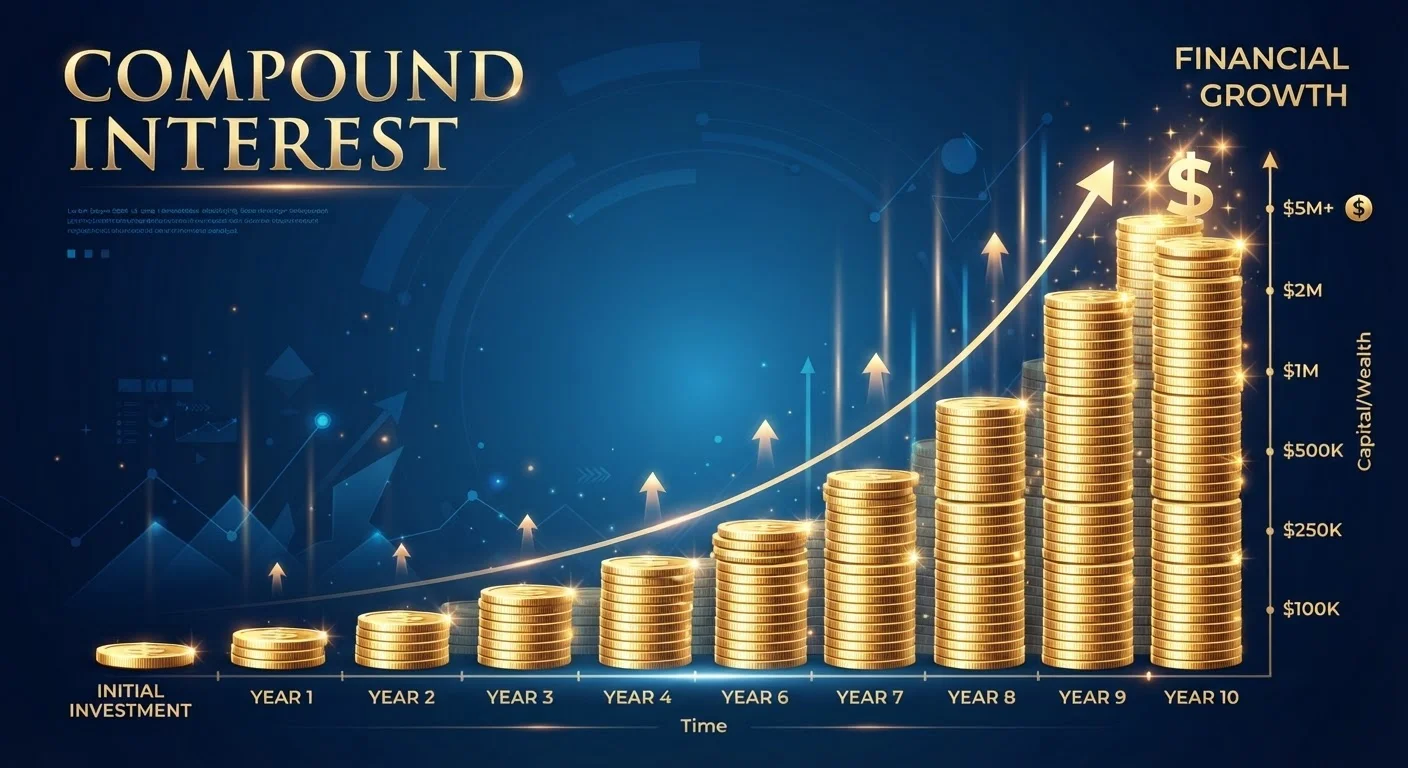
How Compound Interest Actually Works
The mechanics of compound interest are straightforward - but their long-run impact is anything but. When you deposit money in a savings account or invest in a retirement fund, you earn a return on that balance. With compound interest, those earnings are added to your balance and then also begin earning returns. The result is growth that accelerates rather than staying flat.
Consider a simple illustration: $10,000 invested at a 7% average annual return. After year one, you have $10,700. In year two, the 7% return applies to $10,700 - not just your original $10,000. That gap widens every single year. After 30 years, that single deposit would grow to roughly $76,000 without adding another dollar. Add regular contributions and the numbers become far more striking.
This is why financial educators often describe compound interest as one of the most powerful concepts in personal finance. It's not magic - it's math that rewards patience and consistency. See our guide to investing vs. saving for context on where compounding applies most strongly.
~$76,000
Growth of $10,000 at 7% over 30 years
Illustrative projection based on 7% average annual compounded growth with no additional contributions - actual returns vary and are not guaranteed.
72
The Rule of 72 - years to double your money
Divide 72 by your annual rate of return to estimate how many years it takes an investment to double in value (e.g., 72 ÷ 6% = 12 years).
1%
Annual fee drag on long-term portfolio value
A 1% annual fee difference, compounded over decades, can reduce a portfolio's ending value significantly - highlighting why low-cost funds matter.
Why Starting Early Changes Everything
Time is the most important variable in the compounding equation. Two people can invest the same total amount of money over a lifetime and end up with dramatically different outcomes based solely on when they started. This is sometimes illustrated as the "early bird" scenario in personal finance education.
An investor who contributes $300 per month starting at age 25 will, all else being equal, accumulate significantly more by age 65 than someone who contributes $600 per month starting at age 45 - even though the late starter is putting in twice as much each month. The early investor's contributions have decades more time to compound. Those extra years of growth cannot be bought back by simply contributing more later.
This doesn't mean starting late is futile. Increasing your savings rate at any age meaningfully improves your position. But the data consistently shows that early contributions carry a disproportionate weight. Our article on savings rate explains how even modest adjustments to what you set aside each month can reshape long-term outcomes.
Automate Contributions to Protect Your Timeline
Setting up automatic monthly contributions to a retirement account removes the temptation to skip months or time the market. Consistency matters more than the amount you start with - even small, regular deposits compound meaningfully over a long time horizon. Most 401(k) plans and IRA providers make automatic contributions easy to configure.
Compound Interest in Retirement Accounts and Index Funds
Tax-advantaged retirement accounts - such as 401(k)s and IRAs - are among the most effective vehicles for harnessing compound growth. Inside these accounts, dividends and capital gains are reinvested without triggering annual taxes. That means more of your money stays invested and compounds, rather than being reduced each year by a tax bill.
Index funds, which track broad market benchmarks, are a common choice within retirement accounts because they typically carry low fees and reinvest dividends automatically. Lower fees matter more than most investors realize: a 1% annual fee difference, compounded over 30 years, can reduce a portfolio's ending value by tens of thousands of dollars on a mid-size balance.
For first-time investors, the key is to understand these accounts as long-term compounding engines - not short-term savings vehicles. Withdrawing early triggers penalties and, more importantly, resets the compounding clock on those dollars. If you're exploring common misconceptions about getting started, common investing myths covers several that may be holding you back.
The Other Side: Compound Interest in Debt
Compound interest isn't always working in your favor. On credit cards, personal loans, and other high-interest debt, it works the same way - but in reverse. An unpaid credit card balance at 20% APR doesn't just cost you 20% of what you originally borrowed. That interest accrues, gets added to your balance, and then interest is charged on the new, higher total. Left unchecked, this cycle can make debt feel impossible to escape.
This is why financial guidance consistently prioritizes eliminating high-interest debt before aggressively investing. Every dollar of credit card interest you avoid is a guaranteed, risk-free return - something no investment can promise. For a structured approach to managing both goals at once, our comprehensive resource on saving and debt repayment walks through how to balance both priorities effectively.
Understanding compounding in both directions - as a wealth builder and a debt accelerant - gives you a clearer picture of where your financial energy is best directed. Once high-interest balances are gone, redirecting those same monthly payments into a retirement account lets compound interest shift from working against you to working powerfully in your favor.
This article is for general informational and educational purposes only and does not constitute personalized financial, investment, or tax advice. Consult a qualified financial professional before making decisions based on your individual circumstances.
Frequently Asked Questions
Simple interest is calculated only on your original principal. Compound interest is calculated on the principal plus all previously earned interest. Over long periods, this difference becomes enormous - compound growth is exponential while simple interest is linear.
It depends on the account or investment. Savings accounts often compound daily or monthly. Retirement investment accounts effectively compound continuously as dividends and gains are reinvested. More frequent compounding leads to slightly higher returns at the same stated rate.
Yes - and this is critical to understand. Credit card balances and other high-interest debt compound just like savings, meaning unpaid balances grow rapidly. Paying more than the minimum and eliminating high-interest debt quickly limits how much compounding works against you.
The Rule of 72 is a simple mental shortcut: divide 72 by your annual interest rate to estimate how many years it takes your money to double. At 6% annual growth, your investment doubles roughly every 12 years. It's a useful way to visualize compounding's power.
No. In savings accounts and CDs, the rate may be fixed or variable but principal is typically protected. In investment accounts, returns are not guaranteed and values can decline. Past performance does not guarantee future results. Always consider your risk tolerance before investing.
Contributing regularly to tax-advantaged accounts like a 401(k) or IRA and reinvesting dividends and gains allows compounding to work at full force. Starting as early as possible and avoiding early withdrawals preserves the time horizon that makes compounding most powerful.
The content on this site is for informational purposes only and is not a substitute for professional advice. Always consult a qualified professional for guidance specific to your situation.