

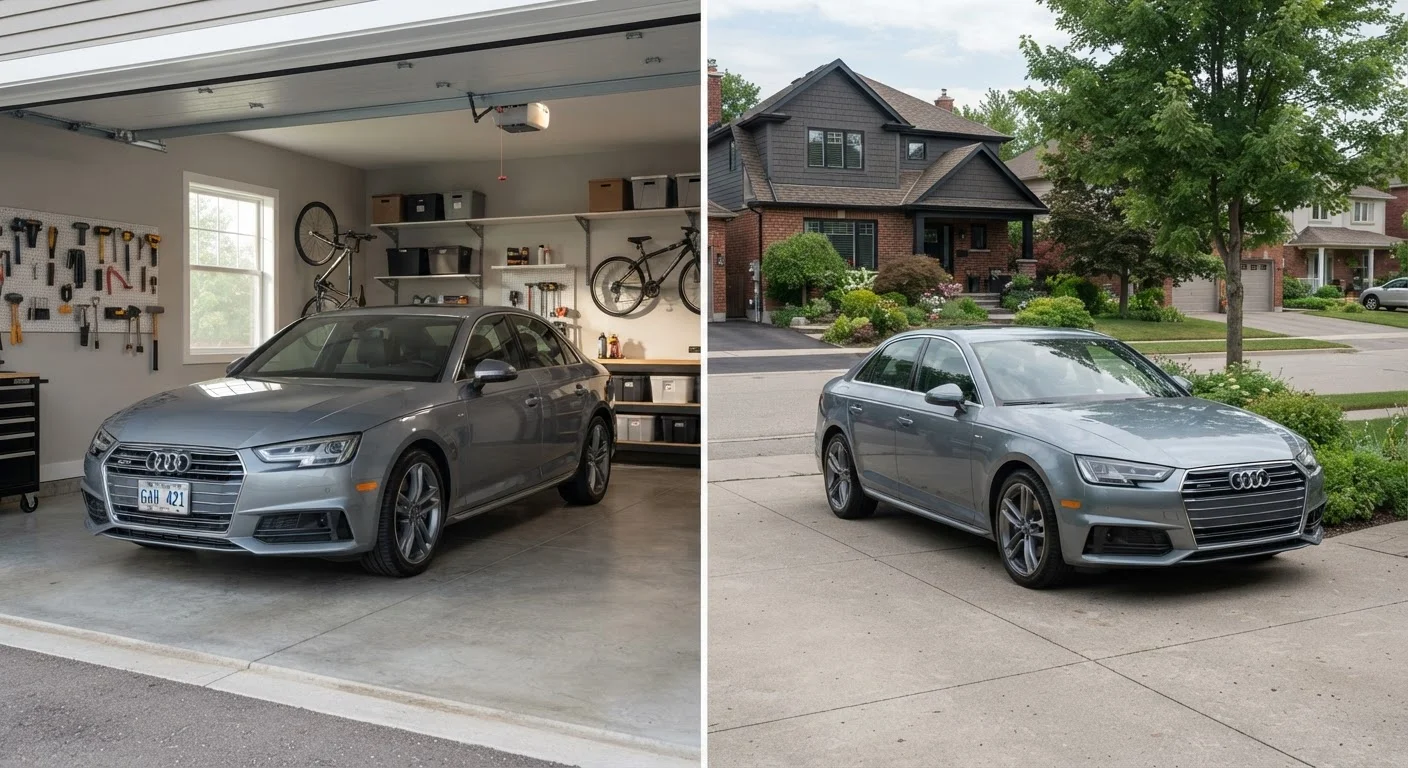
Option A
Garage Storage
The controlled-environment option for serious vehicle protection.
Best for: Owners who want to minimize UV damage, temperature extremes, and weather-related wear on paint, battery, and rubber components.
Option B
Driveway Storage
The accessible, common-sense default for millions of American households.
Best for: Owners with limited or repurposed garage space who need convenient, accessible parking and are willing to offset exposure with routine maintenance.
How Parking Location Shapes Long-Term Vehicle Condition
Most drivers don't think of where they park as a maintenance decision - but it is. Every hour your car sits outside, it's exposed to UV radiation, humidity, temperature change, and airborne contaminants. Those forces accumulate slowly, which is why the effects only become obvious years later in the form of faded paint, cracked rubber seals, weakened battery cells, and early corrosion.
Garage parking creates a buffer against nearly all of these forces. The interior temperature stays more stable, UV light is eliminated, and rain, dew, and road spray are kept away from seals, underbody metal, and wiring. Driveway parking removes all of those protections - though how much that matters depends heavily on your climate, vehicle age, and maintenance habits.
For a broader picture of how regional weather stresses vehicles differently, see our seasonal car care guide by climate.
| Criterion | Garage Storage | Driveway Storage |
|---|---|---|
| UV & sun exposure | Eliminated | Continuous, climate-dependent |
| Paint & clear coat longevity | Significantly extended | Faster degradation without waxing |
| Interior fading & cracking | Minimal risk | Higher risk in sunny climates |
| Battery cold-weather stress | Reduced | Higher with overnight frost |
| Corrosion & rust risk | Lower with good ventilation | Higher in salt or humid regions |
| Tire pressure stability | More consistent | Fluctuates with outdoor temps |
| Security from theft or vandalism | Generally higher | More exposed |
| Accessibility & convenience | Depends on garage layout | Typically immediate |
Paint, Interior, and UV Damage
Ultraviolet radiation is one of the most consistent and underestimated sources of vehicle degradation. Clear coat begins to oxidize with sustained UV exposure, leading to dull, chalky paint that's costly to restore. Interior plastics and leather crack and fade when regularly heated by direct sunlight, and dashboard surfaces can warp over years of exposure in high-sun regions.
A garage eliminates UV exposure almost entirely. A driveway-parked vehicle, even one covered with a car cover, still absorbs radiated heat from the surrounding surface. High-quality wax or paint sealant applied two to four times a year can slow UV damage for outdoor-parked vehicles, but it requires consistency. Ceramic coatings offer longer-lasting protection but don't replace the benefit of shade and shelter.
~40%
Battery capacity loss in extreme cold
The US Department of Energy has noted that cold temperatures can reduce electric vehicle battery performance by roughly 40%, with conventional batteries also affected by sustained low temperatures.
1 PSI
Tire pressure drop per 10°F temperature fall
This relationship - approximately 1 PSI per 10°F change - is well established and documented by the National Highway Traffic Safety Administration (NHTSA) as a common cause of underinflation.
~30%
Of US garages primarily used for vehicle storage
According to the US Department of Energy's 2015 Residential Energy Consumption Survey, roughly one-third of attached garages are used primarily to park vehicles, with the rest serving as storage or workspace.
Battery, Fluids, and Cold-Weather Performance
Temperature extremes affect more than comfort - they affect vehicle chemistry. Lead-acid and lithium-ion batteries lose capacity faster when repeatedly cycled through deep cold or excessive heat. A car left outside in freezing temperatures overnight requires more cranking power to start, accelerating wear on the starter motor and battery. A garage, even an unheated one, typically holds temperatures several degrees warmer than outdoor air, which can make a real difference in battery longevity and cold-start performance.
Engine oil thickens in the cold and becomes less effective at initial lubrication until the engine warms up. Tire pressure drops approximately 1 PSI for every 10°F decrease in temperature, affecting handling and fuel efficiency. These aren't catastrophic problems in isolation, but they compound over time - and garage storage reduces their frequency and severity.
If your garage space is currently being used for other purposes, our garage organization guide offers a practical approach to reclaiming it.
Moisture, Corrosion, and Underbody Exposure
Corrosion is one of the most expensive long-term consequences of outdoor parking, particularly in regions that use road salt in winter or experience high humidity year-round. Salt and moisture work together to oxidize exposed metal on brake lines, exhaust components, suspension parts, and the vehicle's frame. Vehicles driven in northern states and parked outdoors are at substantially higher risk than those kept in garages, even partially heated ones.
One nuance worth noting: a poorly ventilated garage can trap moisture, which may actually worsen corrosion in humid climates if condensation accumulates under the vehicle. Proper airflow - even passive ventilation through wall vents - prevents this. Driveway-parked vehicles benefit from open-air drying after rain, but they're also continuously re-exposed. Regular undercarriage washing during winter months is one of the most effective countermeasures for driveway-parked vehicles in salt-belt states.
Garage Humidity Can Work Against You
An enclosed garage in a humid climate can trap moisture that condenses under your vehicle overnight, particularly if the car is brought in wet from rain. Passive ventilation - louvered vents or a small dehumidifier - helps prevent this. This is more of a concern in the Southeast and Pacific Northwest than in arid regions like the Southwest.
The content on this site is for informational purposes only and is not a substitute for professional advice. Always consult a qualified professional for guidance specific to your situation.