

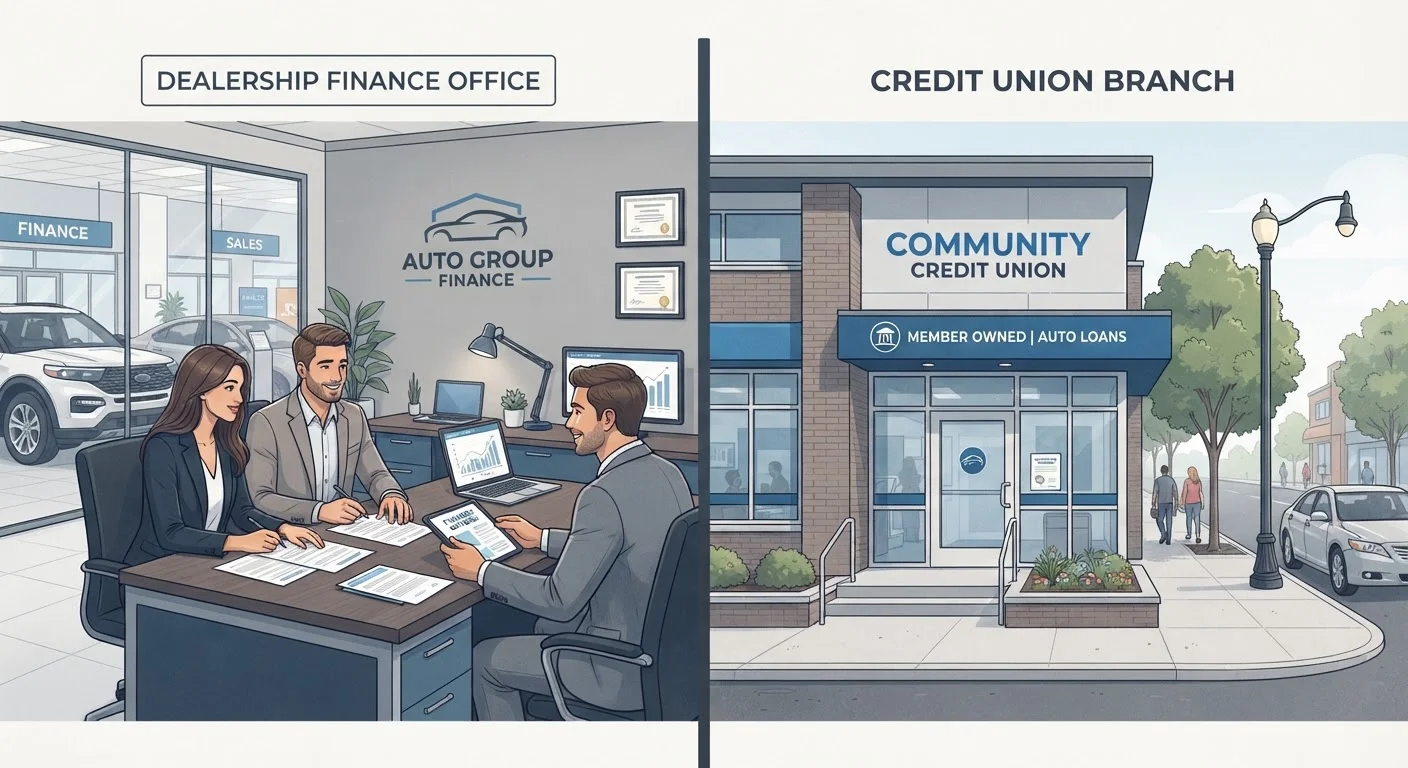
Option A
Dealer Financing
The convenient, one-stop option with hidden trade-offs.
Best for: Buyers who qualify for manufacturer-subsidized rates or who want to handle everything in one visit.
Option B
Bank or Credit Union Financing
The independent route that puts negotiating power in your hands.
Best for: Buyers who want a firm rate benchmark before setting foot in the dealership.
How Each Financing Path Actually Works
Understanding the mechanics before you compare rates is essential. To understand how APR, loan term, and principal interact across either option, see our guide to how auto loan interest works.
Dealer financing is technically indirect lending. When you finance through a dealership, the dealer submits your application to one or more lenders in its network - banks, captive finance arms (lenders owned by automakers), or specialty auto lenders. The lender approves you at a base rate called the buy rate. The dealer is typically permitted to mark that rate up - sometimes by 1 to 2.5 percentage points - and keep the difference as compensation. You may never see the buy rate.
Bank or credit union financing is a direct relationship between you and the lender. You apply, receive a decision and a specific APR, and if approved, arrive at the dealership with a check or a commitment letter. The dealer knows you have a competing offer. That changes the dynamic of the entire negotiation.
| Criterion | Dealer Financing | Bank or Credit Union Financing |
|---|---|---|
| How rate is set | Lender buy rate, often marked up by dealer | Direct APR from your institution |
| Promotional rates available | Yes - manufacturer-subsidized APR offers | No access to captive lender promotions |
| Negotiating position | Dealer controls rate information | Buyer arrives with a competing offer |
| Speed and convenience | Handled in one dealership visit | Requires separate application in advance |
| Rate transparency | Buy rate typically not disclosed | APR disclosed directly to borrower |
| Credit flexibility | Access to subprime lenders if needed | Member relationships may help at credit unions |
| Used vehicle restrictions | Varies by lender in dealer network | Some lenders restrict older/high-mileage vehicles |
The Real Advantages and Risks of Each Option
Where dealer financing has a genuine edge: Manufacturer-subsidized rates are the clearest case. When an automaker's captive lender offers 0% or a very low promotional APR, that offer is only accessible through the dealership - no outside lender competes with it. These promotions are real, but they typically require strong credit scores and apply to specific models and trim levels. If you don't qualify on credit, the advertised rate won't apply to you.
Dealer financing is also faster on the day of purchase. For buyers who have already done their rate research, the one-stop convenience is a legitimate benefit.
Where dealer financing carries risk: The rate markup structure means you may pay more than the lender's actual approval rate. Because monthly payment is often the focus of finance office conversations, markups can be obscured when the discussion shifts to payment size rather than APR. Always ask for the APR in writing and compare total interest paid - not just the monthly figure.
Where your own bank or credit union has an edge: Pre-approval from your own institution gives you a hard number to negotiate from. Credit unions, in particular, are member-owned nonprofits that historically offer competitive rates and may have more flexibility for members with complicated credit histories. Getting pre-approved also separates the vehicle price negotiation from the financing conversation - a structurally stronger position. Understanding what pre-approval actually means can help you read any approval letter accurately.
Where outside financing has limits: Your bank or credit union won't match a manufacturer promotional rate. Approval is also not instant in every case, and some lenders place restrictions on vehicle age or mileage for used cars.
Rate Shopping and Your Credit Score
Multiple auto loan inquiries within a short window - typically 14 to 45 days depending on the credit scoring model - are usually counted as a single inquiry for scoring purposes. This means shopping your rate across several lenders before committing has less credit score impact than many buyers assume. Check with each lender about whether they use a soft or hard pull at the pre-approval stage.
How to Use Both Sources Strategically
The most practical approach for most buyers is to treat these two paths as complementary rather than mutually exclusive. Here's the general logic:
- Apply for pre-approval from your bank or credit union first. This establishes a baseline rate at no cost and with no obligation. Most lenders use a soft inquiry for pre-qualification and a hard inquiry only upon full application - ask specifically before applying.
- Bring your pre-approval to the dealership. You are under no obligation to disclose your rate upfront. Negotiate the vehicle price as a separate conversation before financing enters the discussion.
- Ask the dealer to beat your rate. Present your outside offer and ask whether dealer financing can improve on it. If a promotional manufacturer rate applies to your transaction and your credit qualifies, the dealer's offer may legitimately win.
- Compare total cost, not monthly payment. A lower monthly payment achieved by extending the loan term can cost significantly more in total interest. Calculate total interest paid for any offer before deciding.
If you accept dealer financing and later feel the rate was higher than it should have been, refinancing through your own institution is an option - typically with no prepayment penalty on most auto loans, though you should verify this in your contract. Be aware that add-ons pitched in the finance office at signing can affect your total loan balance regardless of which lender you use.
This article provides general financial education and is not personalized financial or lending advice. Consult a qualified financial professional for guidance specific to your situation.
The content on this site is for informational purposes only and is not a substitute for professional advice. Always consult a qualified professional for guidance specific to your situation.