

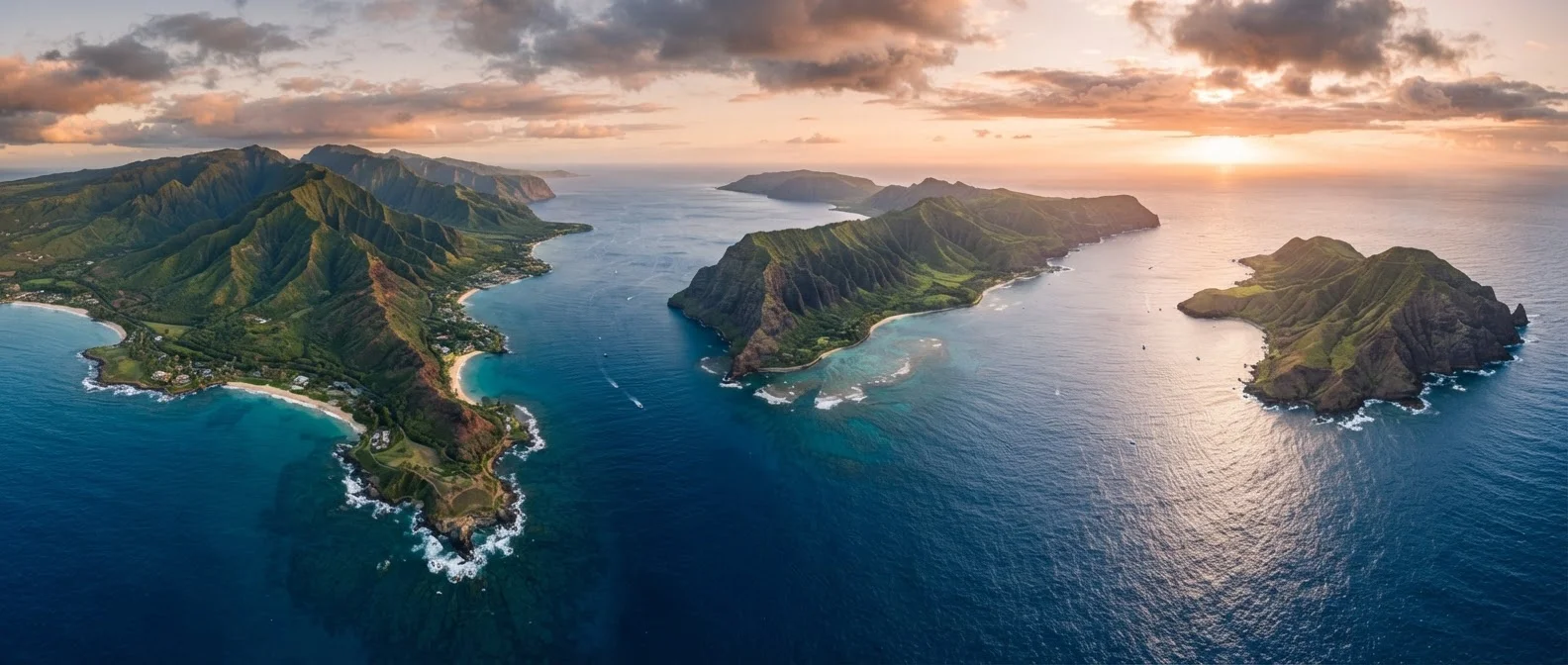
Why Island Choice Matters More Than You Think
Many first-time visitors book a flight to "Hawaii" the way they might book a trip to a single city - as if one destination covers everything. In reality, choosing an island is more like choosing between entirely different countries. Oahu's skyline bears almost no resemblance to Kauai's cathedral valleys, and the Big Island's lava fields exist on a different planet from Maui's turquoise resort bays.
Because inter-island travel adds time and expense, most travelers stay on one or two islands per trip. Understanding what each offers before you book is the single most effective planning move you can make.
10 of 14
Earth's climate zones found in Hawaii
The U.S. Department of Agriculture recognizes Hawaii as containing nearly all major climate zones, concentrated across its volcanic terrain.
~1,500 miles
Length of the Hawaiian island chain
The Hawaiian archipelago stretches across the central Pacific, making it one of the most geographically isolated island chains on Earth.
13,796 ft
Height of Mauna Kea from sea floor
Measured from its oceanic base, Mauna Kea on the Big Island is considered the tallest mountain on Earth, surpassing Everest by this measure.
~10 million
Annual visitors to Hawaii (pre-pandemic baseline)
Hawaii Tourism Authority data has historically shown visitor arrivals near or above 10 million annually, with Oahu receiving the largest share.
Oahu: Urban Energy Meets Iconic History
Oahu is home to Honolulu, the state capital, and hosts more than two-thirds of Hawaii's total population. It's the most connected island - with the widest range of accommodations, public transit options, and cultural institutions - making it an approachable starting point for first-timers.
Waikiki Beach is heavily developed but genuinely beautiful. Beyond the tourist strip, neighborhoods like Chinatown and Kaimuki offer authentic local dining and gallery scenes. Pearl Harbor's historical sites provide one of the most significant World War II memorials in the country. Oahu's windward coast - particularly the Kailua and Lanikai areas - delivers a quieter, locals-first beach experience that surprises many visitors expecting only crowds.
The tradeoff: Oahu is the least "untouched" of the main islands. If you're seeking solitude in nature, you'll find it, but you'll have to seek it more deliberately here.
Maui: The All-Rounder With Dramatic Range
Maui consistently ranks among the most popular U.S. island destinations, and the diversity of its terrain explains why. The Road to Hana - a winding coastal highway through rainforest, waterfalls, and black-sand beaches - is one of America's great road trips. Haleakalā National Park takes visitors to a 10,023-foot summit above the clouds, where sunrise views feel genuinely otherworldly.
The leeward resort corridor between Lahaina and Wailea offers calm swimming beaches and well-developed visitor infrastructure. Whale watching between December and April (when humpbacks congregate in the Auau Channel) is world-class.
Visitors should be aware that parts of West Maui, including the historic town of Lahaina, were devastated by wildfires in August 2023. Recovery is ongoing, and travelers should check current conditions and consider how their visit can support the local community rather than strain it.
Visiting West Maui After the 2023 Wildfires
The 2023 wildfires caused devastating loss of life and property in and around Lahaina. As recovery continues, travelers are encouraged to verify which areas are accessible, engage with locally owned businesses that welcome visitors, and approach the region with sensitivity. Official updates are available through the County of Maui and Hawaii Tourism Authority.
Kauai: The Garden Isle for Nature Seekers
Kauai is the oldest of the main islands geologically, and time has carved it into something extraordinary. The Na Pali Coast - a series of sheer sea cliffs accessible only by boat, helicopter, or strenuous trail - is arguably the most dramatic coastline in the United States. Waimea Canyon, often called the "Grand Canyon of the Pacific," drops nearly 3,600 feet through layered volcanic rock.
Kauai has deliberately limited large-scale development, which keeps the island quieter and more intimate. It suits travelers who prioritize hiking, kayaking, snorkeling, and simply being in nature over nightlife or luxury resort amenities. The North Shore around Hanalei Bay is particularly lush and photogenic, though winter swells make swimming conditions variable - always check local advisories before entering the water.
The Big Island: Where Geology Is Still Writing History
At roughly the size of Connecticut, the Big Island (officially named Hawaii) is larger than all the other main islands combined - yet it's one of the least densely populated. That space creates room for extraordinary diversity: snow-capped Mauna Kea (at 13,796 feet, the tallest mountain on Earth when measured from its oceanic base), tropical rainforests on the Hamakua Coast, desert conditions near South Point, and active lava flows in Hawaii Volcanoes National Park.
That national park is the centerpiece for many visits. Volcanic activity is dynamic and conditions change frequently - always consult the National Park Service before planning access to lava viewing areas. The Kona and Kohala coasts on the leeward side offer calm, sunny beaches and calm snorkeling conditions, including a chance to swim with manta rays on night dives.
The Big Island rewards patient, curious travelers willing to drive long distances between attractions. It is not a compact, one-resort island - plan accordingly.
How to Match Your Travel Style to the Right Island
Use these broad profiles as a starting point - not a definitive rulebook. Every island has more depth than any single article can capture.
- First-time visitor wanting ease and variety: Oahu or Maui
- Nature-focused traveler who wants solitude: Kauai or the Big Island
- History and culture enthusiast: Oahu (Pearl Harbor, Bishop Museum, diverse neighborhoods)
- Geology and adventure traveler: The Big Island
- Beach-and-snorkel focused: Maui (leeward coast) or the Big Island (Kona side)
- Road-trip and scenic drive lover: Maui (Road to Hana) or the Big Island (Saddle Road, Chain of Craters Road)
Whatever island you choose, travel respectfully. Hawaii's natural environments and Indigenous Hawaiian culture are not backdrop for vacation photos - they're living, meaningful, and in some places fragile. Follow posted rules, stay on marked trails, and take time to learn a little of the place's history before you arrive.
Frequently Asked Questions
There's no single right answer - it depends on what you want. Oahu offers the most infrastructure, cultural attractions, and nightlife. Maui is a strong all-rounder with beaches, road trips, and resorts. Kauai and the Big Island suit travelers drawn to nature and adventure over urban amenities.
No. Each island is separated by open ocean, so inter-island travel requires a short flight or, in limited cases, a ferry service. Budget extra time and money if you plan to visit more than one island on a single trip.
Not at all. Hawaii has 10 of Earth's 14 climate zones, and conditions vary dramatically not just between islands but even within a single island. The windward (northeast-facing) sides tend to be wetter and greener, while leeward (southwest-facing) coasts are drier and sunnier.
There are eight main islands: Hawaii (the Big Island), Maui, Oahu, Kauai, Molokai, Lanai, Niihau, and Kahoolawe. Of these, Oahu, Maui, Kauai, and the Big Island receive the vast majority of visitors. Niihau is privately owned and not open to general tourism.
No. Hawaii is a U.S. state, so American citizens travel there with the same identification used for any domestic flight. International visitors follow standard U.S. entry requirements.
Hawaii is a year-round destination. April through early June and September through November tend to offer fewer crowds and milder prices. Winter (December-March) brings humpback whales to Maui's waters but also peak tourist season. Always verify current conditions before booking.
The content on this site is for informational purposes only and is not a substitute for professional advice. Always consult a qualified professional for guidance specific to your situation.