

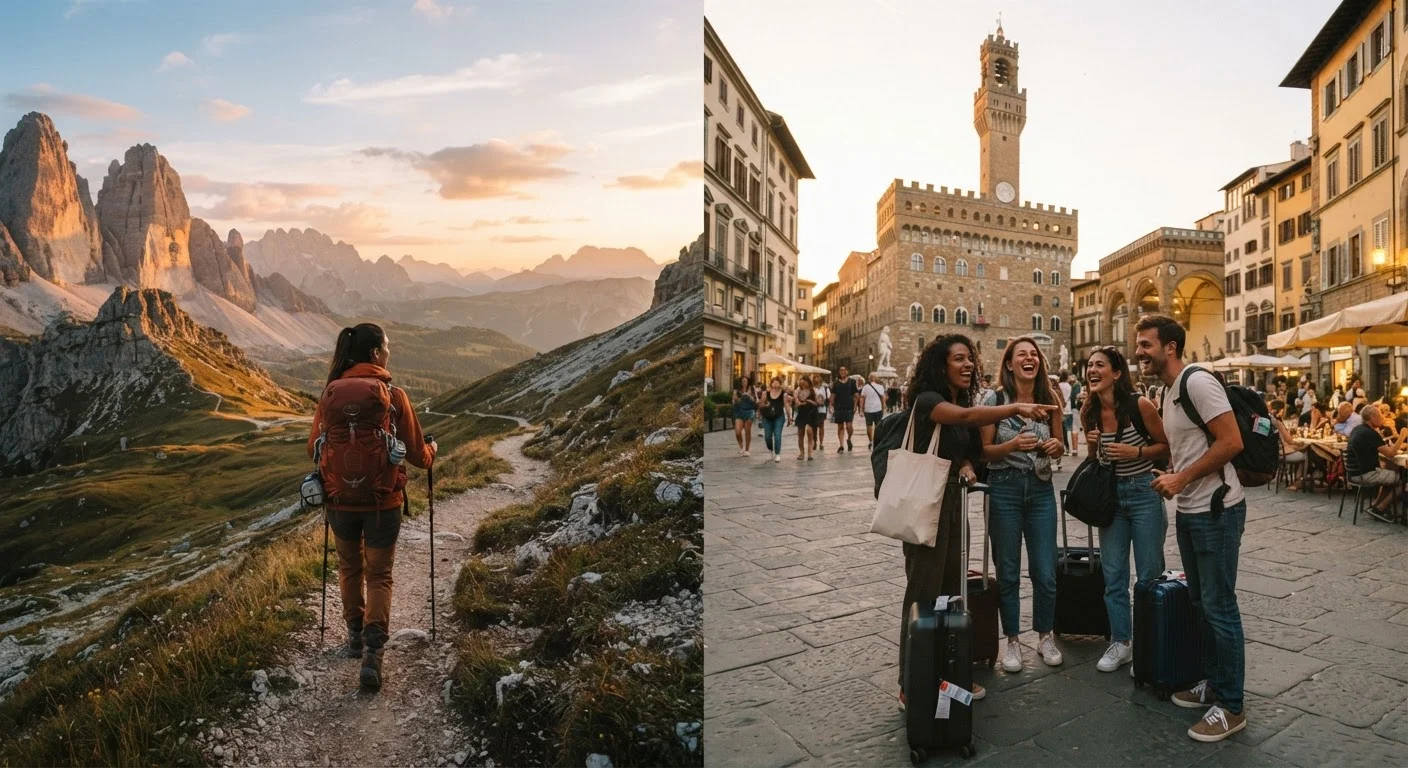
Option A
Solo Travel
The fully independent, self-directed adventure.
Best for: Travelers who value total flexibility, introspective experiences, and the freedom to change plans at will.
Option B
Group Travel
The structured, socially rich, guided experience.
Best for: Travelers who prefer built-in logistics, shared costs, and the safety net of traveling with others.
Cost: Who Actually Pays More?
The assumption that solo travel is always cheaper doesn't hold up under scrutiny. When traveling alone, you absorb the full cost of a hotel room - many properties charge a single supplement, which can add 20-50% to the nightly rate compared to splitting it with a partner. You'll also shoulder the entire cost of taxis, private transfers, and any tours you book independently.
Group tours, by contrast, negotiate rates at scale. Operators book hotel blocks and charter transport, spreading costs across participants. For some destinations - particularly in Africa, South America, or Southeast Asia - a group itinerary can actually be more cost-efficient than piecing the same trip together solo.
That said, group tours bundle everything into a package price, which means you're paying for services whether or not you use them. Solo travelers can be extremely budget-conscious by choosing hostels, cooking their own meals, and timing activities strategically. For a deeper look at what travel costs actually look like in practice, see our anatomy of a travel budget.
| Criterion | Solo Travel | Group Travel |
|---|---|---|
| Flexibility | Total - change plans anytime | Limited - fixed itinerary |
| Accommodation cost | Higher (single supplement common) | Lower (shared/block-booked rates) |
| Logistics burden | Entirely on you | Handled by operator |
| Social experience | Organically built; can be isolated | Built-in community |
| Safety support | Self-managed | Guide and group oversight |
| Ideal for unfamiliar destinations | Requires more research | Well-suited - guided expertise |
| Pace control | Entirely your own | Group consensus required |
Flexibility vs. Structure: The Core Trade-Off
Solo travel is fundamentally about autonomy. You decide when to sleep in, when to skip a museum, and when to take an unplanned detour to a village you spotted on the map. There's no group consensus required, no waiting for stragglers, and no locked-in schedule.
Group travel trades that freedom for reliability. Your accommodation is booked, your bus is waiting, and your guide knows the entry requirements. For travelers who find logistics stressful - or who simply don't want to spend hours researching transportation options - that structure is genuinely valuable, not a limitation.
A practical middle ground that many experienced travelers use: book a structured group tour for the first few days in a new country to get oriented, then break off independently for the remaining time. This hybrid approach is increasingly available through operators offering modular itineraries.
25%
Solo travelers as share of global tourism
Industry research from the Adventure Travel Trade Association has consistently noted solo travelers as one of the fastest-growing segments of international tourism.
20-50%
Typical single-supplement premium on hotel rooms
Single supplements - the extra cost solo travelers pay for a double room - commonly range from 20% to 50% above the per-person twin rate at many hotels.
72%
Group tour participants who cite logistics relief as key benefit
Surveys by group tour operators consistently find that pre-arranged logistics - not social connection - rank as the primary appeal among first-time group travelers.
Safety and Confidence on the Road
Safety is one of the most legitimate factors in this decision, and it deserves an honest treatment. Solo travelers - particularly women traveling alone - face a statistically different risk profile than those in groups, depending on the destination. That doesn't mean solo travel is unsafe, but it does mean the preparation required is more substantial.
Group tours provide inherent safety advantages: there's always someone who knows where you are, local guides who understand cultural norms and safe zones, and an operator with emergency protocols. For destinations with political instability, language barriers, or limited tourist infrastructure, this matters enormously.
Solo travelers can and do navigate these situations safely through thorough research, sharing itineraries with trusted contacts, and staying alert to local conditions. Regardless of which approach you choose, travel coverage is worth understanding before you go - our guide on travel insurance vs. international health coverage explains what each policy type actually protects against.
Always verify current entry requirements, travel advisories, and safety guidance through official government sources before finalizing any trip.
The Social Dimension
Loneliness is a real factor in solo travel that doesn't get discussed enough. Extended solo trips can become isolating, particularly in destinations where language barriers limit casual interaction. On the flip side, many solo travelers report that traveling alone actually makes them more open to meeting people - you're more approachable without a companion and more likely to strike up conversations with locals and fellow travelers.
Group tours solve the social equation by design, but they introduce their own dynamics. Traveling with strangers means navigating personality clashes, pace mismatches, and compromises. Most travelers who do group tours report a mixed bag: some tour companions become lifelong friends, others are sources of friction.
If you're traveling with children, the social and logistical math shifts considerably - our guide on traveling with kids covers how family travel changes the planning calculus in practical terms.
The content on this site is for informational purposes only and is not a substitute for professional advice. Always consult a qualified professional for guidance specific to your situation.