

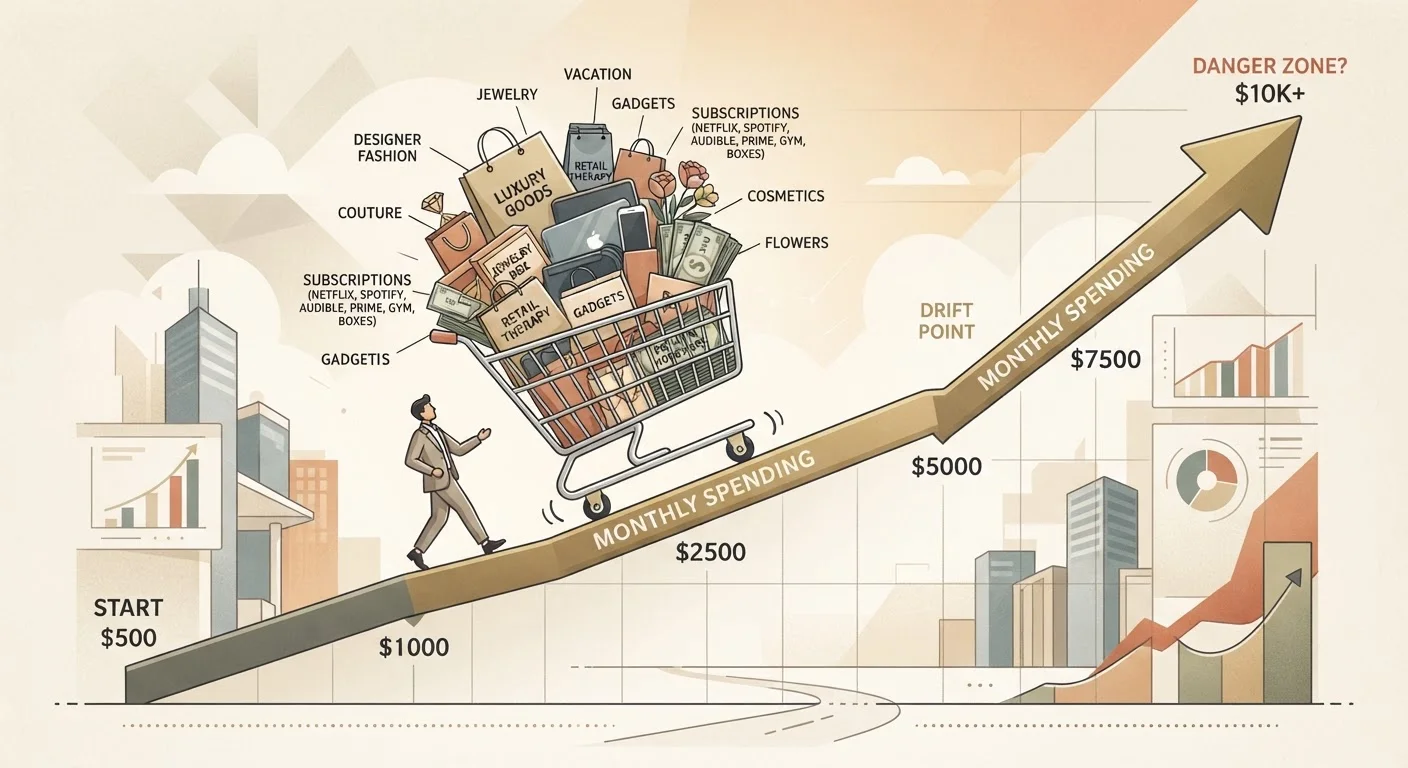
How Lifestyle Creep Works
The mechanism behind lifestyle creep is straightforward: income goes up, and spending follows - not in one large leap, but in dozens of small, seemingly sensible steps. A slightly nicer apartment because you can afford it. A streaming service added here, a gym membership there. Takeout on weekday nights because the hours are longer now. Each choice passes a basic reasonableness test. Taken together, they quietly reset your financial baseline to a higher level.
What makes this pattern particularly hard to spot is that it doesn't feel like a mistake at the time. Each upgrade is usually a genuine improvement in comfort or convenience. The problem isn't any single spending decision - it's the cumulative effect on savings, financial resilience, and long-term goals.
Behavioral research consistently shows that people adapt quickly to improvements in their standard of living but rarely adapt back when circumstances change. Economists sometimes call this hedonic adaptation: the new normal stops feeling like a luxury and starts feeling like a minimum. Once that mental shift occurs, cutting back feels like deprivation, even if the higher spending was never part of a deliberate financial plan.
~70%
Of Americans report living paycheck to paycheck
Surveys by the Federal Reserve and various financial research groups have consistently found a large share of American households carry little financial buffer, even across income levels - a pattern that lifestyle creep helps explain.
< 5%
Median personal savings rate in recent years
The U.S. Bureau of Economic Analysis tracks the personal savings rate; it has frequently dipped below 5% in recent years, suggesting that income gains are being consumed by spending rather than accumulated as savings.
3-6x
Income growth needed to materially change savings without habit change
Financial planning research suggests that without deliberate allocation, people tend to absorb income increases into consumption - meaning meaningful savings gains require both more income and intentional spending decisions.
Common Triggers and Warning Signs
Lifestyle creep tends to intensify around recognizable life events. A salary raise or promotion is the most obvious trigger - extra take-home pay creates room that spending naturally fills. But other transitions are equally powerful: moving to a new city (and matching local spending norms), getting married, having children, or entering a social circle with different consumption habits.
Some of the most common warning signs include:
- Subscriptions that auto-renew unnoticed. Streaming platforms, software tools, meal kits, and membership clubs can add up to several hundred dollars a month without any active decision-making.
- Dining and food habits that have quietly escalated. Moving from cooking most meals to eating out several times a week represents a substantial recurring cost increase.
- Housing costs that absorbed most of a raise. Upgrading to a larger or more expensive home often consumes income gains before they can reach savings.
- "Treating yourself" becoming routine rather than occasional. The psychological framing of a treat is that it's exceptional - when it becomes habitual, it's simply a spending category.
These patterns are worth examining because they interact with other financial vulnerabilities. Our article on hidden costs shoppers overlook explores how ongoing ownership expenses compound the initial price of many upgrades.
A software developer receives a 20% salary increase and upgrades from a shared apartment to a one-bedroom unit. Within six months, they've also added three new subscription services, switched to a premium gym, and eat out for lunch daily.
A teacher starts receiving summer tutoring income and begins buying coffee from a café every morning instead of making it at home, books occasional ride-share trips instead of taking the bus, and upgrades to a paid streaming tier.
A couple gets married, combines households, and finds they now have more disposable income. They start dining at nicer restaurants regularly, take on a larger car payment, and redecorate with higher-end furniture.
A recent graduate lands their first full-time job after years of student income. They sign up for multiple streaming platforms, join a fitness studio, and upgrade their phone and laptop in the first three months.
Why Awareness Is the Most Useful Starting Point
There's no universally correct answer to how much income should go toward lifestyle improvements versus savings. That balance depends on individual goals, obligations, and values - factors that a financial professional can help assess for your specific situation. What is broadly useful, however, is simply being deliberate rather than passive.
The goal isn't to resist all spending increases indefinitely. It's to make active choices rather than letting income quietly disappear into upgraded habits. A few practical approaches to that kind of deliberateness:
- Review your savings rate when income changes, not just your spending. If the rate drops after a raise, that's a signal worth investigating.
- Audit recurring costs annually. List every subscription and automatic charge. Decide for each whether it's earning its place.
- Pause before converting one-time purchases into ongoing commitments. A single upgrade is a decision; an upgrade that requires monthly maintenance or subscription costs is a different kind of commitment.
Building habits around these reviews makes the process less burdensome over time. Our guide on habits that keep a budget running smoothly offers practical structures for staying consistent. And when income changes significantly - through a raise, a job change, or another major shift - adjusting your budget after a major life change walks through how to recalibrate intentionally rather than reactively.
“The danger of lifestyle inflation is not that people enjoy their money - it's that they do so without awareness. When spending rises automatically with income, the decision about what kind of life to build gets made by default rather than by design.”
— Carl Richards, Certified Financial Planner and author of 'The Behavior Gap'
This article is for general informational and educational purposes only and does not constitute personalized financial advice. For guidance specific to your financial situation, consult a qualified, licensed financial adviser.
Frequently Asked Questions
Not necessarily. Spending more as you earn more is a natural and legitimate part of financial growth. The concern arises when spending rises faster than savings and wealth-building, leaving you no better off financially despite earning significantly more.
A deliberate upgrade is a conscious, planned decision - you weigh trade-offs and decide it fits your financial goals. Lifestyle creep is the opposite: spending rises without active awareness or planning, often driven by habit, social comparison, or simply because money is available.
Compare your savings rate now to what it was two or three years ago relative to your income. If your income has grown substantially but your savings rate has stayed flat or declined, lifestyle creep is a likely contributor. Reviewing recurring expenses line by line can also reveal how much the baseline has shifted.
No. It can affect anyone who experiences an income increase, however small. A part-time worker who picks up extra hours, a recent graduate landing a first job, or someone receiving a modest annual raise can all experience lifestyle creep if spending automatically rises to meet the new income.
Yes. When extra income is absorbed by new spending habits rather than debt repayment, the payoff timeline extends significantly. This is one of the behavioral patterns explored in our article on <a href="/finance/saving-and-debt/why-people-stay-in-debt-longer-than-they-plan-to">why people stay in debt longer than planned</a>.
If you're concerned about your overall financial trajectory - savings, debt, or retirement readiness - speaking with a licensed financial adviser is worthwhile. This article offers educational context, not personalized financial advice.
The content on this site is for informational purposes only and is not a substitute for professional advice. Always consult a qualified professional for guidance specific to your situation.