

Why Attic Insulation Deserves Your Attention
Heat rises - which means your attic is where a significant portion of your home's conditioned air escapes. An under-insulated attic forces your heating and cooling system to work harder year-round, affecting comfort and energy use alike. Yet many homes, especially those built before the 1980s, fall well short of current insulation standards.
Understanding the options available - and how they're rated - puts you in a much stronger position to evaluate what your attic actually needs. This isn't about chasing the most expensive product; it's about matching the right material to your specific space and climate.
Ventilation Still Matters in Vented Attics
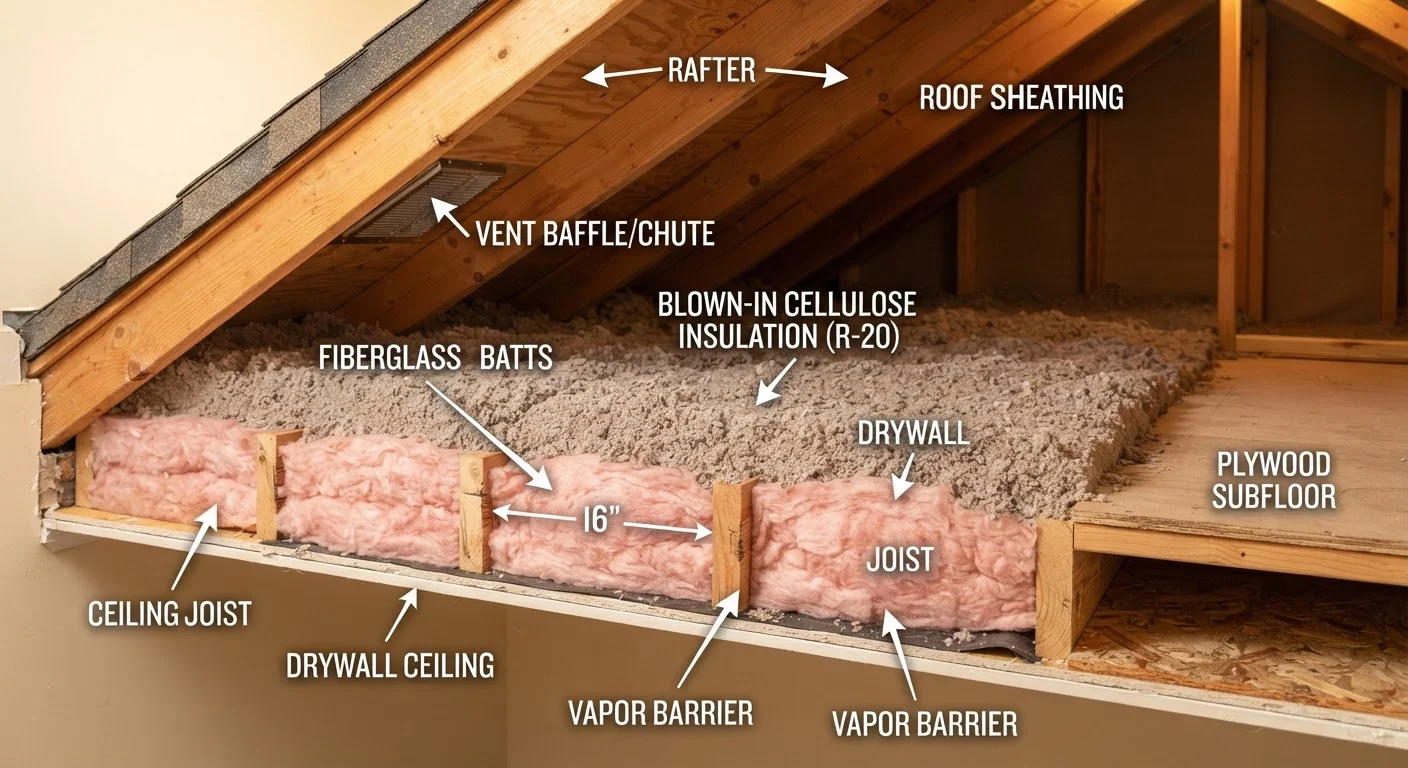
In a traditional vented attic, insulation goes on the attic floor - not against the roof deck - and soffit-to-ridge airflow must remain unobstructed. Blocking soffit vents with insulation can trap moisture and lead to mold or structural damage. Install ventilation baffles before adding any blown-in or batt insulation to maintain proper airflow channels.
The Three Main Insulation Types for Attics
Fiberglass Batts
Batts are pre-cut panels of fiberglass (or mineral wool) sized to fit standard joist spacing. They're widely available, relatively affordable, and straightforward to install in open, accessible attics with evenly spaced framing. The tradeoff: gaps around pipes, wiring, or irregular framing can create thermal weak points. Proper fitting without compression is critical to maintaining rated R-value.
Blown-In Insulation
Loose-fill insulation - typically fiberglass or cellulose - is blown into the attic using a machine, allowing it to settle into irregular spaces more completely than batts. Cellulose, made largely from recycled paper treated with fire retardants, is a popular choice for topping off existing insulation. Blown-in insulation is well-suited to finished or hard-to-reach attics but can settle slightly over time, reducing effective depth.
Spray Foam Insulation
Spray polyurethane foam (SPF) is applied as a liquid that expands and hardens, creating both an air barrier and insulation layer in one step. It's particularly effective when applied to the underside of roof decking in unvented attic assemblies. However, spray foam requires professional installation and appropriate ventilation during and after application. Costs are considerably higher than other options.
Air Seal Before You Insulate
Adding insulation over existing air leaks is one of the most common and costly attic upgrade mistakes. Before installing any new material, seal gaps around recessed lights, plumbing stacks, top plates, and attic hatches with appropriate caulk or expanding foam sealant. This step costs relatively little but can significantly improve the real-world performance of whatever insulation you choose.
Climate Zones and R-Value Targets
The U.S. Department of Energy publishes recommended R-values by climate zone - a system dividing the country into eight zones based on temperature extremes. Zone 1 (southernmost states like Florida) targets R-30 to R-49, while Zone 7 (northern Minnesota, Alaska borderlands) calls for R-49 to R-60.
If you're in a mixed-humid climate like the mid-Atlantic or parts of the South, vapor management becomes a secondary concern alongside R-value. In these areas, the placement of vapor barriers or retarders matters - something a local energy auditor or insulation contractor can advise on specifically.
R-49 to R-60
Recommended attic R-value for cold climates
The U.S. Department of Energy recommends this range for Climate Zones 6 and 7, which include states like Minnesota, Wisconsin, and Montana.
~11%
Heat lost through a poorly insulated attic
The U.S. EPA estimates that properly sealing and insulating can save on average around 11% on total energy costs in a typical American home.
R-3.5-R-6.5
R-value per inch for common insulation types
Fiberglass batts provide roughly R-3.2 per inch, blown-in cellulose around R-3.5 per inch, and closed-cell spray foam up to R-6.5 per inch.
It's also worth noting that simply reaching a target R-value isn't the whole story. Air sealing gaps around light fixtures, plumbing penetrations, and attic hatches before adding insulation dramatically improves real-world performance. Air leaks can undermine even well-specified insulation.
Choosing What Fits Your Attic
There's no single correct answer, but a few questions help narrow your options:
- Is your attic accessible and open? Batts work well here, especially for a first-time DIY project with straightforward joist spacing.
- Do you have an irregular or hard-to-reach space? Blown-in insulation conforms better to obstructions and existing material.
- Is your attic currently unvented or do you plan to convert it? Spray foam applied to the roof deck suits unvented assemblies, but this is a significant construction decision that warrants professional input.
- Are you topping off existing insulation? Blown-in cellulose layers easily over old batts and can address depth without a full removal.
Before committing to any approach, a professional energy audit can reveal exactly where your attic is losing performance - and whether insulation or air sealing should come first. Many utility companies offer subsidized audits worth looking into. For a grounded perspective on what energy upgrades realistically deliver, see our guide to common energy efficiency myths.
Frequently Asked Questions
The U.S. Department of Energy divides the country into climate zones and recommends attic insulation between R-30 and R-60 for most homes. Colder northern climates generally need R-49 to R-60, while milder southern climates may be fine at R-30 to R-38. Check the DOE's Zone Map or ask a local insulation contractor for your specific zone.
Neither is universally better - it depends on your attic layout. Blown-in insulation conforms well to irregular spaces and is excellent for topping off existing insulation. Batts are simpler to handle in open, evenly spaced joist bays. Many homes benefit from a combination of both.
Fiberglass batts and blown-in cellulose are the most DIY-accessible options, though proper safety gear and air sealing are essential first steps. Spray foam insulation, especially closed-cell foam, should be installed by a licensed professional due to chemical handling and ventilation requirements.
In many jurisdictions, adding insulation to an existing attic does not require a permit, but requirements vary by location. If you're also doing air sealing, fire-blocking, or altering ventilation, permits may apply. Always verify with your local building department before starting work.
A simple visual check helps: if your existing insulation is level with or below the attic floor joists, it likely falls short of current recommendations. An energy auditor can use blower-door testing and thermal imaging to identify gaps more precisely.
Open-cell spray foam is lighter, less expensive, and vapor-permeable - it expands significantly but has a lower R-value per inch (around R-3.5 to R-3.8). Closed-cell foam is denser, provides a vapor barrier, and achieves R-6 to R-7 per inch, making it more effective in smaller spaces or humid climates.
The content on this site is for informational purposes only and is not a substitute for professional advice. Always consult a qualified professional for guidance specific to your situation.