

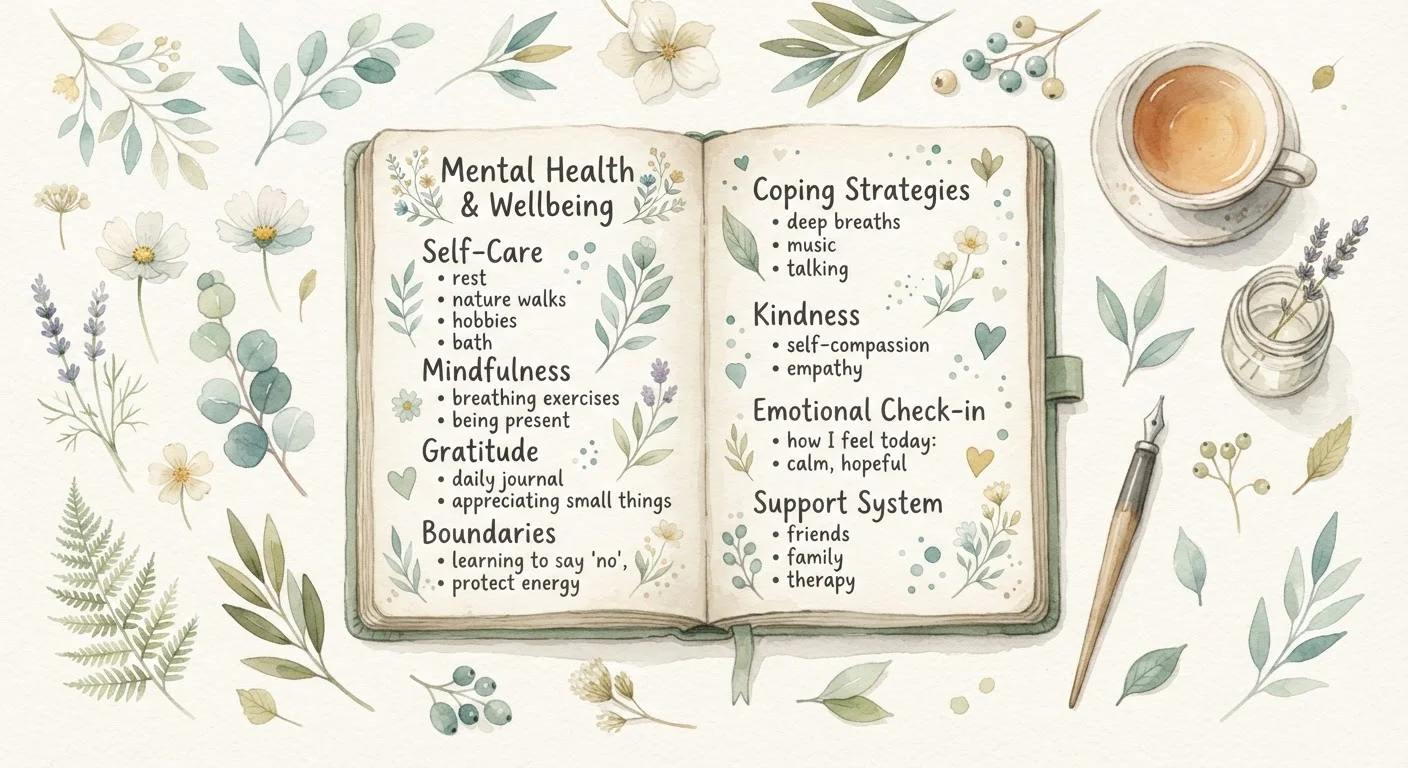
Why Learning Mental Health Language Matters
Mental health conversations happen everywhere-in doctors' offices, news stories, workplaces, and everyday conversations with friends. Yet the terminology can feel like a barrier rather than a bridge. When clinical language goes unexplained, it can leave people confused, or worse, reluctant to seek support.
This reference covers the mental health terms you're most likely to encounter, explained in plain language. It is intended as general health information and education only-not a substitute for evaluation or care by a qualified mental health professional. If you're new to this subject area, this grounded introduction to mental health concepts is a useful companion read.
Affect
The outward expression of emotion observed by others, such as facial expressions, tone of voice, or body language. Clinicians may describe affect as flat, blunted, or full-range depending on how much emotional expression a person displays.
Anxiety
A state of worry, nervousness, or unease about an anticipated event or uncertain outcome. Anxiety is a normal human experience, but when it becomes persistent, disproportionate, or disruptive to daily life, it may indicate an anxiety disorder.
Cognitive Distortion
An inaccurate or exaggerated thought pattern that reinforces negative thinking. Common examples include catastrophizing (assuming the worst) and all-or-nothing thinking (seeing situations as entirely good or bad with no middle ground).
Coping Mechanism
A strategy-conscious or unconscious-used to manage stress, difficult emotions, or challenging situations. Coping mechanisms can be adaptive (helpful) or maladaptive (harmful in the long run).
Mood
A sustained internal emotional state that colors a person's overall outlook over hours or days. Unlike affect, which is observable from the outside, mood is typically self-reported and can shift gradually.
Resilience
The capacity to adapt and recover from adversity, trauma, or significant stress. Resilience is not a fixed trait; research suggests it can be developed over time through relationships, skills, and experience.
Rumination
The repetitive, passive focusing on distressing thoughts or feelings, especially past events or current problems, without moving toward active problem-solving. Rumination is associated with depression and anxiety.
Psychotherapy
A broad term for structured, talk-based treatment delivered by a trained mental health professional to help individuals understand and change thoughts, emotions, or behaviors. It encompasses many approaches, including cognitive-behavioral therapy (CBT) and others.
Stigma
Negative attitudes, beliefs, or stereotypes directed at people with mental health conditions. Stigma can discourage help-seeking and contribute to discrimination. Reducing stigma is a major focus of public mental health efforts.
Trigger
A stimulus-a person, place, memory, or situation-that provokes a strong emotional or psychological response, often associated with a past experience. The term is widely used but not uniformly defined across clinical contexts.
Dissociation
A disconnection from one's thoughts, feelings, surroundings, or sense of identity. Mild dissociation (like daydreaming) is common; severe or frequent dissociation may be a symptom of a diagnosable condition and warrants professional evaluation.
Emotional Regulation
The ability to manage and respond to emotional experiences in a flexible and appropriate way. Difficulties with emotional regulation are a feature of several mental health conditions and a focus of many therapy approaches.
Core Concepts at a Glance
The terms below appear frequently across mental health resources, clinical settings, and public health discussions. Knowing what they actually mean-and what distinguishes one from another-helps you engage more confidently with information about your own or others' wellbeing.
| Adults with mental illness in the U.S. | Approximately 1 in 5 (National Institute of Mental Health (NIMH), 2022 data) |
| Average delay from symptom onset to treatment | 11 years (National Alliance on Mental Illness (NAMI)) |
| Most common mental health conditions | Anxiety disorders and depression (World Health Organization (WHO)) |
| U.S. crisis support line | Call or text 988 (Substance Abuse and Mental Health Services Administration (SAMHSA)) |
| Psychotherapy effectiveness | Widely supported by research (American Psychological Association (APA)) |
Mental health literacy doesn't require a clinical degree. Familiarity with foundational vocabulary can reduce stigma, improve communication with providers, and help you recognize when professional support may be warranted. Always consult a licensed mental health professional for concerns about your own mental health or that of someone you care about.
This article is for informational purposes only and does not constitute medical or psychological advice. If you or someone you know is experiencing a mental health crisis, please contact a qualified healthcare professional or call 988 (the Suicide and Crisis Lifeline in the U.S.).
The content on this site is for informational purposes only and is not a substitute for professional advice. Always consult a qualified professional for guidance specific to your situation.