

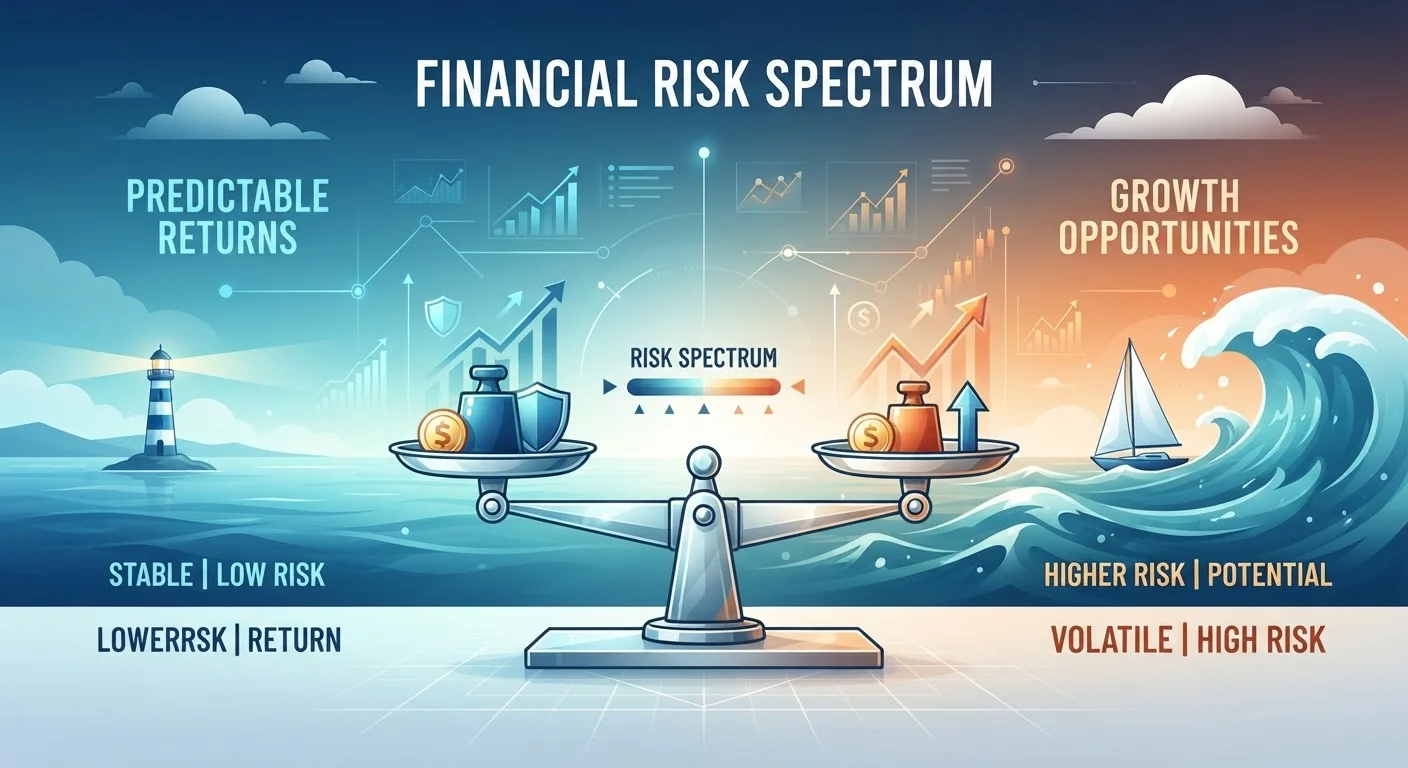
What Risk Tolerance Actually Means
When people talk about risk in investing, they usually mean one thing: the possibility that your investment will lose value. Risk tolerance is simply how much of that possibility you can handle - financially and emotionally - without making decisions you'll regret.
It has two distinct dimensions. The first is financial capacity: can your overall situation absorb a loss without derailing your goals? If you have a stable income, an emergency fund, and decades before you need the money, a market downturn is a setback - not a crisis. The second dimension is emotional comfort: even if you could technically afford a loss, would a 25% portfolio drop cause you to lose sleep or make impulsive decisions?
Both matter. A portfolio built only around financial capacity ignores the very real psychological pressures that cause investors to sell at the worst possible time. See how behavioral traps erode long-term returns for a closer look at how that plays out.
Honest Self-Assessment Matters Most
When evaluating your risk tolerance, try to picture a real market downturn - not a hypothetical one. Ask yourself how you actually behaved during the last significant market drop, not how you think you would behave. Past reactions to volatility are often a better predictor of future behavior than questionnaire answers filled out during calm markets.
Why Risk Tolerance Changes Over Time
Risk tolerance isn't a personality trait locked in at birth. It shifts - sometimes gradually, sometimes abruptly - in response to your financial situation, goals, and life stage.
Time Horizon
The single biggest driver of appropriate risk-taking is how long your money has to grow before you need it. A 25-year-old saving for retirement at 65 has roughly four decades for a portfolio to recover from downturns. A 60-year-old planning to retire in five years does not. This is why conventional financial thinking generally suggests shifting toward more conservative investments as retirement approaches - not because risk is inherently bad, but because recovery time shrinks.
Income Stability and Life Events
A promotion, a layoff, a new child, or a divorce each reshapes your financial foundation. When income is steady and obligations are manageable, you may be able to tolerate more volatility. When financial obligations spike - a mortgage, childcare costs, or supporting aging parents - the cushion that supports risk-taking often narrows. Major life changes are a natural prompt to recalibrate your financial plan, including how your investments are structured.
Accumulated Wealth
Paradoxically, as some people build wealth, their relative risk tolerance can increase - because a 20% loss on a large, diversified portfolio doesn't threaten their lifestyle the way the same loss might have earlier in their careers. Others become more protective of what they've built. Neither response is wrong; both are worth examining honestly.
~20%
Typical annual stock market decline in a correction
The S&P 500 has historically experienced drops of 10% or more roughly once a year on average, with deeper corrections less frequent but not rare - a key reason time horizon matters so much.
1.7%
Average investor return gap vs. the funds they hold
According to Morningstar's Mind the Gap research, the average fund investor has earned meaningfully less than the funds they invest in over time, largely due to poorly timed buying and selling driven by emotional reactions.
3-6 months
Emergency savings buffer recommended before investing
Most personal finance frameworks suggest maintaining liquid emergency savings before taking on significant investment risk, because needing to liquidate investments during a downturn locks in losses.
How Risk Tolerance Shapes Your Portfolio
Risk tolerance directly influences asset allocation - the mix of stocks, bonds, and other investments in your portfolio. Stocks historically offer higher long-term growth potential but experience sharper short-term swings. Bonds tend to be more stable but generate lower long-term returns. Cash and equivalents are the most stable but typically lose purchasing power to inflation over time.
An investor with a high risk tolerance and a long time horizon might hold a portfolio weighted heavily toward stocks. An investor nearing retirement with a lower tolerance may shift toward a greater proportion of bonds and income-generating assets. This is not about finding a "correct" answer - it's about finding an allocation you can actually maintain through market cycles without abandoning your plan. Asset allocation and diversification are the foundational concepts that translate your risk tolerance into a concrete portfolio structure.
The goal is a portfolio matched to your situation - one you can hold through volatility rather than abandoning at the first market dip. Building a portfolio you can stick with walks through how to put these principles into practice.
Assessing Your Own Risk Tolerance
Self-assessment starts with a straightforward question: How would you react if your portfolio dropped 20% over six months? Would you hold steady, view it as a buying opportunity, or feel compelled to move everything to cash? Your honest answer reveals more about your actual risk tolerance than any questionnaire.
From there, consider the practical factors:
- Time horizon: When will you need to draw on these funds - in 5 years, 20 years, or longer?
- Income stability: Is your income reliable, or does it fluctuate significantly?
- Emergency reserves: Do you have liquid savings that would cover 3-6 months of expenses, separate from your investments?
- Other obligations: Debts, dependents, and near-term large expenses all reduce your capacity for risk.
Comparing your instinctive emotional reaction with your objective financial situation gives you a fuller picture. If the two don't align - for example, if you have a long time horizon but strong anxiety about losses - a more conservative allocation may still make sense. Staying invested through volatility is more valuable than chasing optimal returns and then abandoning the plan.
Understanding the trade-off between saving and investing can also help clarify where different pools of money belong, depending on your goals and timeline.
This article is intended for general educational purposes only and does not constitute personalized financial, investment, or tax advice. Please consult a licensed financial adviser before making decisions about your own investments or financial situation.
Frequently Asked Questions
Risk tolerance combines two distinct ideas: risk capacity (the objective, financial ability to absorb losses based on income, savings, and time horizon) and risk appetite (the subjective, emotional comfort with seeing your portfolio's value decline). Both matter when building a portfolio. Someone with high financial capacity but low emotional comfort may still need a more conservative allocation to avoid stress-driven mistakes.
For most people, risk tolerance does decrease with age - primarily because the time horizon for recovering from market downturns shortens. A 30-year-old can weather a market crash with decades to recover; a retiree cannot afford to wait years for their portfolio to bounce back. That said, individual circumstances vary widely, and some retirees with significant assets and pensions may maintain moderate exposure to growth-oriented investments.
Start by honestly considering how you'd feel if your portfolio dropped 20% in a single year - would you hold steady or feel compelled to sell? Also assess your financial situation: emergency savings, job stability, debts, and how soon you need the money. Many financial advisers and brokerage platforms offer risk-tolerance questionnaires as a starting point, though a licensed financial adviser can provide a more thorough assessment.
Investing in a portfolio more aggressive than your true tolerance often leads to emotional reactions during market downturns - most commonly panic-selling at low prices. This behavior is one of the most documented reasons individual investors underperform the broader market over time. Aligning your portfolio with your actual tolerance helps you stay the course through volatility.
A good rule of thumb is to revisit your risk tolerance whenever a major life event occurs - a job change, marriage, divorce, new child, approaching retirement, or significant change in income or expenses. Even without major events, reviewing your investment allocation annually is a sound practice to ensure your portfolio still reflects your current goals and circumstances.
The content on this site is for informational purposes only and is not a substitute for professional advice. Always consult a qualified professional for guidance specific to your situation.