

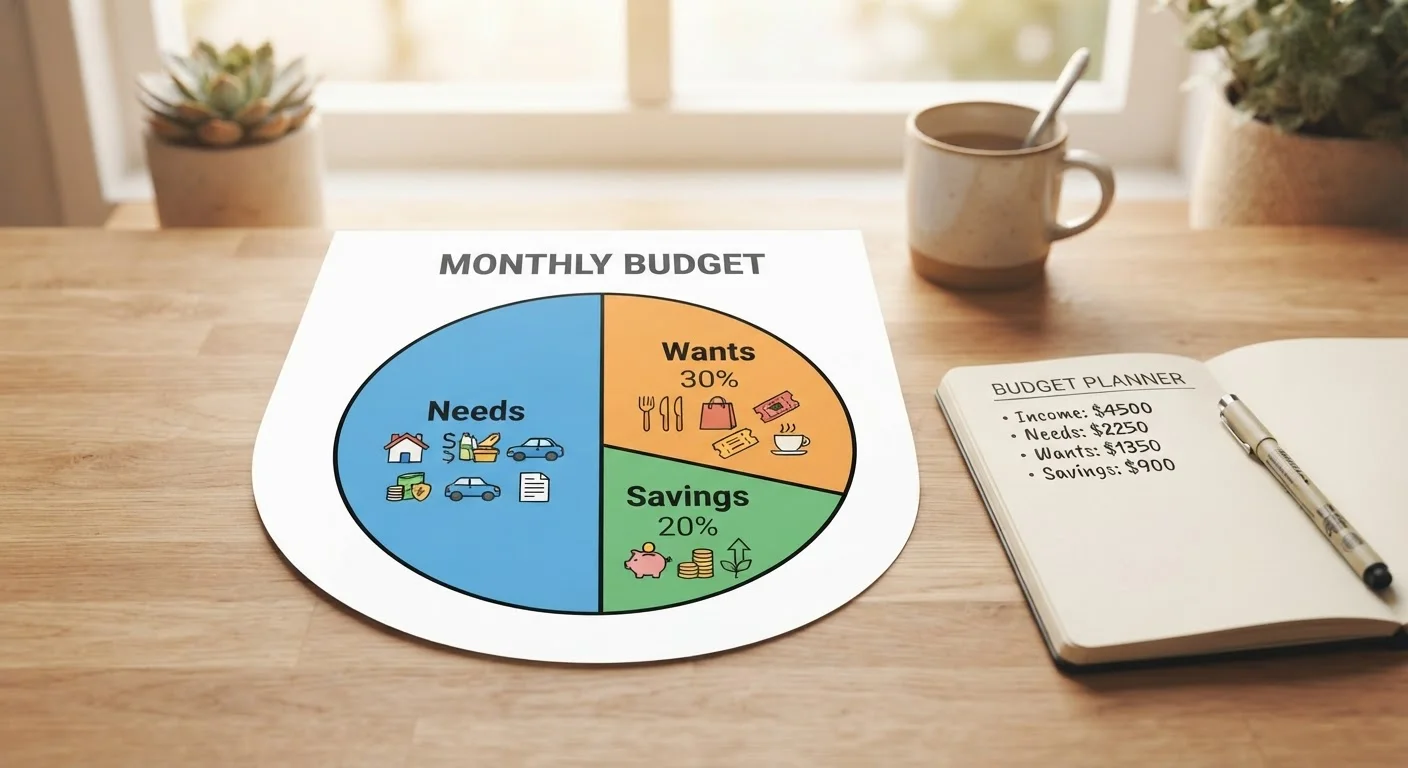
Breaking Down the Three Categories
The 50/30/20 rule works by applying three fixed percentages to your monthly after-tax income. Each category has a distinct purpose, and understanding what belongs in each one is essential before you can apply the framework effectively.
Needs (50%)
Needs are non-negotiable expenses - the bills that must be paid for you to maintain a basic standard of living. These include rent or mortgage, utilities, groceries, health insurance premiums, minimum loan payments, and essential transportation costs like a car payment or public transit pass. If skipping the expense would put your housing, health, or employment at risk, it's likely a need.
Wants (30%)
Wants are the spending choices that improve your quality of life but aren't strictly essential. This includes dining out, streaming services, gym memberships, vacations, clothing beyond the basics, and entertainment. The line between needs and wants can feel blurry - internet service, for instance, may be a need if you work from home - so it's worth examining each expense honestly rather than automatically labeling it one or the other.
Savings and Debt Repayment (20%)
The final 20% is directed toward your financial future. This can include contributions to a retirement account, building an emergency fund, or making extra payments on high-interest debt. If you're carrying significant debt, this category functions as a dual-purpose bucket. See our framework for prioritizing savings and debt repayment if you're unsure how to divide this portion.
~33%
Average share of income Americans spend on housing
According to U.S. Bureau of Labor Statistics Consumer Expenditure Survey data, housing consistently represents the largest single expense category for American households.
57%
Americans who don't follow a budget
A Gallup survey found that fewer than half of American adults maintain a detailed monthly household budget, highlighting how common it is to manage money without a formal plan.
Why This Framework Has Staying Power
One reason the 50/30/20 rule resonates with so many people is its simplicity. Most budgeting approaches require spreadsheets, category-by-category tracking, or detailed record-keeping. This framework asks only that you know your monthly take-home pay and roughly which bucket each expense belongs in.
That accessibility makes it a practical starting point - particularly for people who have never had a formal budget. It doesn't demand perfection; it asks for direction. If you want a structured checklist to complement this approach, our monthly budget setup checklist walks through each step of building a full monthly plan.
“The secret to getting ahead is getting started. The 50/30/20 plan works because it is simple enough to actually use.”
— Elizabeth Warren, U.S. Senator and co-author of 'All Your Worth'
The rule also builds in a savings commitment automatically. Rather than saving whatever is left over at the end of the month - a habit that often results in saving nothing - the 20% target is allocated first by design, which behavioral finance research consistently supports as more effective than treating savings as an afterthought.
Where the Rule Falls Short
The 50/30/20 rule is a guideline, not a universal solution. Several real-world conditions can make it difficult or misleading to apply without modification.
High Cost of Living
In cities where housing costs are disproportionately high relative to income - such as many metros on the coasts - rent alone can exceed 40% of take-home pay for middle-income earners. Meeting the 50% needs ceiling may be structurally impossible without significant income growth or relocation.
Low or Variable Income
For households earning near or below the median, necessary expenses may consume 70% or more of income, leaving little room for wants or savings. The framework's percentages assume a level of financial slack that doesn't exist for everyone. Freelancers and gig workers with unpredictable income may also find percentage-based rules difficult to apply consistently month to month.
Stage-of-Life Variation
Someone aggressively paying down student loans may need to temporarily direct more than 20% toward debt. A new parent facing childcare costs may see needs surge well past 50%. The rule doesn't adapt automatically to life events - it requires intentional recalibration.
Adjust the Percentages to Fit Your Life
If needs genuinely exceed 50% of your income, consider shifting a portion from the wants category rather than cutting savings. Protecting even a small savings contribution - say, 10% - maintains the habit and the financial buffer it builds. The rule is a starting structure, not a ceiling.
If the fixed-percentage approach feels too constraining, a personal spending philosophy may offer a more flexible alternative that aligns decisions with your values rather than preset ratios.
How to Put It Into Practice
Applying the 50/30/20 rule starts with one number: your monthly after-tax income. From there, multiply that figure by 0.50, 0.30, and 0.20 to get your target dollar amounts for each category. Then compare those targets against your actual spending from recent bank and credit card statements.
Most people find that this comparison alone is clarifying. Overspending on wants is common, and discovering that 40% of income goes to discretionary purchases - rather than the intended 30% - can motivate meaningful change without requiring a detailed line-item budget.
For ongoing monitoring, use your financial health checklist to periodically review how your spending and saving habits align with your targets. Treat the 50/30/20 percentages as guardrails, not rules that must be hit exactly every month. The framework's value lies in building consistent financial awareness - and that matters more than mathematical precision.
This article is for general informational and educational purposes only and does not constitute personalized financial, tax, or investment advice. For guidance specific to your situation, consult a qualified financial professional.
Frequently Asked Questions
Needs are essential expenses you cannot reasonably eliminate - rent or mortgage payments, utilities, groceries, health insurance, minimum debt payments, and basic transportation costs. Subscriptions, dining out, and discretionary shopping are generally considered wants, not needs.
Yes. The 20% bucket typically covers both building savings (such as an emergency fund or retirement contributions) and making extra debt payments beyond the required minimum. How you split that 20% depends on your interest rates and financial priorities.
In high-cost cities or during periods of reduced income, needs can easily exceed 50% of take-home pay. In those cases, the framework should be adjusted - the percentages are starting targets, not mandatory thresholds. Cutting wants further or increasing income are common adaptations.
The rule can be difficult to apply on a low income when needs alone consume most of available income. It may be more useful as an aspirational target than an immediate plan. A qualified nonprofit credit counselor can help create a realistic budget for tight financial situations.
After-tax income - also called take-home pay - is what remains after federal and state income taxes, Social Security, and Medicare are withheld from your paycheck. If you're self-employed, you'll need to estimate your tax liability and subtract it from gross income.
The content on this site is for informational purposes only and is not a substitute for professional advice. Always consult a qualified professional for guidance specific to your situation.