

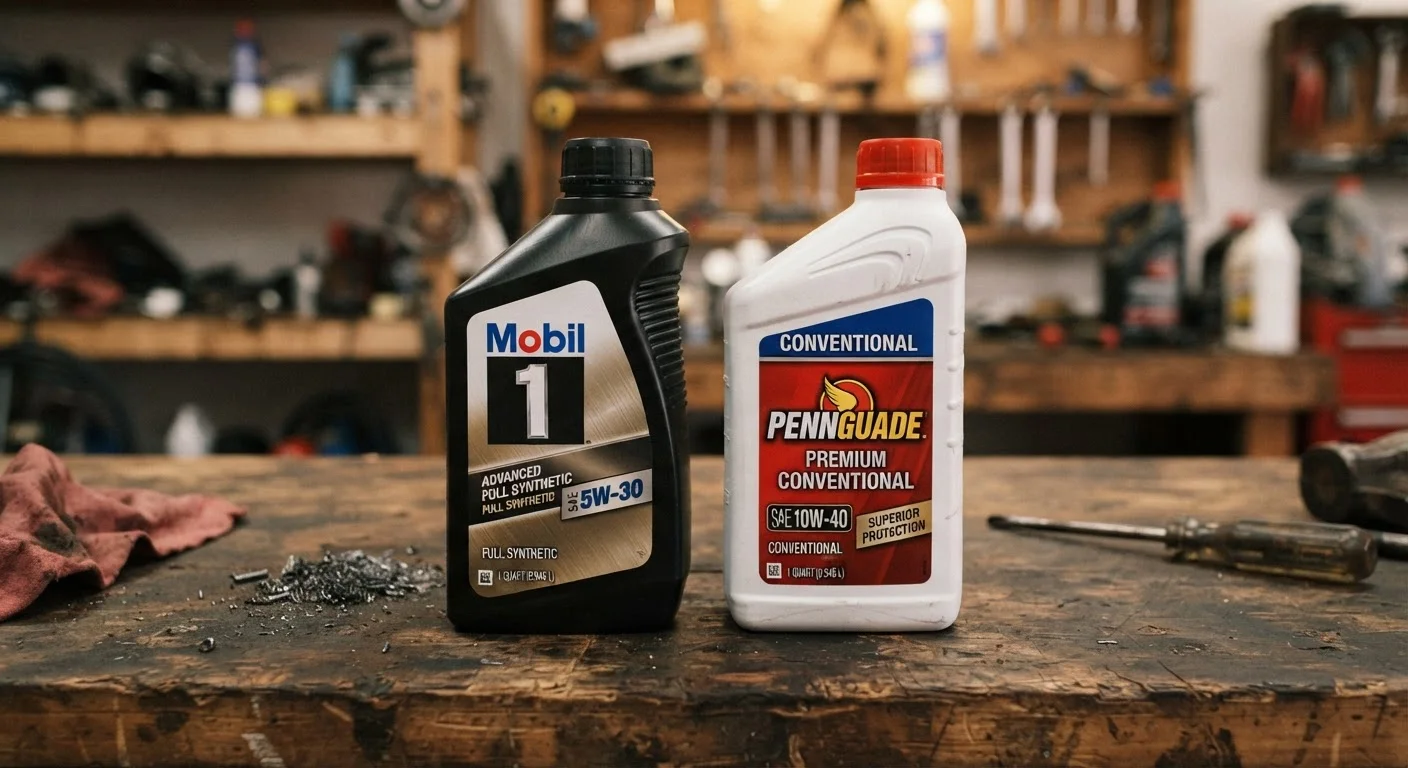
Option A
Synthetic Motor Oil
The engineered, high-performance option.
Best for: Drivers with newer vehicles, turbocharged engines, extreme climates, or demanding driving patterns who want extended drain intervals.
Option B
Conventional Motor Oil
The time-tested, budget-friendly standard.
Best for: Owners of older vehicles with straightforward engine designs who follow regular, short drain intervals and drive under typical conditions.
What Actually Separates These Two Oils?
Conventional motor oil starts as crude petroleum extracted from the ground. It's refined to remove impurities and blended with additives, but the base molecules remain irregular in size and shape - a natural consequence of its origin. That molecular inconsistency affects how uniformly it lubricates engine parts and how quickly it breaks down under heat and stress.
Synthetic motor oil, by contrast, is built in a laboratory. Chemists construct uniform, tailored molecules optimized for lubrication, then blend in additives for specific performance targets. The result is an oil with more predictable behavior across a wider range of conditions. There's also a middle category - synthetic blend oil - which mixes both types and generally lands between the two in both performance and cost.
The difference isn't marketing spin. Independent testing consistently shows that full synthetic oil maintains viscosity (resistance to flow) more reliably at temperature extremes, resists oxidation longer, and produces fewer harmful deposits inside the engine.
| Criterion | Synthetic Motor Oil | Conventional Motor Oil |
|---|---|---|
| Base material | Chemically engineered molecules | Refined crude petroleum |
| Typical change interval | 7,500-15,000 miles | 3,000-5,000 miles |
| Cold-weather performance | Flows readily at low temps | Thickens more in cold starts |
| Heat resistance | High thermal stability | Breaks down faster under heat |
| Cost per quart | Higher upfront cost | Lower upfront cost |
| Engine deposit formation | Lower deposit tendency | Moderate deposit tendency |
| Required by some manufacturers | Yes - many modern engines | Rarely mandated now |
Oil Change Intervals: The Cost Equation
One of the most persistent myths in automotive maintenance is the universal 3,000-mile oil change rule. That figure originated decades ago when engine tolerances were looser and conventional oil formulations were less refined. Today's engines and today's oils - synthetic especially - are engineered for much longer service intervals.
Many vehicles running full synthetic oil are specified by their manufacturers for intervals of 7,500 to 10,000 miles or more. Some reach 15,000 miles under ideal conditions. Conventional oil typically warrants a change every 3,000 to 5,000 miles. If you factor in the number of changes per year and the labor cost of each, the price gap between synthetic and conventional narrows considerably over time.
3,000 mi
Old conventional oil change rule of thumb
The American Automobile Association and most modern automakers now consider this interval outdated for the majority of current vehicles.
~2x
Typical synthetic vs. conventional cost per quart
Synthetic oil generally costs roughly twice as much per quart, though longer drain intervals can offset this difference over an annual driving cycle.
10,000+ mi
Common synthetic interval for modern engines
Many vehicle manufacturers specify 7,500-10,000 mile oil change intervals for full synthetic, with some high-end vehicles reaching 15,000 miles under normal conditions.
That said, intervals are not universal. Severe driving conditions - frequent towing, extensive idling, dusty environments, extreme temperatures - shorten the effective life of any oil. Always consult your owner's manual for the manufacturer's recommended interval and viscosity grade; that guidance overrides any general rule of thumb.
When the Choice Is Already Made For You
For a large and growing share of American drivers, the synthetic-versus-conventional decision isn't really a choice. Many automakers now require full synthetic oil to maintain warranty coverage, particularly for turbocharged engines, direct-injection engines, and vehicles with variable valve timing systems. Using the wrong oil type in these vehicles can cause premature wear and potentially void warranty protections.
If your vehicle was manufactured in the past decade, check your owner's manual before assuming conventional oil is acceptable. The specification page will list the required viscosity grade (such as 5W-30 or 0W-20) and whether synthetic is mandated. A qualified mechanic can also confirm what's appropriate for your specific engine if the manual isn't available.
Check Your Warranty Terms Before Switching
Using an oil type that doesn't meet your manufacturer's specification can affect warranty coverage on powertrain components. This applies in both directions - using conventional oil where synthetic is required, and vice versa in rare cases. Always verify the specification in your owner's manual or with a licensed mechanic before changing oil types, especially on a vehicle still under warranty.
High-mileage vehicles deserve a separate note. If an older engine has worn seals, switching abruptly to full synthetic can sometimes cause minor leaks - not because synthetic is harmful, but because its different chemical properties interact differently with aged seals. This isn't universal, and high-mileage synthetic blends are formulated to address it, but it's worth discussing with a mechanic before making the switch on an engine with significant miles.
The content on this site is for informational purposes only and is not a substitute for professional advice. Always consult a qualified professional for guidance specific to your situation.