

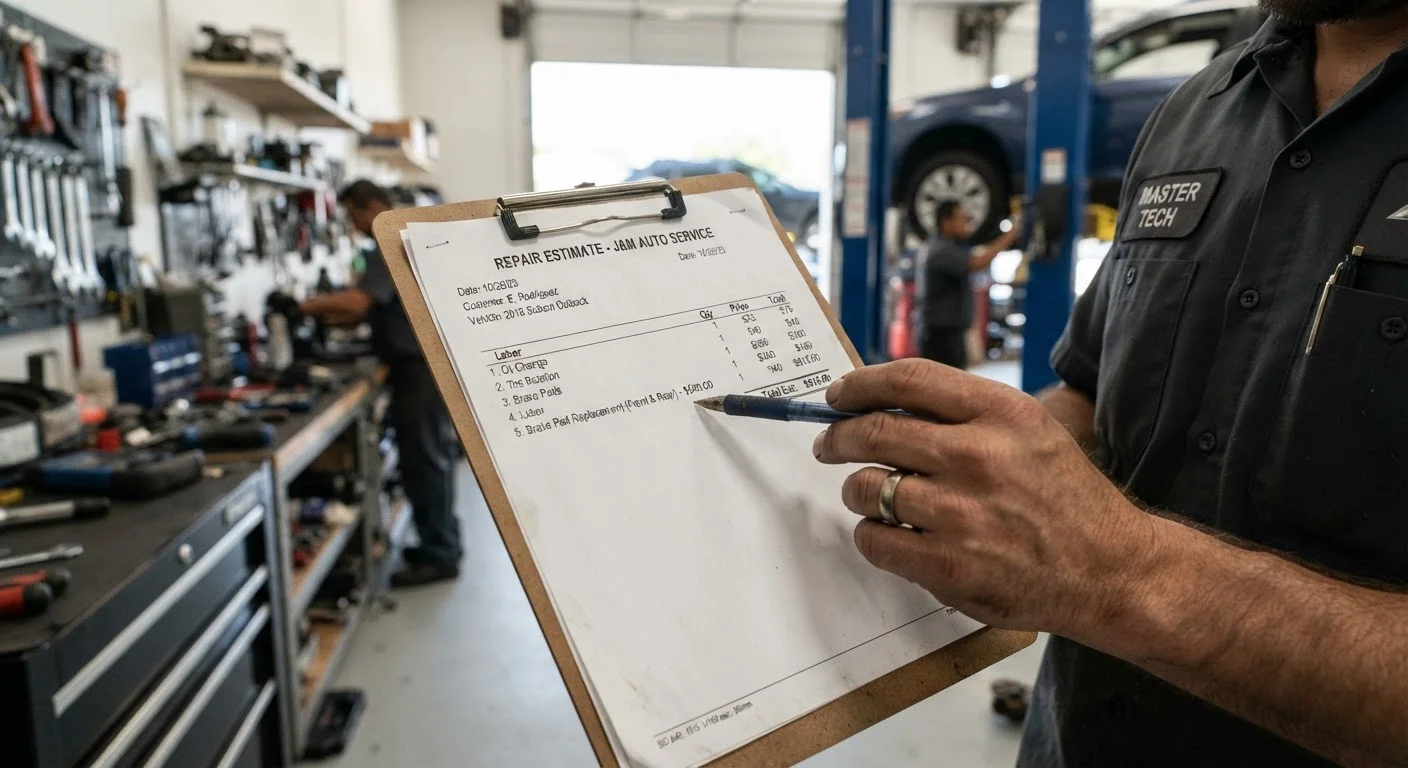
Why Repair Estimates Confuse Most Car Owners
A repair estimate is a financial document, and like most financial documents - warranty fine print is another familiar example - it is written in industry shorthand that favors the issuing party. Terms like "R&R," "flat rate," and "shop supplies" mean specific things that affect your final bill, but they are rarely explained unprompted.
The result is that many car owners either approve work they do not fully understand or delay necessary repairs out of suspicion. Neither outcome serves you well. Reading an estimate line by line, with a clear understanding of each cost category, gives you the information you need to ask informed questions and make a confident decision.
What you will need
The tools and materials below will help you work through the estimate systematically.
Written repair estimate (from the shop)
The document you will analyze line by line to understand all charges before authorizing work.
Online flat-rate labor lookup tool
Used to verify that the labor hours billed match standard industry estimates for the specific repair.
Parts pricing reference (e.g., retailer site for OEM/aftermarket prices)
Lets you compare the shop's parts cost against retail prices to gauge the markup applied.
Notepad or notes app
Record questions, clarifications received, and any changes agreed upon verbally during your conversation with the service advisor.
How to Read Each Section of the Estimate
Follow the steps below in order. You can complete this review at the shop counter or at home if the shop provides a digital or printed copy in advance - which you should always request.
Confirm the estimate is itemized in writing
Before reading a single line, verify that the document breaks costs into separate categories rather than presenting one lump sum. A properly structured estimate lists each part, its quantity and price, the labor operations with associated hours, any shop supply fees, and applicable taxes as distinct line items. A single bundled total gives you nothing to evaluate or dispute.
Understand the parts section
Each part should be listed by name, part number if applicable, quantity, and unit cost. Note whether parts are labeled OEM (Original Equipment Manufacturer - made to the vehicle maker's specifications), aftermarket (made by a third party), or remanufactured (rebuilt used parts). OEM parts typically cost more; aftermarket and remanufactured parts can be legitimate alternatives for many repairs, though quality varies by supplier. It is reasonable to ask which category applies and to discuss alternatives if cost is a concern.
Shops routinely apply a markup on parts - this is standard industry practice that covers ordering, storage, and warranty handling. A markup in the range of 20-50% above wholesale cost is common, though this varies by shop and region.
Decode the labor charges
Labor is usually expressed as a number of hours multiplied by the shop's hourly rate. Most shops use a flat-rate system: a published guide (such as Chilton or Mitchell) assigns a standard time value to each type of repair regardless of how long the job actually takes. A technician who completes the job faster than the flat rate still bills the full flat-rate time; one who takes longer typically does not charge more. This system is industry standard, not unique to any particular shop.
Check that each labor operation is described specifically (e.g., "Replace front brake pads and rotors - 2.0 hrs") rather than generically (e.g., "Labor - 2.0 hrs"). Vague labor descriptions make it harder to verify the time is appropriate.
Identify diagnostic and shop supply fees
Many estimates include a diagnostic fee - a charge for the technician's time spent identifying the problem using scan tools or physical inspection. This is a legitimate charge. Always ask upfront whether the diagnostic fee will be credited toward the repair total if you authorize the work; many shops do apply it, but not all.
Shop supply fees (also called environmental or miscellaneous fees) cover consumables like rags, cleaning solvents, and disposal of fluids. These are typically a small percentage of the total or a flat fee. They are standard but negotiable in some cases - it is fair to ask what the fee covers if it seems high.
Check for add-ons you did not request
Scan the estimate for services you did not bring the vehicle in for and did not discuss. It is common for a shop to recommend additional work discovered during the inspection - this can be legitimate and valuable, particularly for safety-related items. However, each additional item should be presented to you separately, with its own parts and labor breakdown, before being added to the estimate.
Ask the service advisor to explain the urgency and rationale for any unanticipated recommendation. Some items may be genuinely time-sensitive (e.g., worn brake hardware accompanying a brake job); others can reasonably wait for a follow-up visit. Understanding the difference helps you prioritize spending. For context on how deferred maintenance affects long-term costs, see why deferred maintenance adds up.
Compare estimates if the job is significant
For repairs above a few hundred dollars, obtaining a second written estimate from another reputable shop gives you a concrete reference point. Significant variation in parts pricing or labor hours warrants a direct question to each shop about the discrepancy - sometimes it reflects parts quality differences, sometimes labor efficiency, and occasionally pricing inconsistency. Price alone should not be the deciding factor; the shop's qualifications and transparency matter as well. See how to evaluate a mechanic's trustworthiness before making your final decision.
Always Get Written Authorization
In most US states, shops are legally required to provide a written estimate and obtain your authorization before starting work. Never approve repairs verbally only. If a shop discovers additional problems mid-repair, they must contact you before proceeding with work beyond what was originally authorized. Keep a copy of every estimate and authorization you sign.
Once you have reviewed every line, summarize any outstanding questions in writing and present them to the service advisor before signing. This creates a record of the clarifications you received, which can be valuable if a dispute arises later.
Common Estimate Red Flags to Watch For
Most shops operate honestly, but certain patterns in an estimate deserve closer scrutiny:
- No part numbers listed: Makes it difficult to verify parts cost or quality independently.
- Labor described only as "miscellaneous" or "general": Legitimate labor charges should correspond to a specific, nameable repair operation.
- Diagnostic fee that appears as a flat charge with no explanation: Ask what diagnostic procedure was performed and how long it took.
- Total does not match the sum of line items: Always add up the subtotals yourself and confirm they match the grand total before taxes.
- Pressure to authorize immediately: A reputable shop will give you time to review the estimate without artificial urgency.
Verbal Estimates Offer No Protection
If a shop gives you a price over the phone or in person without a written document, that number carries no legal weight in a dispute. Always request a written, itemized estimate before you leave your vehicle. If a shop refuses to provide one, treat that as a significant red flag.
Keeping a copy of the signed estimate after the repair is complete is also worth the small effort. If a related problem recurs, the estimate documents what was replaced and when - relevant information for any warranty claim on the parts or labor performed.
Cross-Reference Labor Time Online
Free tools exist that let you look up standard labor hour estimates for common repairs by vehicle make, model, and year. Checking the flat-rate time before your appointment helps you gauge whether the shop's labor charge is in a reasonable range. This takes about five minutes and requires only your vehicle's basic information.
The content on this site is for informational purposes only and is not a substitute for professional advice. Always consult a qualified professional for guidance specific to your situation.